
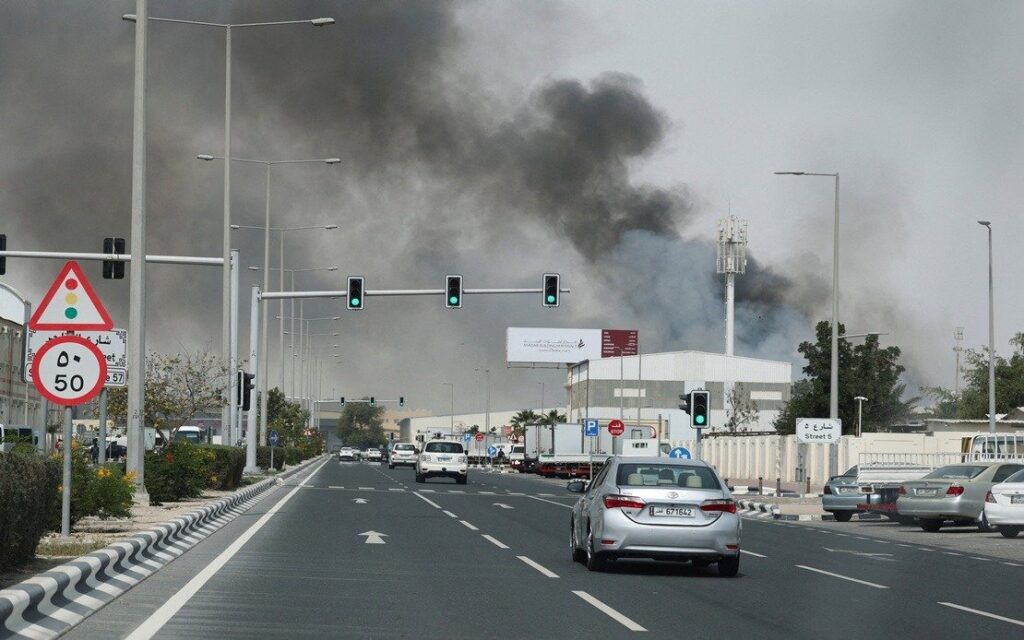
Image: from Geo English X @geonews_english
By Open Chronicle Staff with Agencies
SHARJAH — The war in the Middle East took a sharp and dangerous turn toward the United Arab Emirates on Tuesday as an Iranian ballistic missile struck a prominent telecommunications facility in Sharjah. The strike, which injured two Pakistani nationals, marks one of the most significant expansions of Tehran’s retaliatory campaign against U.S. allies in the Gulf since Operation Epic Fury began on February 28.
Emirati authorities confirmed that the projectile impacted an administrative building belonging to the Thuraya Telecommunications Company in Sharjah’s central district. While the building sustained visible structural damage, officials reported that no deaths occurred, and the two victims are currently in stable condition at a local hospital.
Targeted Infrastructure: The Thuraya Strike
Thuraya is a major regional satellite provider, and the targeting of its administrative hub suggests a deliberate attempt by Tehran to degrade communication networks utilized by regional and international partners.
As of Tuesday afternoon, the UAE government had not disclosed whether the missile was detected by its Patriot or THAAD air defense batteries, or if the impact was the result of a failed interception. The silence from Abu Dhabi regarding a military counter-response has left regional markets in a state of high tension.
A Pattern of Retaliation
The strike is part of a broader “asymmetric” response by Iran following the death of Supreme Leader Ali Khamenei and over 1,300 others in the initial U.S.-Israeli offensive. Tehran’s strategy has shifted toward targeting “host nations”—countries like the UAE, Qatar, and Jordan that house American military assets or financial interests.
“This is no longer a localized conflict between the U.S. and Iran,” noted a regional security analyst. “By striking Sharjah, Tehran is sending a message to every Gulf capital: if U.S. bombers fly from your soil, your infrastructure is a legitimate target.”
Türkiye’s Growing Alarm
The escalation has placed Ankara in an increasingly precarious position. As a NATO member with deep economic ties to both Iran and the UAE, Türkiye serves as a critical mediator and trade hub.
-
Economic Risks: Turkish firms are heavily invested in UAE construction and logistics. A widening missile war threatens thousands of Turkish citizens working in the Emirates.
-
Energy Security: Ankara has warned that strikes on Gulf infrastructure will trigger catastrophic energy price shocks, directly impacting the Turkish economy.
-
Diplomatic Strategy: While maintaining open channels with Washington and Tehran, Turkish officials have intensified calls for an immediate de-escalation, fearing that a “total war” will spark a new wave of regional refugees and a permanent supply chain collapse.
The Midnight Clock
The Sharjah strike occurred just hours before President Donald Trump’s 8:00 PM EDT deadline. With U.S. forces poised to begin “one night” of total infrastructure demolition in Iran, the missile hit in the UAE serves as a grim preview of the regional chaos that could unfold if a ceasefire is not reached before the clock runs out.