
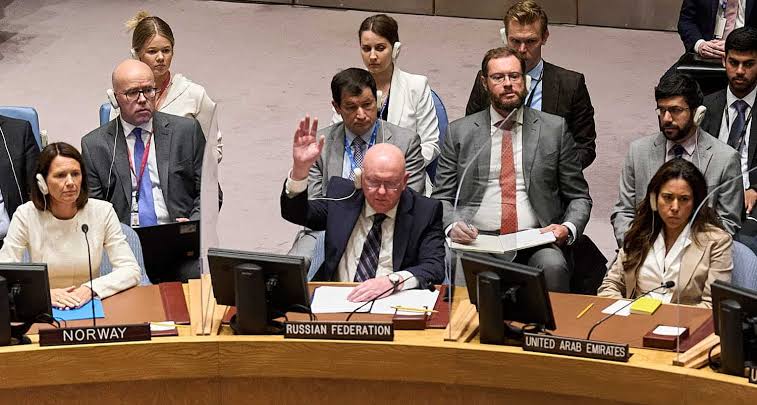
Image: from Hamdan News X @HamdanWahe57839
By Open Chronicle Staff with Agencies
UNITED NATIONS — Russia and China exercised their veto power at the U.N. Security Council on Tuesday, blocking a resolution aimed at reopening the Strait of Hormuz. The diplomatic stalemate comes just hours before an 8 p.m. ET deadline set by President Donald Trump for Iran to cease its threats against the vital maritime waterway or face targeted military strikes.
The resolution, introduced by Bahrain, received 11 votes in favor and two against. Pakistan and Colombia abstained from the vote.
#BREAKING: UN Security Council fails to pass Bahrain-backed resolution on Strait of Hormuz; China and Russia veto draft. #UNSC #StraitOfHormuz #China #Russia pic.twitter.com/pewR5FF4lW
— Public News X (@PublicNewsX) April 7, 2026
A “Gunpoint” Economy
The U.S. Ambassador to the UN, Mike Waltz, issued a stinging rebuke following the failed vote, accusing Moscow and Beijing of enabling Iranian aggression.
“No one should tolerate that they are holding the global economy at gunpoint, but today, Russia and China did tolerate,” Waltz said. “They sided with a regime that seeks to intimidate the Gulf into submission, even as it brutalizes its own people during a national internet blackout.”
Bahrain’s foreign minister, Abdullatif bin Rashid Al Zayani, echoed these concerns, stating that the council’s failure sends a “wrong signal” to the world that threats to international commerce can pass without decisive action.
Diluted Language Fails to Sway
The defeat of the resolution followed days of intense negotiations. According to reports from The Associated Press, the text was significantly weakened in an attempt to secure Russian and Chinese abstentions.
Key changes to the draft included:
-
Removal of Force: The initial “all necessary means” clause, UN shorthand for military intervention, was stripped after opposition from France, Russia, and China.
-
Defensive Scope: The revised language authorized only “defensive means” to ensure the safety of navigation.
-
Geographic Limitation: Provisions were narrowed strictly to the Strait of Hormuz, removing references to adjacent international waters.
Despite these concessions, the two permanent members remained unmoved. Russia and China argued that the resolution remained too tilted toward Western interests and could serve as a pretext for escalation.
The 8 P.M. Ultimatum
In Tehran, officials remained defiant. Iran’s Ambassador to the U.N., Amir Saeid Iravani, claimed the resolution would have “emboldened” the United States and Israel to continue “unlawful actions” against his country.
The clock is now ticking toward the White House’s 8 p.m. ET deadline. President Trump has threatened to strike Iranian power plants and bridges if the waterway is not reopened.
“The Iranian regime has until 8 p.m. Eastern Time to meet the moment and make a deal with the United States,” White House Press Secretary Karoline Leavitt told Fox News on Tuesday. “Only the president knows where things stand and what he will do.”
As the deadline approaches, global markets remain on edge, with oil prices fluctuating in response to the heightened risk of conflict in the world’s most important energy corridor.