
Image: from MCBN X @MCBNNEWSS
By Open Chronicle Staff with Agencies
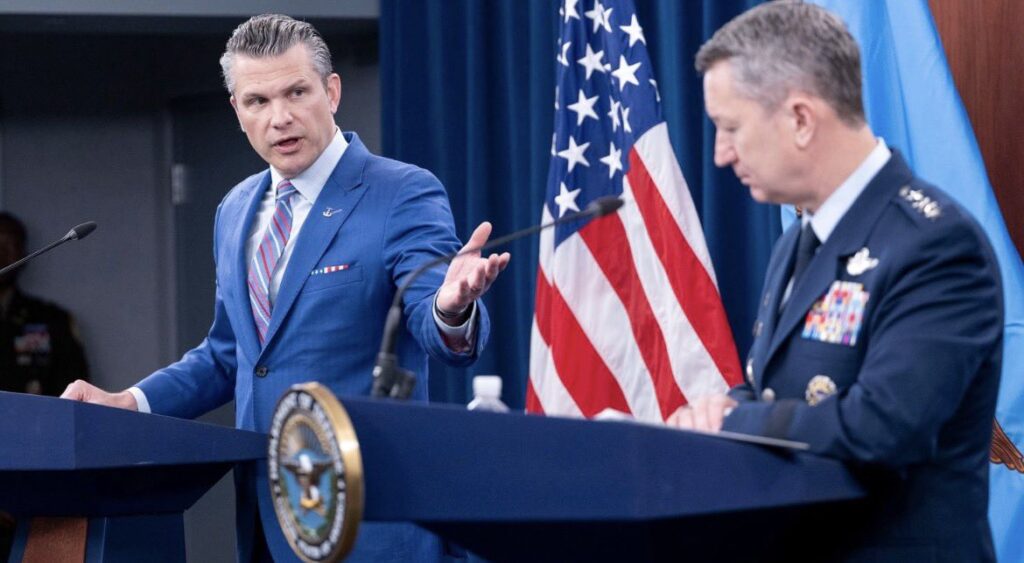
WASHINGTON — In a move that has fueled global anxiety and speculation, the Pentagon abruptly canceled a high-profile press briefing on Monday that was scheduled to feature Defense Secretary Pete Hegseth and the Chairman of the Joint Chiefs of Staff, Gen. Dan Caine.
The cancellation, announced via a brief notice without explanation, comes at a critical juncture in Operation Epic Fury. The briefing was set to take place just 12 hours before a final deadline imposed by President Donald Trump for Iran to reopen the Strait of Hormuz.
A Nation on the Brink
The silence from military leadership stands in stark contrast to the escalating rhetoric from the White House. On Monday, President Trump intensified his ultimatum, warning that failure to comply by 8:00 PM EDT on Tuesday (00:00 GMT Wednesday) would lead to the systematic destruction of Iran’s domestic infrastructure.
“The entire country could be taken out in one night, and that night might be tomorrow night,” the President told reporters, specifically mentioning power plants and bridges as primary targets.
The sudden withdrawal of the Defense Secretary and the nation’s top general from the public eye has led analysts to suggest that the military may be in the final stages of operational planning for a massive aerial campaign, or that sensitive, last-minute negotiations are occurring behind closed doors.
The Human Toll of Epic Fury
The tension is underscored by a rapidly rising casualty count since the joint U.S.-Israeli offensive began on February 28. Recent reports indicate:
-
Regional Fatalities: Over 1,340 people have been killed in Iran and surrounding areas, including the late Supreme Leader Ali Khamenei, in the opening stages of the war.
-
U.S. Casualties: Pentagon data as of April 3 confirms 13 U.S. service members killed and 365 wounded in action.
-
Civilian Impact: Iranian media reported fresh strikes on Tuesday in the city of Pardis, east of Tehran, claiming the lives of at least six people, including three children.
A Region-Wide Escalation
While the world watches the clock, the conflict continues to bleed across borders. Iran has retaliated with a sophisticated mix of ballistic missiles and cruise missiles targeting U.S. assets and allied nations, including Jordan, Iraq, Kuwait, and the UAE.
The disruption has not been limited to the battlefield; global aviation has been paralyzed as major hubs like Mehrabad and Ahvaz International Airports have faced repeated strikes. In a rare move, the Israeli army has even issued direct warnings to Iranian civilians to avoid the national rail network, signaling that transport infrastructure is no longer considered off-limits.
As the 8:00 PM deadline approaches, the absence of a Pentagon briefing leaves a vacuum of information at a moment when the world is seeking clarity on whether the “one night” the President described is about to begin.