
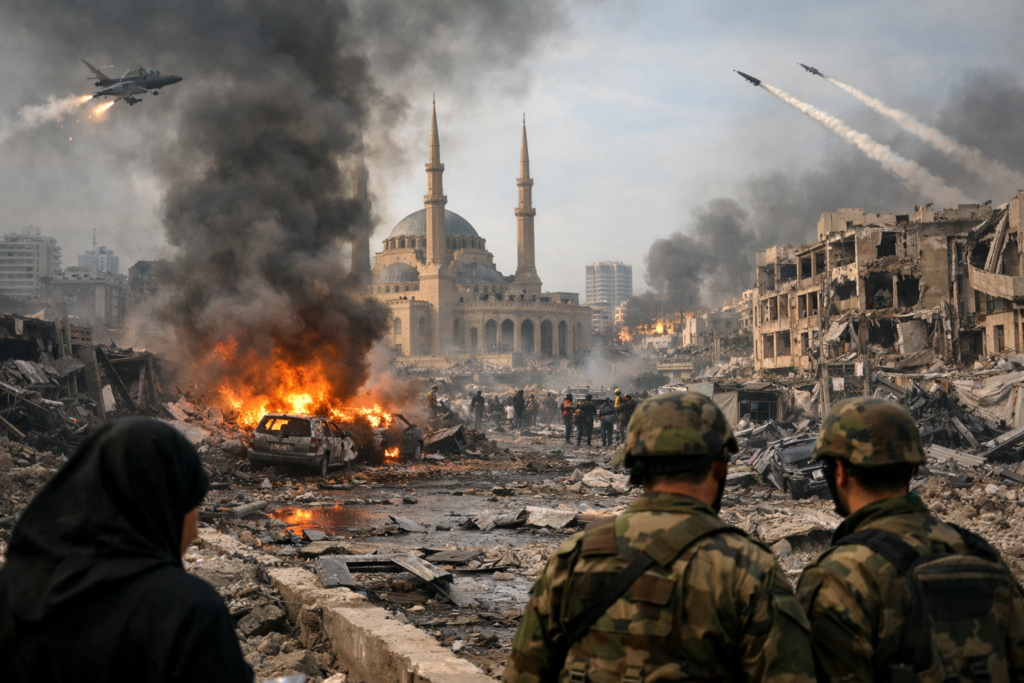
Image Credentials: Image Title: CEASEFIRE CRACKS: LEBANON BOMBED AS U.S.-IRAN TRUCE HANGS BY A THREAD Source: (sora.openai) Date: April 2026. Attribution: This image was created using AI-generated imagery (sora.openai) and does not depict a real-world scene.
By Open Chronicle Staff with Agencies
BEIRUT/WASHINGTON — Less than 24 hours after a historic two-week ceasefire was brokered between Washington and Tehran, the Middle East has been plunged back into chaos. While the “Islamabad Accord” successfully paused direct hostilities between U.S. and Iranian forces, a catastrophic surge in Israeli airstrikes across Lebanon has left the region—and the truce itself—on the verge of total collapse.
As the Strait of Hormuz tentatively reopens, the world is witnessing a “messy” peace where missiles continue to fly even as diplomats pack their bags for follow-up talks in Pakistan.
“100 Strikes in 10 Minutes”: Lebanon’s Bloodiest Day
On Wednesday, the Israeli Air Force launched its most aggressive coordinated offensive since the war began on March 2. Within a ten-minute window, over 100 strikes hit Beirut, the Beqaa Valley, and southern Lebanon.
-
Preliminary Death Toll: The Lebanese Health Ministry reports at least 254 killed and 837 injured.
-
National Mourning: Lebanon has declared an official day of mourning as rescuers struggle to reach survivors in the flattened Dahiyeh district of Beirut.
-
The “Misunderstanding”: While Tehran insists that a ceasefire must include all regional fronts, U.S. Vice President JD Vance and Israeli Foreign Minister Gideon Sa’ar have both clarified that Lebanon is “not part of the deal.”
“Lebanon is not Iranian territory,” Sa’ar stated. “The ceasefire between the U.S. and Iran does not extend to our operations against Hezbollah.”
The Fragile 10-Point Proposal
The ceasefire, announced via Truth Social by President Donald Trump on Tuesday night, follows a 10-point plan mediated by Pakistan. Key pillars include:
-
Immediate Cessation: A two-week pause in direct U.S.-Iran hostilities.
-
Hormuz Access: The immediate reopening of the Strait of Hormuz to restore global oil flow.
-
Nuclear “Dusting”: A U.S.-led effort to remove deeply buried nuclear materials from Iranian sites.
-
Reparations & Assets: Discussions on unfreezing Iranian funds and potential war reparations.
However, Iran’s Parliament Speaker, Mohammad Bagher Ghalibaf, already claims the U.S. has violated three key clauses: the failure to stop the war in Lebanon, a reported drone incursion into Iranian airspace, and the continued denial of Iran’s right to uranium enrichment.
Wall Street Surges, UAE Demands Billions
Despite the carnage in Lebanon, global markets reacted with relief to the pause in direct U.S.-Iran fighting. The Dow Jones surged over 1,300 points (+2.85%), closing at a record high as fears of a “Total Infrastructure Decimation” in Iran subsided.
Meanwhile, the United Arab Emirates has issued a staggering demand for accountability. The UAE Foreign Ministry revealed that over the past 40 days, Iran has launched 2,819 ballistic and cruise missiles toward its territory. Abu Dhabi is now demanding full financial compensation for the “casualties and property damage” sustained during the conflict.
A Diplomatic Schism: Spain Urges EU Sanctions
The severity of Wednesday’s strikes on Lebanon has sparked a major rift within the West. Spanish Prime Minister Pedro Sanchez called for the immediate suspension of the 1995 Association Agreement with Israel—the treaty governing trade and political cooperation between the EU and Tel Aviv.
“The disregard for life and international law is intolerable,” Sanchez wrote on X, urging the international community to include Lebanon in the truce to prevent a wider Mediterranean catastrophe.
The “Messy” Reality
As VP, JD Vance prepares to depart Budapest, he acknowledged the “messy” nature of the truce: “An hour after the ceasefire was announced, the Iranians launched missiles, then the Israelis responded… this is the nature of a ceasefire.”
The world now watches the clock. With the two-week window ticking and the IRGC warning of “regretful retaliation” if the strikes in Lebanon do not cease, the “Islamabad Accord” may prove to be the shortest peace in modern history.