
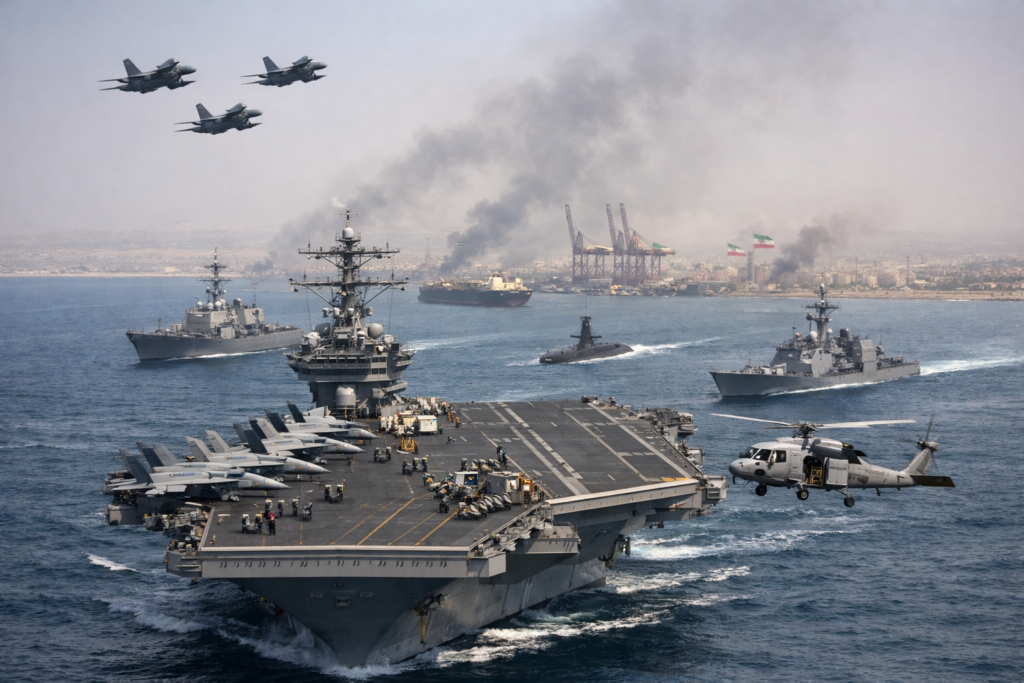
Image Credentials: Image Title: US Announces Full Naval Blockade of Iranian Ports Starting Monday Source: (sora.openai) Date: April 2026. Attribution: This image was created using AI-generated imagery (sora.openai) and does not depict a real-world scene.
By Open Chronicle Staff with Agencies
April 12, 2026
WASHINGTON — In a dramatic escalation of the ongoing conflict in the Middle East, the United States military has announced a total naval blockade of all Iranian ports, scheduled to go into effect at 10 a.m. ET on Monday.
The move follows a week of intense regional instability and marks the most aggressive maritime maneuver by the U.S. since the start of hostilities on February 28. According to a statement released by U.S. Central Command (CENTCOM) on Sunday, the blockade aims to completely sever Iran’s maritime trade routes while ostensibly maintaining international shipping lanes for other nations.
U.S. Central Command: Forces will begin implementing a blockade of all maritime traffic entering and exiting Iranian ports at 10:00 AM Monday.pic.twitter.com/PxEgfBNEdp
— The ₿itcoin Therapist (@TheBTCTherapist) April 12, 2026
Scope of the Blockade
The blockade will cover all Iranian coastal entries and exits, spanning both the Arabian Gulf and the Gulf of Oman. CENTCOM emphasized that the operation would be “enforced impartially against vessels of all nations” attempting to enter or depart from Iranian jurisdiction.
“The blockade will be enforced impartially against vessels of all nations entering or departing Iranian ports and coastal areas… CENTCOM forces will not impede freedom of navigation for vessels transiting the Strait of Hormuz to and from non-Iranian ports.”, U.S. Central Command (CENTCOM)
Clarifying the Strait of Hormuz
The CENTCOM announcement appeared to clarify—and partially walk back, earlier comments made by President Donald Trump on social media. The President had initially suggested that “any ships” passing through the Strait of Hormuz would be blocked.
Military officials clarified on Sunday that the Strait will remain open for traffic bound for other regional ports, such as those in the UAE, Kuwait, and Iraq, provided they are not engaging in trade with Tehran. This distinction is seen as a vital attempt to prevent a total collapse of global oil markets and to reassure regional allies.
A Fragile Peace Shattered
The blockade comes just days after the rescue of a downed U.S. airman in Iranian territory, a mission that utilized advanced “Ghost Murmur” heartbeat sensors and Pegasus spyware, and the collapse of high-level talks in Pakistan.
While a two-week ceasefire had been tentatively agreed upon last week, the U.S. move to choke off Iranian ports suggests that the diplomatic window has slammed shut. Analysts warn that a blockade is traditionally considered an act of war under international law, and Tehran is expected to view the 1400 GMT deadline as a final ultimatum.
With the USS Gerald R. Ford carrier strike group and other NATO-aligned naval assets already positioned in the region, the world now watches the Monday deadline with bated breath, as the potential for a direct naval confrontation between U.S. and Iranian forces reaches its highest point in decades.