
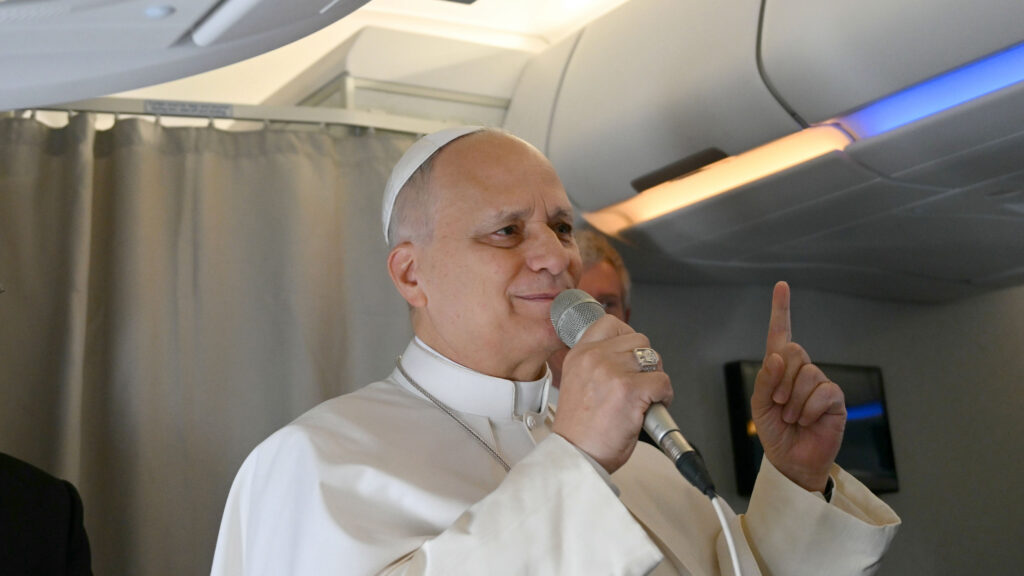
Image: from KOLO8 X @KOLO8
Open Chronicle | With Agencies
Washington — Donald Trump has intensified his confrontation with the Vatican, launching a fresh verbal attack on Pope Leo XIV while firmly rejecting calls to apologize for his earlier remarks targeting the leadership of the Catholic Church.
The latest escalation underscores a deepening rift between Washington and the Vatican, reflecting broader disagreements over global conflicts, diplomacy, and the role of moral authority in international affairs.
US President Donald Trump has refused to apologise after criticising Pope Leo XIV over his stance on the war in Iran. The dispute comes as Pope Leo continues to call for peace, urging global leaders to prioritise dialogue over conflict.
Al Jazeera's @SoniaRGallego reports. pic.twitter.com/7I5HQsXvBY
— Al Jazeera English (@AJEnglish) April 13, 2026
A Hardline Position Amid Mounting Criticism
Speaking publicly, Trump defended his previous comments as consistent with his political doctrine, emphasizing that he sees no justification for retracting or moderating his stance. He framed his rhetoric within the context of his longstanding “America First” approach, arguing that it entitles him to openly challenge institutions he perceives as misaligned with U.S. security priorities.
Despite criticism from religious leaders and political figures across Europe and Latin America, Trump signaled no willingness to soften his tone. Analysts note that such defiance may resonate with segments of his domestic base, even as it risks alienating Catholic voters and international partners.
Diverging Visions on War and Peace
At the heart of the dispute lies a fundamental divergence in worldview. The Vatican has consistently advocated for diplomatic solutions, ceasefires, and humanitarian engagement in conflict zones. In contrast, Trump’s rhetoric reflects a more assertive posture, often emphasizing military strength and unilateral decision-making in addressing global crises.
These opposing approaches have widened the gap between the two sides in recent months, transforming what was once periodic disagreement into a sustained and highly visible confrontation.
Global Reactions and Political Implications
The renewed clash has drawn mixed reactions worldwide. Some observers interpret Trump’s remarks as part of a broader strategy to consolidate political support through confrontation and ideological clarity. Others warn that the rhetoric risks undermining cooperation on key humanitarian and social issues where the United States and the Vatican have historically found common ground.
The episode has also reignited debate over the role of religious institutions in global politics, particularly as moral voices weigh in on issues such as war, migration, and inequality.
A Relationship Under Strain
The relationship between Washington and the Vatican has long been shaped by both collaboration and tension. However, the current phase marks an unusually sharp divergence, with implications extending beyond diplomacy into the realms of public opinion and cultural alignment.
As the situation evolves, the standoff between Trump and the Vatican is likely to remain a focal point of international attention, reflecting broader questions about leadership, values, and the intersection of politics and faith in a rapidly shifting global landscape.