
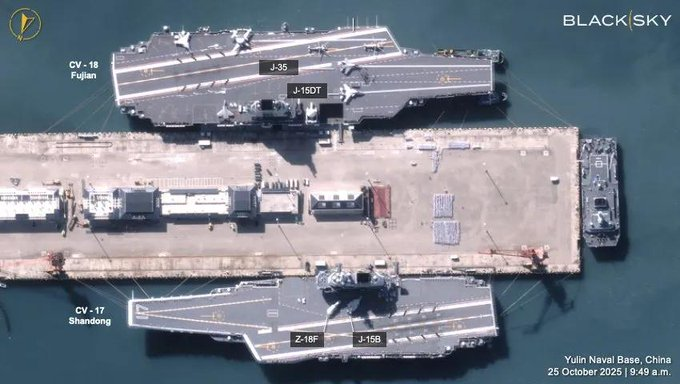
Image: from WORLD AT WAR X @World_At_War_6
Beijing — China’s most advanced aircraft carrier, the CNS Fujian (Type 003 aircraft carrier), is expected to achieve full operational capacity by the end of 2026, marking a major milestone in the rapid modernization of the People’s Liberation Army Navy.
The development underscores Beijing’s accelerating push to project power beyond its shores, as it consolidates its position as the world’s second-largest operator of aircraft carriers after the United States.
From Commissioning to Combat Readiness
Commissioned in late 2025, the Fujian represents a significant technological leap over China’s earlier carriers. State media reports indicate that the vessel is transitioning from initial operational capability to full combat readiness at an unusually fast pace.
Military analysts suggest that achieving full operational capacity will depend on the carrier’s ability to sustain full flight operations, including launching and recovering aircraft across its entire deck under combat conditions.
🇨🇳Chinese State Media reports that the CNS-Fujian will be aimed towards long-distance deployments joint carrier task force operations in 202
2026 would also be a crucial year for the Fujian to build up its Air wing.pic.twitter.com/7TyKs420yi
— PLA Military Updates🇨🇳 (@PLA_MilitaryUpd) April 12, 2026
A New Generation of Carrier Technology
At more than 80,000 tons displacement, the Fujian is the largest warship ever built in China. It is also the country’s first aircraft carrier equipped with electromagnetic catapults, a system that allows for faster launches, heavier payloads, and more efficient sortie generation.
This capability brings the PLAN closer to the operational standards of the United States Navy, long considered the benchmark in carrier aviation.
The Fujian can carry more than 50 aircraft, including advanced fighter jets and early warning systems, significantly enhancing China’s naval aviation capabilities.
Expanding Reach Into Blue Waters
The carrier is expected to undertake far-sea training missions, testing its ability to operate in open ocean environments far from mainland support. These exercises are designed to simulate real combat scenarios, including air defense, maritime strikes, and round-the-clock flight operations.
Such deployments reflect China’s broader strategy of developing “blue-water” naval capabilities, enabling sustained operations beyond the so-called first island chain and into the wider Indo-Pacific.
Rapid Rise of China’s Carrier Fleet
China’s progress in carrier development has been swift. At the start of the 21st century, it had no operational carriers. It’s first, the Liaoning was a refurbished Soviet-era vessel, followed by the domestically built Shandong.
With the addition of the Fujian, China now operates three carriers, surpassing fleets such as the UK’s Royal Navy and India’s Navy in carrier numbers.
Strategic Ambitions and Future Expansion
Under the leadership of Xi Jinping, Beijing has signaled ambitions to expand its carrier fleet significantly, with long-term goals that could see as many as nine carriers in service by 2035.
A fourth carrier is already believed to be under construction, highlighting the scale and pace of China’s naval ambitions.
Analysts note that these developments are closely tied to broader strategic objectives, including safeguarding maritime interests and enhancing China’s ability to project power in contested regions such as the South China Sea and beyond.
A Shifting Balance at Sea
The emergence of Fujian as a fully operational supercarrier marks a turning point in global naval dynamics. As China narrows the technological gap with established naval powers, the balance of maritime power is increasingly shifting.
For regional actors and global powers alike, the rise of China’s carrier fleet signals a new era of competition and capability on the world’s oceans.