
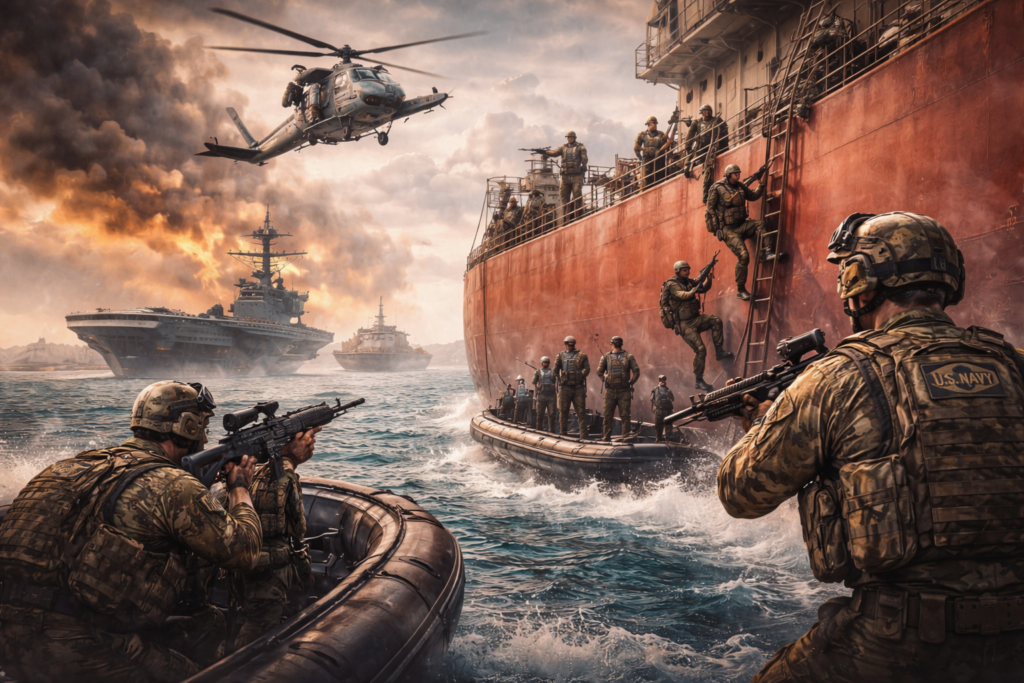
Image Credentials: Image Title: U.S. Warns Ships “Prepare to Be Boarded” as Donald Trump Blockade Tightens in Strait of Hormuz Source: (chatgpt.com) Date: April 2026. Attribution: This image was created using AI-generated imagery (chatgpt.com) and does not depict a real-world scene.
Open Chronicle | With Agencies
Gulf Region — The United States military has issued stark warnings to vessels operating in the Strait of Hormuz, cautioning that ships attempting to breach Washington’s naval blockade of Iran will be boarded and could face the use of force.
Audio released by United States Central Command captured a direct message to maritime traffic, declaring the blockade a “legal action” and ordering vessels to avoid Iranian ports or risk interception.
Escalation at a Global Oil Chokepoint
The Strait of Hormuz remains one of the world’s most critical corridors, with roughly one-fifth of global oil supply passing through its narrow waters. The blockade, launched after the collapse of peace talks, is intended to pressure Tehran back to negotiations.
U.S. officials say vessels attempting to transit to or from Iranian ports will be subject to interdiction and possible seizure, marking one of the most aggressive maritime enforcement actions in recent years.
Conflicting Messages From Washington
The military’s warning contrasts sharply with earlier statements by Donald Trump, who claimed that the Strait had been “permanently opened” following understandings with Xi Jinping.
Despite those claims, U.S. officials have confirmed that the blockade remains fully in effect, creating confusion over Washington’s strategic messaging and long-term intentions.
Iran Responds With Disruption Tactics
In response, Iran has sought to disrupt maritime traffic through asymmetric tactics, including the deployment of drones, naval mines, and fast attack boats. Authorities have also reportedly imposed informal restrictions on shipping, favoring certain countries while pressuring Western-linked vessels.
Maritime analysts report that some ships are now attempting to evade detection by switching off tracking systems or using false identification signals, a practice that complicates monitoring efforts and raises the risk of accidental confrontation.
Global Reactions and Rising Tensions
The blockade has drawn criticism from China, a major importer of Iranian oil. Beijing has condemned the move as destabilizing, warning against a return to what it describes as “the law of the jungle” in international relations.
This has also heightened concerns across global energy markets, where disruptions in the Strait could trigger price spikes and supply shortages.
Military Build-Up Continues
As tensions escalate, the Pentagon is preparing additional reinforcements, including thousands of troops aboard the USS George H.W. Bush (CVN-77) and accompanying warships.
The deployment signals Washington’s readiness to escalate if necessary, even as officials maintain that diplomatic options remain under consideration.
A Precarious Standoff
The situation in the Strait of Hormuz now stands at a critical juncture, with competing narratives, military posturing, and fragile diplomacy unfolding simultaneously.
For global markets and regional stability, the stakes are immense. Whether the blockade leads to renewed negotiations or deeper confrontation may depend on the next moves from Washington, Tehran, and other major powers watching closely from the sidelines.