
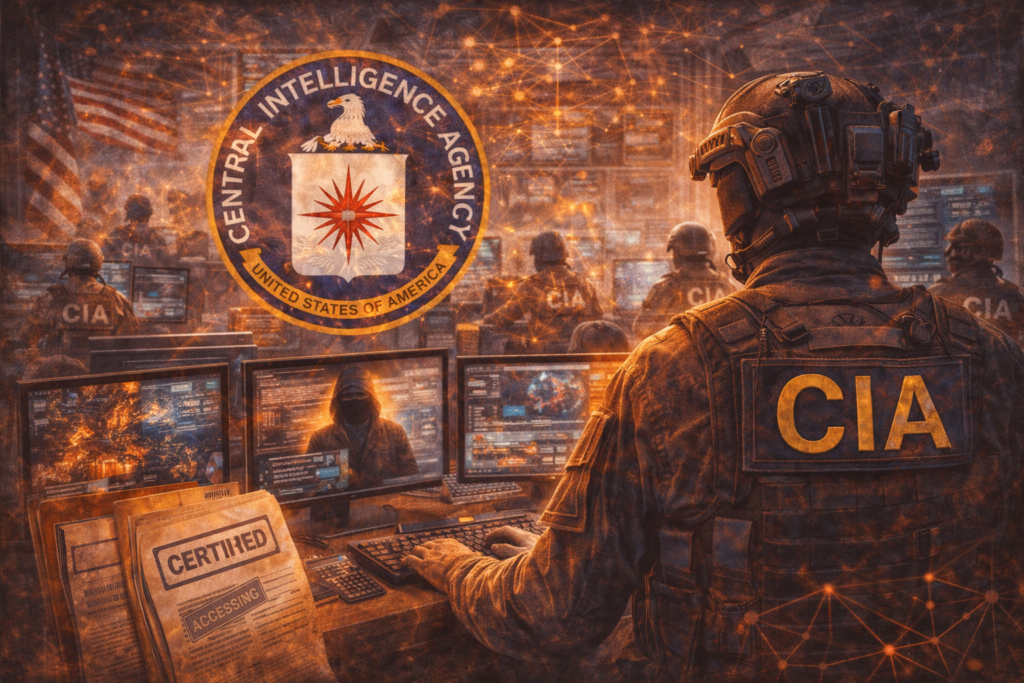
Image Credentials: Image Title: CIA Elevates Cyber Espionage Division in Strategic Shift Source: (chatgpt.com) Date: April 2026. Attribution: This image was created using AI-generated imagery (chatgpt.com) and does not depict a real-world scene.
Open Chronicle | With Agencies
Washington — The CIA has quietly elevated its cyber espionage division to a higher operational status, signaling a significant shift in how the United States approaches digital intelligence and cyber threats.
The agency’s Center for Cyber Intelligence, previously part of its Directorate of Digital Innovation, was upgraded to a full mission center late last year under Director John Ratcliffe. The move gives the unit greater authority, resources, and direct access to senior leadership.
A Strategic Priority in Cyberspace
Officials say the reorganization reflects the growing importance of cyber operations in modern intelligence work. By elevating the center, the CIA aims to strengthen its ability to monitor, analyze, and disrupt foreign cyber threats while advancing its own technological capabilities.
The change also allows the cyber division to report directly to the director, increasing its influence within the agency and ensuring priority access to funding and personnel.
Former officials described the shift as a clear signal that cyber operations are now central to U.S. intelligence strategy.
Expanding Offensive and Defensive Capabilities
The decision aligns with broader national security priorities outlined by the Trump administration, which has emphasized a more assertive posture in cyberspace.
Recent policy guidance calls for deploying both defensive and offensive cyber tools to counter adversaries and impose consequences for digital attacks against the United States.
Ratcliffe has previously argued that the CIA must become less risk-averse and more proactive in developing capabilities that can operate effectively in the cyber domain.
Internal Restructuring
As part of the reorganization, functions from the Transnational and Technology Mission Center, established during the previous administration, have been redistributed across other departments.
The agency has informed Congress of the changes and is updating its public materials to reflect the new structure.
A Powerful but Secretive Unit
The Center for Cyber Intelligence is one of the CIA’s most advanced and least publicly understood divisions. It oversees cyber operations, strategic analysis, and the development of tools used in digital espionage.
Its work can involve highly specialized operations, including the use of custom-built hacking tools and, in some cases, traditional intelligence methods such as recruiting assets or conducting field operations to gain digital access.
Public insight into the unit’s capabilities remains limited. One of the few major disclosures came in 2017, when a leak known as “Vault 7” revealed details about the agency’s cyber tools and techniques, including methods for exploiting software vulnerabilities and conducting surveillance through connected devices.
Coordination and Competition
The expansion of the CIA’s cyber role also raises questions about coordination with other U.S. entities, particularly the Pentagon and U.S. Cyber Command, which also conduct cyber operations.
Experts note that while the CIA focuses on intelligence gathering and covert activity, military cyber units are typically responsible for large-scale offensive actions.
Balancing these roles will be key as the United States increases its reliance on cyber capabilities as both a defensive shield and a strategic deterrent.
A New Era of Intelligence
The elevation of the CIA’s cyber division reflects a broader transformation in global intelligence, where digital operations are increasingly as critical as traditional espionage.
As adversaries invest heavily in cyber warfare, the ability to operate effectively in this domain is becoming a defining element of national security.
The CIA’s latest move underscores that in today’s geopolitical landscape, control of information systems and digital infrastructure is no longer secondary. It is central to the balance of power.