
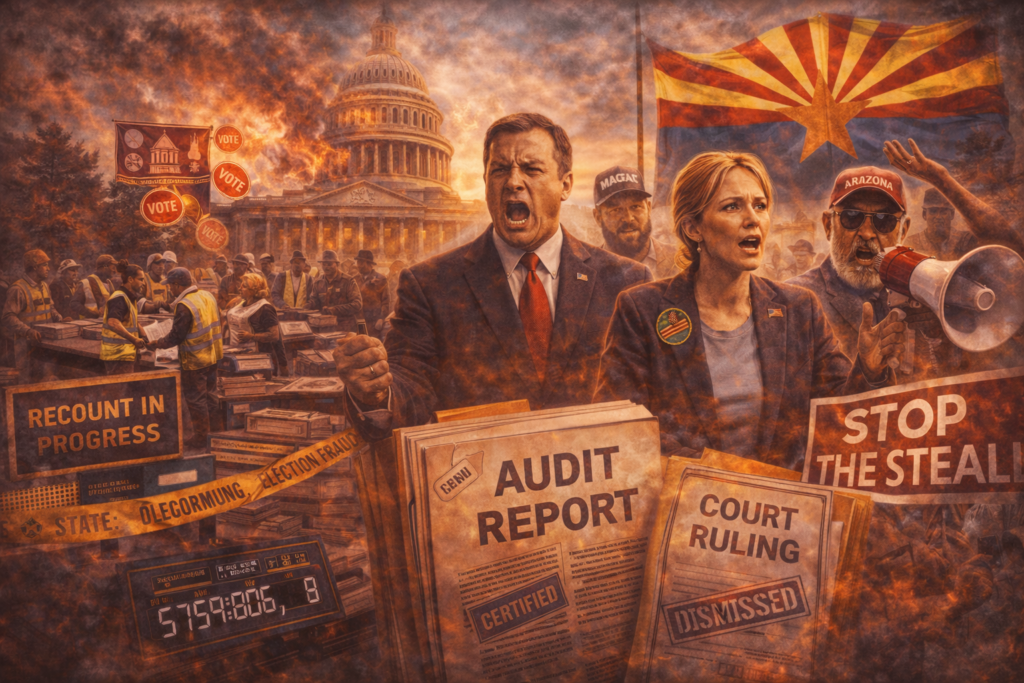
Image Credentials: Image Title: Election Denial Movement Persists in Arizona, Raising Concerns Ahead of Future Votes Source: (chatgpt.com) Date: April 2026. Attribution: This image was created using AI-generated imagery (chatgpt.com) and does not depict a real-world scene.
Open Chronicle | With Agencies
Phoenix — Efforts to challenge and undermine election results continue to shape political dynamics in the U.S. state of Arizona, years after the 2020 presidential election, with officials and analysts warning of lasting impacts on public trust and election administration.
Despite repeated audits, court rulings, and investigations confirming the legitimacy of past election outcomes, a network of activists and political figures continues to promote claims of widespread fraud, many of which have been discredited.
A Movement That Has Not Faded
The election denial movement in Arizona has evolved rather than disappeared. While early efforts focused on overturning the 2020 results, more recent activity has shifted toward influencing local election systems, including county-level administration and voting procedures.
Supporters argue they are advocating for election integrity. Critics, however, say the movement is rooted in misinformation and risks undermining confidence in democratic institutions.
Pressure on Election Officials
Election officials across Arizona have faced increasing scrutiny and, in some cases, threats, as they work to administer voting processes under intense political pressure.
Local administrators report that routine procedures, such as ballot counting and certification, have become flashpoints for controversy, often fueled by online campaigns and public demonstrations.
Officials emphasize that existing safeguards, including bipartisan oversight and auditing mechanisms, are designed to ensure accuracy and transparency.
Legal Challenges and Policy Changes
The movement has also influenced legislative and legal efforts aimed at reshaping election laws in the state. Proposals have included stricter voter identification requirements, changes to mail-in voting procedures, and expanded authority for state officials to intervene in local election processes.
Supporters frame these measures as necessary reforms, while opponents warn they could create barriers to voting and increase the risk of political interference.
Impact on Voter Confidence
One of the most significant consequences of ongoing election denial claims is their effect on public trust. Surveys and local reporting suggest that a portion of voters remains skeptical about election outcomes, even in the absence of evidence supporting fraud claims.
Experts warn that sustained doubt in the electoral system could discourage participation and complicate the administration of future elections.
National Implications
Arizona has become a focal point in the broader national debate over election integrity and misinformation. Developments in the state are closely watched as indicators of how similar movements may influence elections elsewhere in the United States.
The persistence of election denial narratives highlights the challenges faced by institutions in addressing misinformation while maintaining public confidence.
Looking Ahead
As future elections approach, officials in Arizona are preparing for continued scrutiny and potential disputes. Efforts are underway to improve communication, enhance transparency, and reinforce security measures.
The situation underscores a broader reality facing democracies worldwide: trust in electoral systems is as critical as the systems themselves, and rebuilding that trust may prove to be a long-term challenge.