
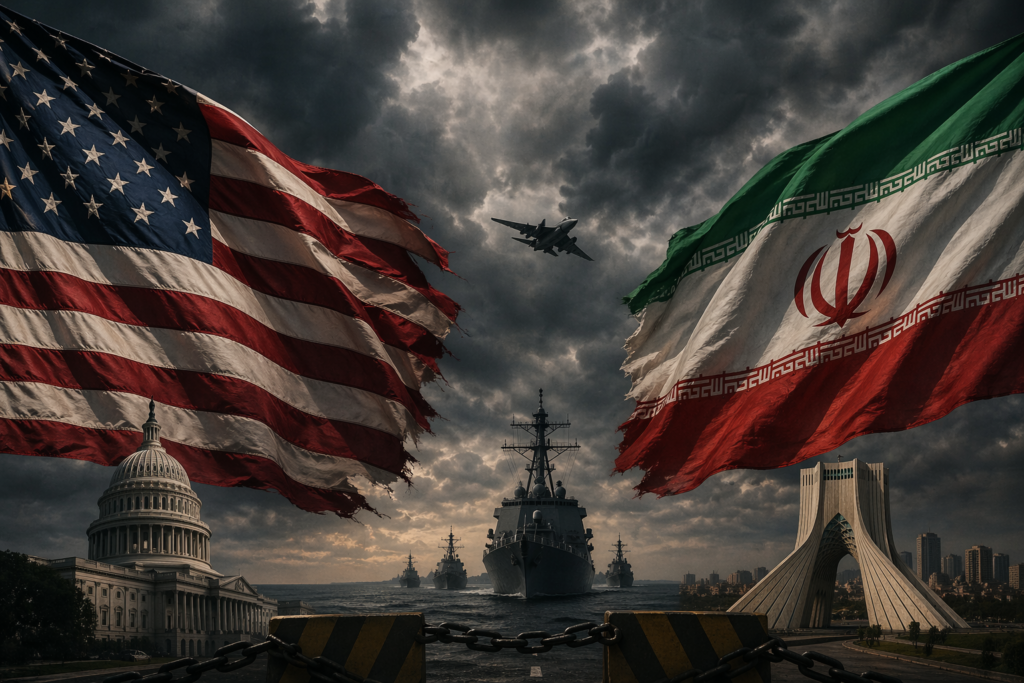
Image Credentials: Image Title: Donald Trump renews threats as Iran rejects talks, raising risk of renewed conflict Source: (chatgpt.com) Date: April 2026. Attribution: This image was created using AI-generated imagery (chatgpt.com) and does not depict a real-world scene.
Open Chronicle | Global Affairs
Tensions between the United States and Iran are escalating once again, as Tehran signals it will not participate in a new round of peace talks and Washington intensifies both military and political pressure ahead of a looming ceasefire deadline.
Iranian officials said there are currently no plans to attend negotiations in Islamabad, where senior U.S. representatives are expected to arrive. The refusal reflects growing frustration in Tehran over what it describes as “unreasonable and unrealistic demands” from Washington, particularly while a U.S. naval blockade of Iranian ports remains in place.
The fragile ceasefire between the two sides is set to expire within days, raising fears that the seven-week conflict could quickly reignite.
Escalation at sea deepens standoff
The dispute has been further inflamed by recent developments in the Strait of Hormuz, a critical global energy corridor. U.S. forces fired on and seized an Iranian vessel accused of attempting to breach the blockade, an incident Tehran has condemned as a violation of the truce.
Iranian authorities warned of a response, while reports indicated that drones had been deployed toward U.S. naval assets in the region. The standoff has effectively halted much maritime traffic, pushing oil prices higher and unsettling global markets.
The situation is compounded by Iran’s continued restrictions on shipping through the strait, a chokepoint through which roughly one-fifth of the world’s oil supply typically passes.
Diplomatic efforts falter
Despite the escalation, diplomatic channels remain active but fragile. Masoud Pezeshkian said that while Iran would stand firm against external pressure, diplomacy should still be pursued to reduce tensions.
At the same time, Iranian officials have expressed little optimism about negotiations with the United States under current conditions.
On the U.S. side, President Donald Trump has maintained a hard line, confirming that a delegation including JD Vance is expected to travel to Pakistan. However, the White House has not publicly confirmed the details, and Iran’s absence would undermine the effort.
Trump has also renewed stark warnings, stating that if a deal is not reached, the United States could target critical infrastructure across Iran, including power plants and bridges.
Regional tensions and security concerns
The crisis is reverberating across the wider Middle East. Authorities in the United Arab Emirates announced they had dismantled an Iran-linked cell allegedly planning attacks, while the U.S. Embassy in Iraq warned of potential threats from militia groups.
Meanwhile, Hezbollah claimed an attack on Israeli forces in southern Lebanon, the first since a recent ceasefire there, adding another layer of instability to the region.
European leaders are also seeking a greater role in addressing the broader conflict, with renewed discussions around Gaza, the West Bank, and long-term regional stability.
Mounting human and economic toll
Iran has reported that more than 3,300 people have been killed since the conflict began, including hundreds of children, highlighting the growing humanitarian cost of the war.
At the same time, global markets are reacting to the uncertainty. Oil prices have surged again as shipping through the Strait of Hormuz remains disrupted, while stock markets show signs of volatility.
Even domestic concerns are emerging in the United States, where Trump has publicly disputed forecasts from his own administration about fuel prices, insisting they will fall quickly once the conflict ends.
A critical moment
With the ceasefire nearing its expiration and no clear diplomatic breakthrough in sight, the situation remains highly unstable. Military deployments are increasing, including the arrival of additional U.S. aircraft carrier groups in the region, signaling preparedness for a potential escalation.
For now, both sides appear locked in a high-stakes standoff, where miscalculation or further provocation could rapidly undo the fragile pause in hostilities.