
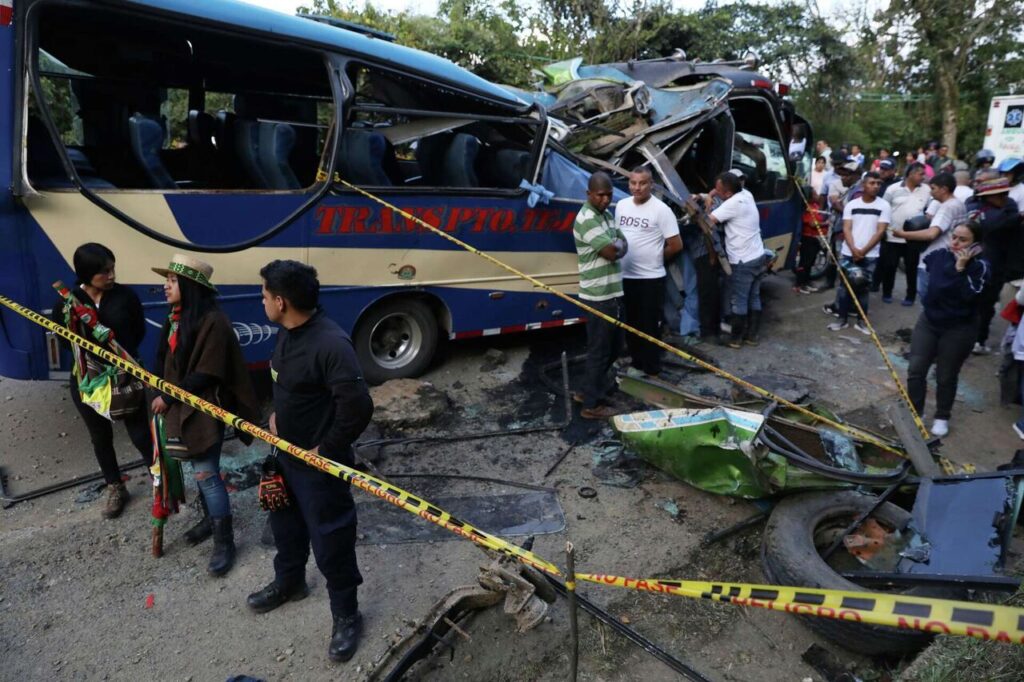
Image: from Azadar Hussain X @Azadar04
Open Chronicle | World Affairs
A devastating bomb attack in southwestern Colombia has left at least 14 people dead and 38 others injured, marking one of the deadliest incidents in the region in recent months. The explosion struck a busy section of the Pan-American highway near Cajibío, in the conflict-affected Cauca region, where violence linked to armed groups has persisted for years.
According to authorities, the explosive device had been planted in a roadside culvert and detonated as vehicles were passing through heavy traffic. The timing of the blast significantly increased the number of casualties, as buses and civilian vehicles were caught in the explosion.
NEW: At least 14 people were killed and 17 injured after an explosive device detonated on the Pan-American Highway in the El Tunel sector of Cajibío, southwestern Colombia.
Authorities believe FARC narcoterrorists planted the bomb along the busy roadway, causing one of the… pic.twitter.com/X2imVrk5rM
— OSINT News (@OSINTNewsqrb) April 26, 2026
Among the most severely affected was a traditional rural bus known as a “chiva,” which was destroyed by the blast. Several nearby vehicles were also damaged, and a large crater was left in the road, underscoring the force of the explosion. Reports suggest that an additional explosive may have been thrown toward a bus moments before detonation, intensifying the destruction.
Gustavo Petro directly blamed the attack on Iván Mordisco, a prominent figure within a dissident faction of the former FARC guerrilla movement. Petro condemned the perpetrators in strong terms, describing them as terrorists and drug traffickers, and ordered an escalation of military operations against the group.
The president also called for enhanced international cooperation to track and dismantle what he characterized as a “narco-terrorist” network operating in the region.
Local officials confirmed that the victims included civilians and children, deepening the sense of tragedy across the community. Octavio Guzmán described the attack as a moment of profound mourning for the region, which has long struggled with insecurity and armed violence.
In a separate but related incident, two people were injured in another bombing near a military base in the city of Cali, raising concerns about a broader escalation of coordinated attacks.
The Cauca region has remained a hotspot for violence involving dissident armed groups, criminal networks, and drug trafficking operations. Despite past peace agreements, factions that rejected demobilization continue to operate, often targeting infrastructure and civilian areas.
Saturday’s attack highlights the fragile security situation in parts of Colombia and the ongoing challenges faced by authorities in stabilizing regions affected by long-running conflict.