
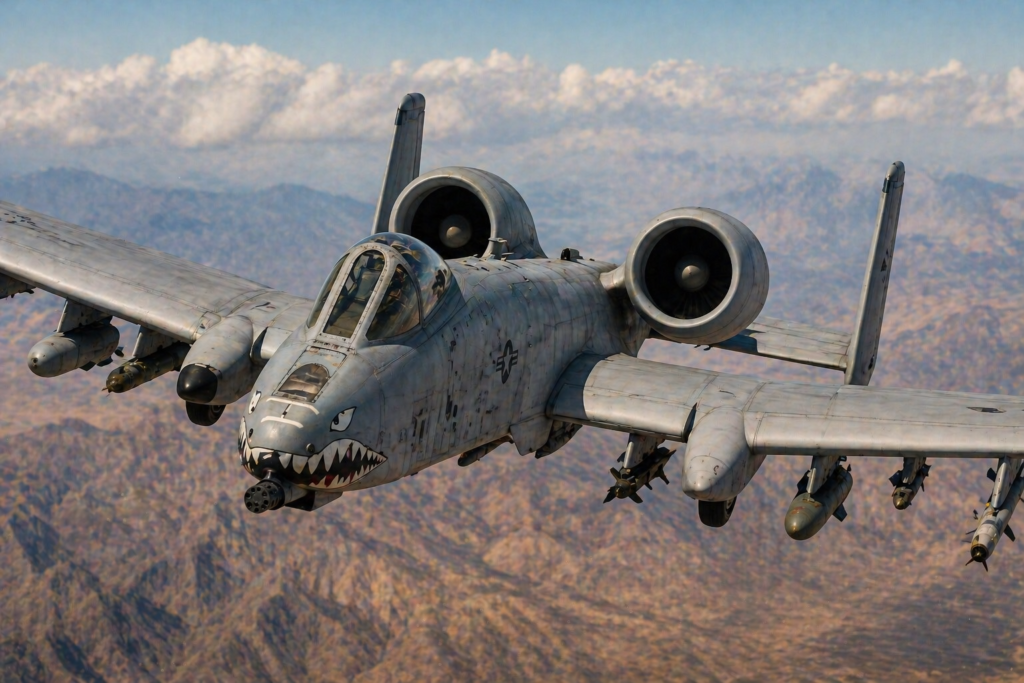
Image Credentials: Image Title: U.S. Air Force Extends A-10 Warthog Service Life to 2030 Source: (chatgpt.com) Date: April 2026. Attribution: This image was created using AI-generated imagery (chatgpt.com) by Open Chronicle and does not depict a real-world scene.
By Open Chronicle with Agencies
The United States Air Force has decided to extend the operational life of the iconic A-10 Thunderbolt II, commonly known as the Warthog, until 2030, delaying a previously planned full retirement.
The announcement was made by Troy E. Meink, who said the decision was taken in coordination with Pete Hegseth. The move reflects a broader effort to maintain combat readiness while the defense industry works to scale up production of newer aircraft.
Under the revised plan, selected squadrons will continue operating the A-10 for several more years. One active-duty squadron at Moody Air Force Base in Georgia and a reserve squadron at Whiteman Air Force Base in Missouri will remain active through 2030. Another active-duty unit at Moody is expected to operate until 2029.
Each squadron will retain 18 aircraft, with a projected fleet of 54 A-10s in service by 2029. That number will be reduced to 36 aircraft by 2030, divided between one active-duty and one reserve squadron. Officials said the Air Force will prioritize maintaining the most serviceable aircraft to maximize operational effectiveness during the extension period.
The decision comes as the A-10 has seen renewed operational demand, particularly in missions linked to the Iran conflict. The aircraft has been deployed in maritime support roles in the Strait of Hormuz, providing close air support and assisting in search and rescue operations.
During a recent mission, A-10 units were involved in the recovery of two downed F-15E airmen. One A-10 aircraft was lost in the operation, though the pilot was safely rescued.
The extension marks a shift from earlier plans outlined in the U.S. defense budget, which had called for a gradual phase-out of the aircraft by 2029. The A-10, long valued for its durability and effectiveness in close air support, continues to play a critical role despite the introduction of more advanced platforms.
Meink credited Donald Trump for supporting the decision, describing it as part of a broader effort to ensure military readiness during a period of heightened global tensions.
The move underscores the enduring relevance of the A-10 in modern warfare, even as the U.S. military continues to invest in next-generation capabilities.