
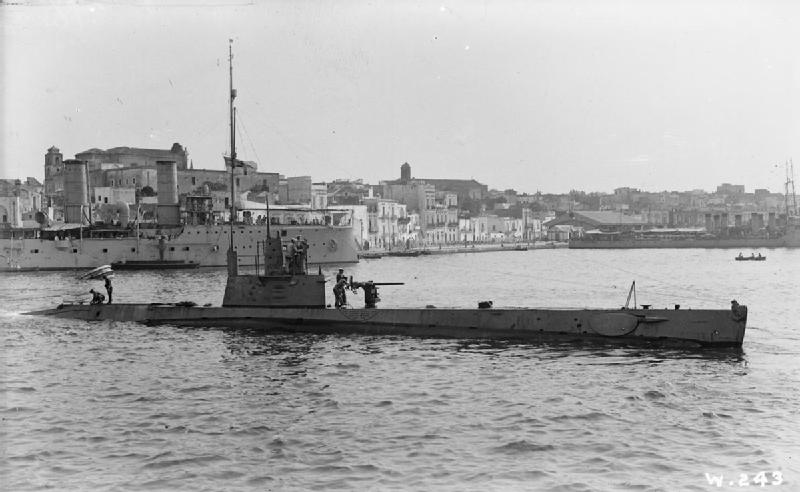
German Navy Type UB III submarine – Image: from This day in WWI X @ThisDayInWWI
The Type UB III submarine was a class of U-boats built during World War I by the German Imperial Navy.
Design
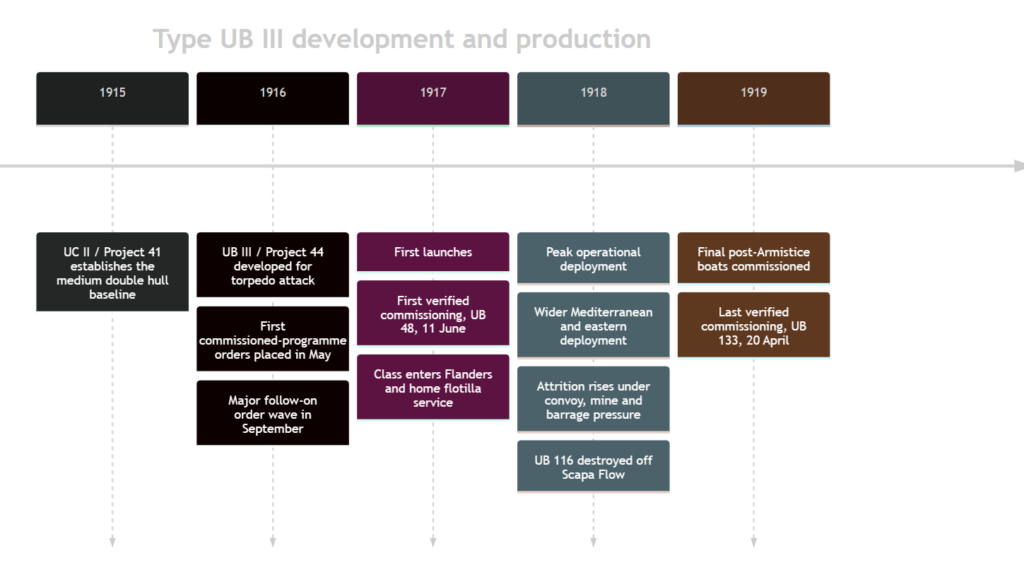
When it became clear that unrestricted submarine warfare would be resumed in 1916, the German Navy sought a way to speed up submarine construction. Since large fleet submarines took more than a year to build, and since the actual coastal Type UB II submarine being built at that time was too small, a design was derived from the successful, small minelaying Type UC II submarine for a medium-sized U-boat capable of reaching the Mediterranean or operating around the British Isles. The forward section of the Type UC II with the mine shaft compartment was replaced with a torpedo compartment containing four torpedo tubes and three spare torpedoes, whilst the aft compartment with one stern torpedo tube and two reloads was retained. More powerful diesel engines were installed to increase the surface speed, and the range was increased by enlarging the saddle tanks. In order to compensate for the extra weight of the engines and armament, fewer battery cells were installed, which reduced submerged speed and range. The conning tower was enlarged so that a second periscope could be installed. The conning tower was now also separated from the control room with a pressure-tight bulkhead.
UB III boats carried 10 torpedoes and were usually armed with either an 8.8 cm (3.5 in) or a 10.5 cm (4.1 in) deck gun. They carried a crew of 34 and had a cruising range of 7,120–9,090 nautical miles (13,190–16,830 km; 8,190–10,460 mi). Between 1916 and 1918, 96 were built.
On 2 May 1916, a total of twenty-four Type UB III were ordered from four yards: UB-48 – UB-53 from Blohm & Voss, UB-48 – UB-53 from AG Weser, UB-48 – UB-53 from AG Vulcan, and UB-48 – UB-53 from Germaniawerft.
Technical characteristics
Published technical figures for UB III boats are close, but not perfectly uniform. The standard class values given by uboat.net and the Historic England appendix are a surfaced displacement of 516 t, a submerged displacement of 651 t, 55.3 m overall length, 5.8 m overall beam, 3.68 to 3.7 m draught, two 550 hp diesels, two 394 hp electric motors, 13.3 to 13.6 knots surfaced, 7.5 to 8 knots submerged, and 10 torpedoes in four bow and one stern tube. By contrast, the German Maritime Museum gives UB 61, described as identical in construction to UB 64, as 508 t surfaced and 639 t submerged. The safest interpretation is that the class had modest batch variation and that different sources are mixing design, trial, and representative boat data.
The biggest technical uncertainty concerns depth. Sources that describe individual boats often present 50 m as a test or design diving depth, while uboat.net and the German Maritime Museum frequently give about 75 m as the maximum. This distinction is important. For rigorous use, 50 m is best treated as the conservative official or routine figure, with about 75 m as a practical upper limit or maximum depth cited in later summaries.
Parameter Typical UB III figure:
- Length overall 55.3 m
- Pressure hull length 40.1 m
- Beam overall 5.8 m
- Pressure hull beam 3.9 m
- Draught 3.68 to 3.70 m
- Height 8.25 m
- Surfaced displacement 516 t typical; 508 t for UB 61 in DSM representative data
- Submerged displacement 651 t typical; 639 t for UB 61 in DSM representative data
- Propulsion 2 × 550 hp MAN diesels; 2 × 394 hp electric motors
- Surface speed 13.3 to 13.6 kn
- Submerged speed 7.5 to 8.0 kn
- Surface range 8,500 to 9,040 nmi at economical speed
- Submerged range 55 nmi at 4 kn
- Diving depth 50 m test/working depth; about 75 m maximum cited
- Torpedo tubes 4 bow, 1 stern, all 50 cm
- Torpedo load 10 torpedoes
- Deck gun 1 × 8.8 cm quick-firing gun
- Gun ammunition, about 160 rounds
Mines none - Crew 34, usually described as 3 officers and 31 men
Service history
The UB IIIs joined the conflict in mid-1917, after the United States declared war on Germany, and the United States Navy was added to the ranks of their enemies. When the convoy system was introduced, it became more difficult to engage enemy merchant shipping without being spotted by destroyer escorts. Nevertheless, the UB IIIs performed their duties with distinction, sinking 521 ships with a total of 1,123,211 gross register tons (GRT) and 7 warships, including the battleship HMS Britannia, before the end of hostilities.
More than 200 UB III boats were ordered; of these, 96 were completed, and 89 commissioned into the German Imperial Navy. Thirty-seven boats were lost, and four of them in accidents. Surviving boats had to be surrendered to the Allies in accordance with the requirements of the Armistice with Germany; some of these boats served until 1935.
Operations and doctrine
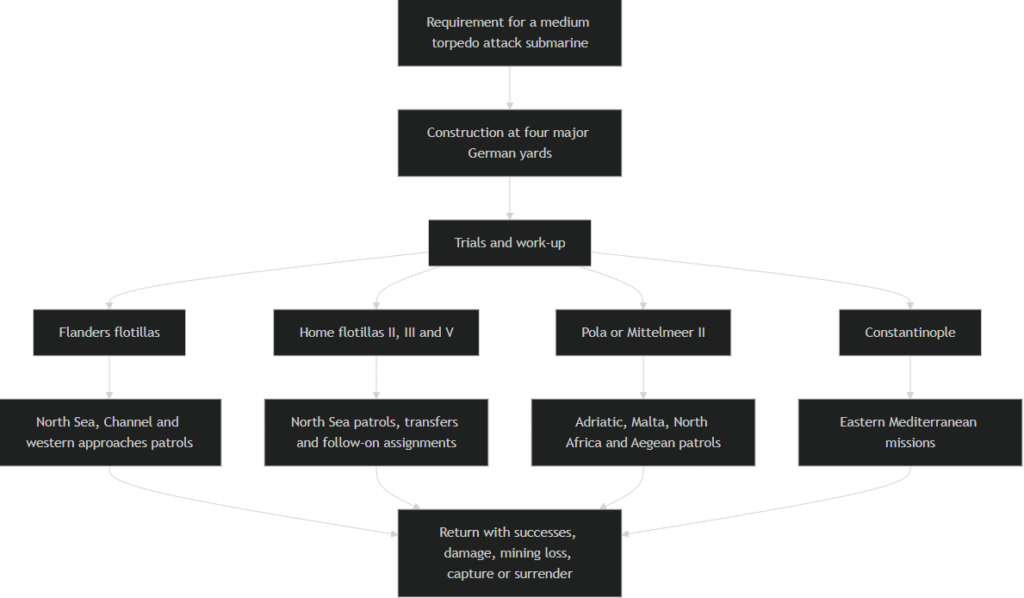
The operational geography of the UB III class was wider than the label “coastal” suggests. The type served from Flanders bases against the North Sea and Channel convoy lanes, from home flotillas for North Sea and western approach work, and from the Adriatic for Mediterranean operations. Verified flotilla assignments on representative boat pages include Flandern I, Flandern II, II Flotilla, V Flotilla, III Flotilla, Pola or Mittelmeer II Flotilla, and even the Constantinople Flotilla. In other words, the class was used wherever Germany needed a medium torpedo attacker with decent surface endurance but smaller physical scale than the larger U types.
The Mediterranean article on uboat.net is especially explicit: UB III boats served as attack torpedo submarines in that theatre, with the main base in Pula and operations extending along the North African coast, around Malta, toward the Suez exit and in the Aegean. That same source also shows why the Adriatic route mattered so much, since the Otranto Barrage complicated movement between the Adriatic and the wider Mediterranean but did not fully stop it.
Tactically, the UB III reflected the final period of First World War submarine warfare. The Flanders operational history makes clear that early surface and deck gun practice gave way to much harsher torpedo first procedures as Q ships, convoy protection, minefields and net barrages made “warning and gunfire” attacks increasingly dangerous. The article also notes that seaplanes escorted submarines in and out of the Flanders ports, that operations extended ever farther from base, and that attrition climbed sharply from mid 1917 onward. In that sense, the UB III was not only a better submarine, it was also a submarine shaped by a harsher battlespace.
The class’s best known offensive records came from individual boats. UB 48, under Wolfgang Steinbauer, completed nine patrols from the Pola or Mittelmeer II Flotilla and sank 36 ships for 110,095 tons, while also damaging eight ships and one warship. UB 50, under Heinrich Kukat, ended with 40 ships sunk for 114,421 tons, seven damaged ships, and the sinking of the pre dreadnought battleship Britannia on 9 November 1918. These records show exactly what the class was built to do: high pressure commerce attack in heavily contested seas.
The class also produced memorable special or symbolic operations. UB 116, commanded by Hans Joachim Emsmann, attempted to reach Scapa Flow in October 1918 in a mission consciously echoing earlier efforts against the Grand Fleet anchorages, but she was detected and destroyed in the controlled defenses of Hoxa Sound. UB 107 is also analytically useful because Historic England treats her career as typical of a late war coastal U boat: active but short, with sinkings achieved before improved Allied defenses and attrition made sustained operational success much harder.
Losses were heavy. A precise independent class wide audit is beyond this session, but a reputable secondary synthesis gives 37 UB III boats lost, including four accidents. That figure fits the pattern shown by the representative record: UB 61 was mined with the loss of 34 men, probably by a mine laid by British submarine E 51; UB 103 and UB 113 were lost off the Flanders routes; UB 110 was sunk after attack, then raised; UB 116 was destroyed at Scapa Flow. Mines, nets, barriers and increasingly effective anti submarine operations explain a large share of the attrition.
The flowchart below reduces the class’s deployment pattern to its operational logic.
Comparative assessment
The UB III’s importance becomes clearest when set beside the types around it. Relative to the UB II, it was not an incremental refinement but a step change in mission utility: much larger, much faster, far better armed, and finally capable of sustained offensive patrols in wider waters. Relative to the UC II, it traded mine warfare for a heavier torpedo battery and higher speed, while preserving roughly similar operational endurance. Relative to contemporary Allied submarines, especially the British E and L classes, it sat in the middle of the spectrum: smaller and usually less comfortable than fleet oriented Allied boats, but highly efficient for commerce war in confined seas. Relative to the later Type VII, it looks like a conceptual ancestor rather than a direct equal, recognizable in tube arrangement and operational concept, but much shallower diving, with less striking power and far weaker underwater survivability.
| Type | Surfaced / submerged displacement | Length | Surface / submerged speed | Torpedo tubes and load | Gun | Range |
|---|---|---|---|---|---|---|
| UB II | 263 / 292 t | 36.13 m | 9.15 / 5.81 kn | 2 bow; 6 torpedoes | 88 mm | 6,650 nmi at 5 kn |
| UC II | 417 / 493 t | 49.35 m | 11.6 / 7.0 kn | 2 bow + 1 stern; 7 torpedoes; plus 18 mines | 88 mm | 9,430 nmi at 7 kn |
| UB III | 516 / 651 t typical | 55.3 m | 13.3 to 13.6 / 7.5 to 8.0 kn | 4 bow + 1 stern; 10 torpedoes | 8.8 cm | 8,500 to 9,040 nmi at economical speed |
| British E class | 667 / 807 t | 181 ft, about 55.2 m | 15.25 / 10.25 kn design | 2 bow + 2 beam + 1 stern; 10 torpedoes | 2 pdr | 3,000 miles at 10 kn service |
| British L class | 914 / 1,089 t typical | 238 ft 7 in, about 72.8 m | 17 / 10.5 kn | 4 bow + 2 beam; 10 torpedoes | 4 in | 3,600 miles at half full power service |
| Type VIIB | 753 / 857 t | 66.5 m | 17.9 / 8.0 kn | 4 bow + 1 stern; 14 torpedoes | 88/45 | 8,700 nmi at 10 kn |
The comparison draws on uboat.net for German types, the Royal Navy Submarine Museum reference pages for E and L classes, and uboat.net’s Type VIIB page as a representative early Type VII.
Several operational judgments follow from that table.
First, UB III versus UB II: the surfaced displacement almost doubled, speed rose sharply, tube count increased from two to five, and the torpedo outfit went from six to ten. That is why UB III could plausibly fight in the western approaches and Mediterranean, while UB II was much more constrained.
Second, UB III versus UC II: these were close cousins but not equivalents. UC II had stronger mining capability and a somewhat longer advertised surface range, but the UB III had more torpedo tubes, more torpedoes, and higher surface speed, which better suited a surprise commerce attack. Put differently, UC II was the more flexible minelayer; UB III was the more purposeful torpedo raider.
Third, UB III versus Allied boats: the British E class was larger and notably better underwater, but UB III had longer surface endurance for low-speed patrol work. The later British L class was plainly a larger fleet and patrol submarine, faster and much more heavily built, but in a different category of operational economy. The UB III’s niche was not parity with every Allied design; it was a particularly efficient compromise between construction burden and offensive patrol value.
Fourth, UB III versus Type VII: the resemblance is conceptual and partially geometric, not merely rhetorical. Interwar German design work through IvS explicitly returned to the UB III lineage, and the later Type VII preserved the medium attack U-boat idea while adding more torpedoes, better sea keeping, far greater depth, and a modernized hull and control arrangement. That is why historians so often describe UB III as the real First World War ancestor of Germany’s classic Second
Legacy
In 1917, Swedish officials were impressed by the design’s performance. As a result, Kockums bought a license for the design, shortened the hull and removed a rear torpedo tube, and built three submarines for the Swedish Navy. The three submarines, the Hajen-class, were slightly modified to build three Bävern-class submarines, still reminiscent of the Type UB III.
Germany was prohibited from acquiring a new submarine force by the Treaty of Versailles, but German admirals had no intention of allowing their nation to forget how to construct submarines. Germany started to manufacture and export slightly modified versions of UB IIs and UB IIIs through the Dutch front company NV Ingenieurskantoor voor Scheepsbouw (IvS). Having kept the skills of their engineers polished by this means, they eventually ordered the construction of a new coastal submarine. The resulting design was an improved UB-III that had the benefit of new, all-welded construction techniques and an array of electronic and electromechanical gadgets: the Type VII submarine, the most common U-boat of the Kriegsmarine, was born. During the interwar era, IvS continued to modernize the design, which resulted in the two Birinci İnönü-class boats being sold to Turkey.
Aftermath and legacy
Postwar fates varied widely. Many UB III boats were surrendered under the Armistice and broken up; others were used in trials or allocated abroad. The Pendennis report shows how UB 86, UB 97, UB 106, UB 112, and UB 128, all UB IIIs, were taken to Falmouth in 1920 and 1921 for explosive trials documented in TNA ADM 189/102. That document is unusually valuable because it preserves not just text but photographs and diagrams that expose the class after its fighting life was over.
UB 88 had one of the most unusual afterlives. She surrendered to the United States, was used for exhibition voyages, passed through the Panama Canal to the West Coast, and was eventually scuttled as a gunnery target off San Pedro in January 1921. U.S. archival finding aids preserve a logbook trail for her in 1919, and the California State Lands Commission still records the wreck as a 182-foot diesel electric submarine sunk by gunfire off Los Angeles County.
Other boats entered foreign naval service. UB 155, commissioned only after the war, was allocated to France and became the French submarine Jean Corre, remaining in service until 1935 before being broken up in 1938. That unusually long afterlife is one of the clearest indications that the UB III was not just a wartime expedient; it was a technically respectable submarine by the standards of its day.
In design legacy, the class mattered even more. Uboat.net’s Operation Ursula article notes that in the late 1920s, the Dutch cover company IvS designed a submarine based on the Great War UB III. That lineage fed directly into the thinking behind the later Type VII family. So while the UB III was a First World War boat, its DNA plainly survived in Germany’s suppressed, exported, and then reconstituted submarine design culture.
As for surviving artifacts and museum evidence, the material record is real but fragmented. The German Maritime Museum’s North Sea Wrecks exhibition includes a model and 3D visualization work based on UB 61; Royal Museums Greenwich holds period drawings of UB 77; Tyne and Wear Archives and Museums preserves a remarkable photograph album of the salvaged UB 110; and the California coast still preserves UB 88 as an underwater archaeological site. On the evidence reviewed here, I found no intact UB III preserved as a full museum boat, so the class survives through wrecks, archives, drawings, photo albums, and isolated objects rather than through a single complete exhibitable hull.
The analytical bottom line is straightforward. UB III was Germany’s most successful late First World War medium torpedo submarine design because it solved a real operational problem with an efficient compromise: enough range for offensive patrols, enough weapons to matter, enough speed to remain tactically useful, and a hull compact enough for relatively rapid mass production. It arrived too late, and into an anti-submarine environment that was improving too quickly, to change the war’s outcome. Even so, it shaped submarine history far beyond 1918.
List of Type UB III submarines
There were 96 Type UB III submarines commissioned into the German Imperial Navy.
| # | Submarine | # | Submarine | # | Submarine |
|---|---|---|---|---|---|
| 1 | SM UB-48 | 33 | SM UB-80 | 65 | SM UB-112 |
| 2 | SM UB-49 | 34 | SM UB-81 | 66 | SM UB-113 |
| 3 | SM UB-50 | 35 | SM UB-82 | 67 | SM UB-114 |
| 4 | SM UB-51 | 36 | SM UB-83 | 68 | SM UB-115 |
| 5 | SM UB-52 | 37 | SM UB-84 | 69 | SM UB-116 |
| 6 | SM UB-53 | 38 | SM UB-85 | 70 | SM UB-117 |
| 7 | SM UB-54 | 39 | SM UB-86 | 71 | SM UB-118 |
| 8 | SM UB-55 | 40 | SM UB-87 | 72 | SM UB-119 |
| 9 | SM UB-56 | 41 | SM UB-88 | 73 | SM UB-120 |
| 10 | SM UB-57 | 42 | SM UB-89 | 74 | SM UB-121 |
| 11 | SM UB-58 | 43 | SM UB-90 | 75 | SM UB-122 |
| 12 | SM UB-59 | 44 | SM UB-91 | 76 | SM UB-123 |
| 13 | SM UB-60 | 45 | SM UB-92 | 77 | SM UB-124 |
| 14 | SM UB-61 | 46 | SM UB-93 | 78 | SM UB-125 |
| 15 | SM UB-62 | 47 | SM UB-94 | 79 | SM UB-126 |
| 16 | SM UB-63 | 48 | SM UB-95 | 80 | SM UB-127 |
| 17 | SM UB-64 | 49 | SM UB-96 | 81 | SM UB-128 |
| 18 | SM UB-65 | 50 | SM UB-97 | 82 | SM UB-129 |
| 19 | SM UB-66 | 51 | SM UB-98 | 83 | SM UB-130 |
| 20 | SM UB-67 | 52 | SM UB-99 | 84 | SM UB-131 |
| 21 | SM UB-68 | 53 | SM UB-100 | 85 | SM UB-132 |
| 22 | SM UB-69 | 54 | SM UB-101 | 86 | SM UB-133 |
| 23 | SM UB-70 | 55 | SM UB-102 | 87 | SM UB-136 |
| 24 | SM UB-71 | 56 | SM UB-103 | 88 | SM UB-142 |
| 25 | SM UB-72 | 57 | SM UB-104 | 89 | SM UB-143 |
| 26 | SM UB-73 | 58 | SM UB-105 | 90 | SM UB-144 |
| 27 | SM UB-74 | 59 | SM UB-106 | 91 | SM UB-145 |
| 28 | SM UB-75 | 60 | SM UB-107 | 92 | SM UB-148 |
| 29 | SM UB-76 | 61 | SM UB-108 | 93 | SM UB-149 |
| 30 | SM UB-77 | 62 | SM UB-109 | 94 | SM UB-150 |
| 31 | SM UB-78 | 63 | SM UB-110 | 95 | SM UB-154 |
| 32 | SM UB-79 | 64 | SM UB-111 | 96 | SM UB-155 |
| Class overview | |
|---|---|
| Builders |
|
| Operators |
|
| Preceded by | UB II |
| Built | 1916–1918 |
| In commission | 1917–1935 |
| Planned | 201 |
| Building | 145 |
| Completed | 96 |
| Canceled | 56 |
| Lost | 37 |
| General characteristics | |
| Type | Coastal submarine |
| Displacement |
|
| Length |
|
| Beam | 5.76–5.80 m (18 ft 11 in – 19 ft 0 in) |
| Draught | 3.67–3.85 m (12 ft 0 in – 12 ft 8 in) |
| Installed power |
|
| Propulsion | 2 shafts, 2 1.40 m (4 ft 7 in) propellers |
| Speed |
|
| Range |
|
| Test depth | 50 m (160 ft) |
| Complement | 3 officers, 31 men |
| Armament |
|


References
- Rössler 1981, pp. 56–57.
- Gröner 1991, pp. 25–30.
- Goebel, Greg. The First Battle of the Atlantic. Archived from the original on 10 March 2002.
- Bendert 2000, p. 9.
- Fontenoy, Paul E. (2007). Submarines: an Illustrated History of Their Impact. Santa Barbara, California: ABC-CLIO. p. 114. ISBN 978-1-85109-563-6.
- G.Williamson and I.Palmer, U-Boats of the Kaiser’s Navy, 2002
- Fontenoy, Paul E. (2007). Submarines: an Illustrated History of Their Impact. Santa Barbara, California: ABC-CLIO. p. 194. ISBN 978-1-85109-563-6.
Bibliography
- Conway’s All the World’s Fighting Ships 1906–1921
- Bendert, Harald (2000). Die UB-Boote der Kaiserlichen Marine, 1914-1918. Einsätze, Erfolge, Schicksal (in German). Hamburg: Verlag E.S. Mittler & Sohn GmbH. ISBN 3-8132-0713-7.
- Dodson, Aidan; Cant, Serena (2020). Spoils of War: The Fate of Enemy Fleets after the Two World Wars. Barnsley: Seaforth Publishing. ISBN 978-1-5267-4198-1.
- Gröner, Erich; Jung, Dieter; Maass, Martin (1991). U-boats and Mine Warfare Vessels. German Warships 1815–1945. Vol. 2. Translated by Thomas, Keith; Magowan, Rachel. London: Conway Maritime Press. ISBN 0-85177-593-4.
- Rössler, Eberhard (1981). The U-boat: The evolution and technical history of German submarines. London: Cassell & Co. ISBN 0-304-36120-8.
Further reading
- Gibson, R. H; Prendergast, Maurice (2003) [1931]. The German Submarine War, 1914–1918. Annapolis, Maryland: Naval Institute Press. ISBN 1591143144.
- Herzog, Bodo (1993). Deutsche U-Boote : 1906 – 1966 [German U-boats : 1906 – 1966] (in German). Erlangen: Müller. ISBN 9783860700365.
- Möller, Eberhard; Brack, Werner (2004). The Encyclopedia of U-Boats. London: Chatham. ISBN 1-85367-623-3.
- Termote, Tomas (2014). Oorlog onder water, Unterseebootsflottille Flandern 1915-1918 [War below sea, submarine flotilla Flanders 1915-1918] (in Dutch). Leuven: Davidsfonds. ISBN 978-90-5908-526-8.
Categories: World War I submarines of Germany
World One War Portal
Explore this subject
Continue exploring related Open Chronicle Encyclopedia entries through the categories associated with this article.

Staff Writers at Open Chronicle produce trusted journalism, strategic analysis and authoritative reference content across global affairs, geopolitics, defense, science, history, technology, business, culture and sport. Their work combines accurate reporting with historical perspective and analytical depth, helping readers understand not only what is happening, but why it matters. Beyond daily news coverage, Staff Writers contribute to the Open Chronicle Encyclopedia, investigative features, original research projects and long-form reports, building a comprehensive knowledge platform designed to inform, educate and preserve reliable information for a global audience.