
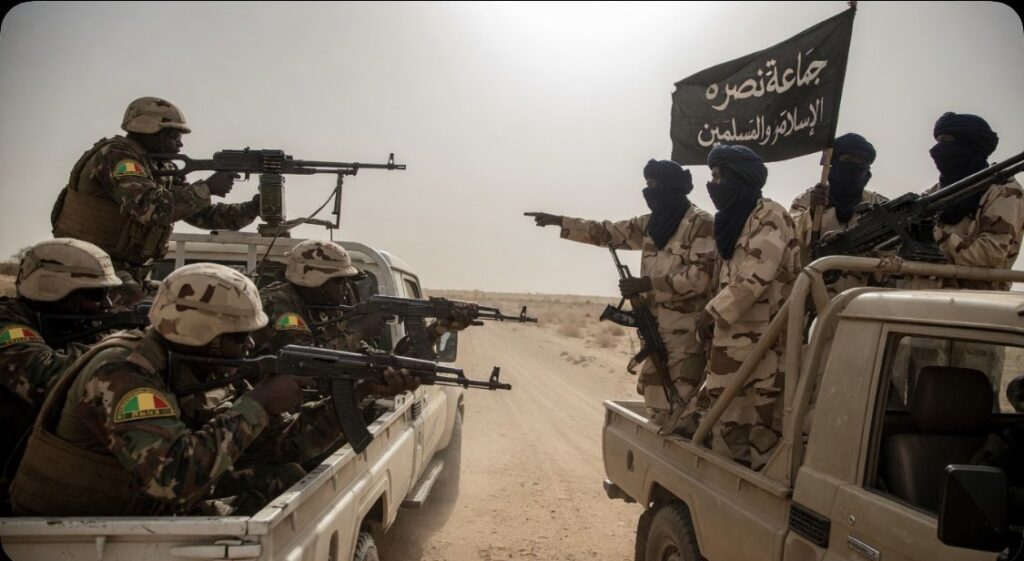
Image: from Réfractaire le retour X @_Refractaire_
By Open Chronicle with Agencies
An armed group linked to al-Qaeda has called on citizens in Mali to rise against the military-led government and support the establishment of Sharia law, following a wave of coordinated attacks across the country.
The group, Jama’at Nusrat al-Islam wal-Muslimin, issued a rare statement in French urging “all sincere patriots” to unite against what it described as a “dictatorship.” The message was released days after the group carried out large-scale assaults on April 25, targeting military bases and areas near the capital, Bamako.
Jama'at Nusrat al-Islam, the Saharan branch of al-Qaeda in the Islamic Maghreb has
reached the presidential palace in Mali.Islamic terrorists are now taking over African countries pic.twitter.com/6k9GoOTRaH
— Daniel Somtochukwu (@Somtolism7) April 25, 2026
The offensive, conducted in coordination with the Azawad Liberation Front, reportedly included the seizure of the northern town of Kidal and the killing of Mali’s defense minister, marking one of the most significant escalations in the country’s ongoing conflict.
In its statement, JNIM called on a broad spectrum of Malian society, including political actors, religious leaders, and members of the armed forces, to oppose the current leadership and work toward what it described as a “peaceful, responsible and inclusive transition.” Central to its demands is the implementation of Sharia law.
The group also warned against the risks of instability following any potential overthrow of the government, stating that a coordinated effort would be needed to prevent a collapse into chaos.
Mali has been under military rule since a series of coups in 2020 and 2021 brought Assimi Goita to power. The current leadership has faced persistent security challenges, particularly from extremist groups operating in the north and central regions of the country.
In response to the recent attacks, Goita said in a televised address that the situation remains under control and pledged to “neutralize” the insurgent groups responsible.
Reports indicate that JNIM has intensified its presence around Bamako, establishing checkpoints along key routes leading into the capital and threatening a blockade. The group has increasingly sought to expand its influence by combining military operations with efforts to gain local support.
The latest developments highlight the fragile security environment in Mali, where armed groups continue to challenge state authority and complicate efforts to stabilize the country.