
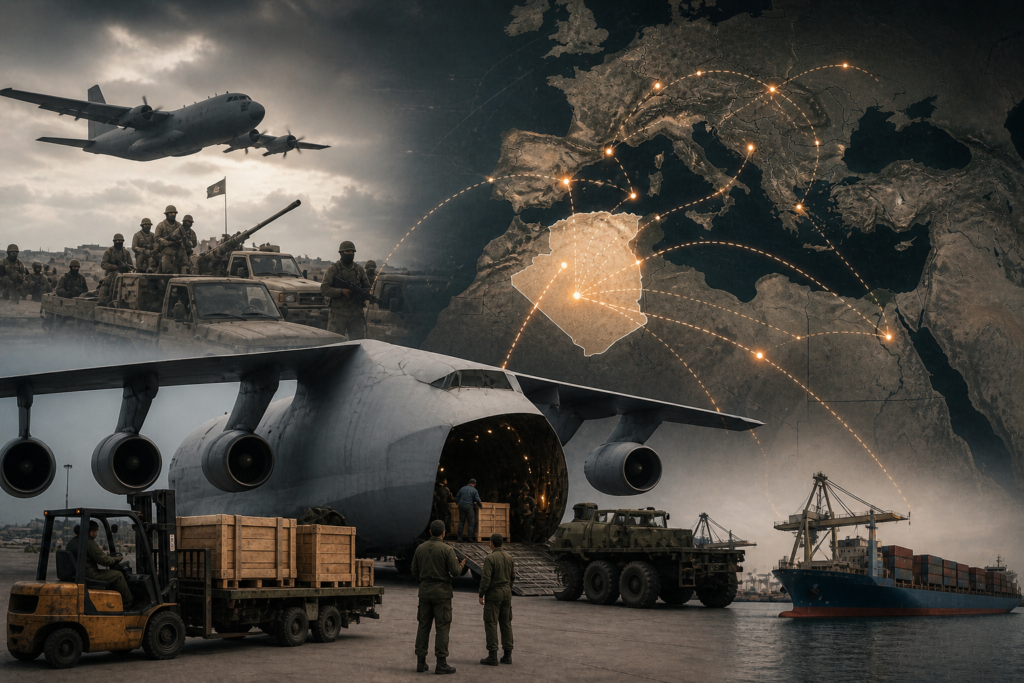
Image Credentials: Image Title: Investigation Reveals Russian ‘Shadow Airlines’ Using Algeria as Strategic Hub for Covert Operations Source: (chatgpt.com) Date: May 2026. Attribution: This image was created using AI-generated imagery (chatgpt.com) by Open Chronicle and does not depict a real-world scene.
By Open Chronicle with Agencies
A network of Russian-linked cargo airlines is using Algeria as a key logistics hub to support covert military and strategic operations across Africa and beyond, according to a Defense News investigation.
The probe identified at least 167 cargo flights between Russia and Algeria from March 2025 to April 2026, many of them connecting facilities tied to United Aircraft Corporation with Algerian military airbases. Analysts believe these flights are likely linked to the delivery of advanced weaponry, including next-generation fighter jets.
Algeria has emerged as a key defense partner for Moscow, continuing to acquire aircraft such as the Su-57 and Su-35 while maintaining large fleets of Russian-built fighters. The country’s geographic position also makes it a valuable staging ground for extending Russian reach into West Africa and the Sahel.
Experts say the scale and pattern of flights suggest more than routine arms transfers. Margaux Garcia, a researcher at C4ADS, noted that the movements align closely with known delivery timelines for military equipment, reinforcing the likelihood of coordinated logistics operations.
The aircraft used in these missions are often Soviet-era cargo planes, particularly the Ilyushin Il-76, which has become a workhorse for these “shadow airline” networks. Due to limited range, these planes rely on intermediary stops such as Algeria to extend their operational reach.
Flight-tracking data indicate that some aircraft employ evasion tactics, including disabling transponders or misreporting destinations, a pattern consistent with other clandestine operations linked to Russian logistics networks.
Beyond Algeria, routes extend deeper into Africa. Flights have been traced to countries such as Guinea and Niger, regions where Russia has expanded its economic and military footprint. In some cases, heavy-lift aircraft like the Antonov An-124 have been observed operating shuttle routes, potentially transporting large volumes of equipment or resources.
The investigation also highlights connections to Russian paramilitary operations, including networks linked to the former Wagner Group and its successor formations. Analysts estimate that a significant portion of these flights support logistical needs for such groups, including the movement of personnel, equipment, and materials.
Candace Rondeaux, an expert on Russian paramilitary activity, described the system as a continuation of established practices. She said the use of civilian-registered aircraft allows Russia to bypass restrictions, maintain plausible deniability, and operate within international aviation frameworks.
The network includes companies such as Gelix Airlines and Aviacon Zitotrans, some of which have been previously sanctioned. These firms often operate under complex leasing arrangements, making it difficult to trace ownership and control of aircraft.
Despite official denials by company representatives, the patterns of flights, destinations, and timing raise persistent questions about the true nature of these operations. Analysts point to the overlap between commercial aviation activity and military logistics as a defining feature of the network.
The use of Algeria as a central hub reflects both strategic geography and shifting global dynamics. With Western sanctions limiting Russia’s access to traditional routes and partners, alternative corridors through Africa and the Middle East have become increasingly important.
As scrutiny grows, the investigation underscores how modern conflicts and geopolitical competition are increasingly supported by shadow logistics networks operating beyond traditional oversight.
The Grand Strategy Institute
Continue Exploring Strategic Analysis
Return to The Grand Strategy Institute for strategic assessments, long-form analysis and research examining geopolitics, military affairs, international security, emerging technologies and the changing international order.
← Back to The Grand Strategy Institute