
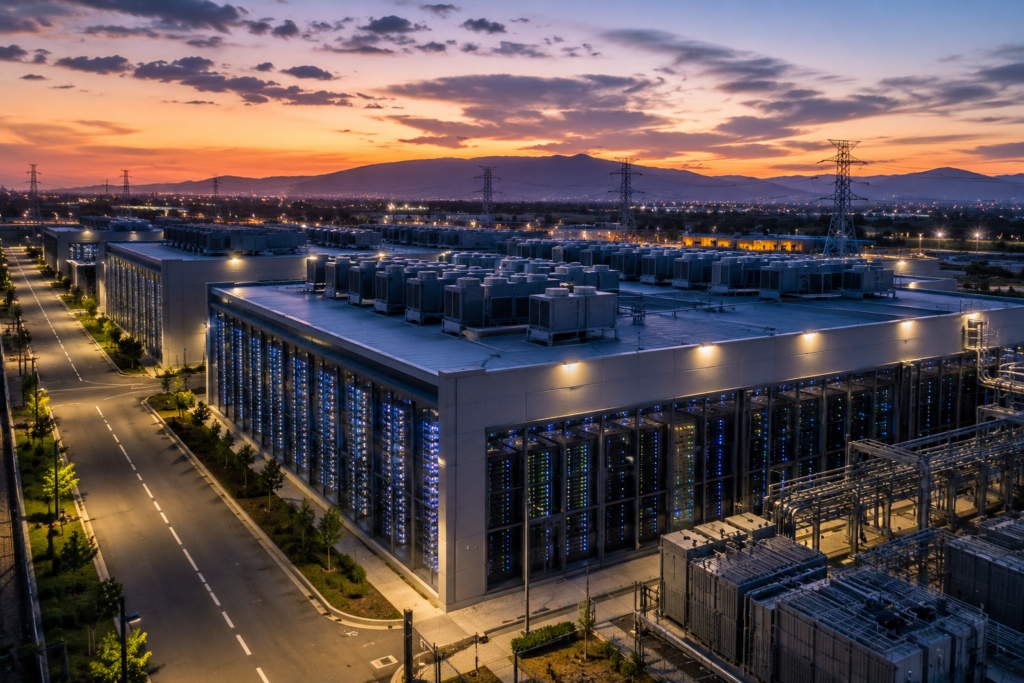
Image Credits: Image Title: America’s AI Boom Sparks Growing Battle Over Data Centers. Source: (chatgpt.com) Date: May 2026. Attribution: This image was created using AI-generated imagery (chatgpt.com) by Open Chronicle and does not depict a real-world scene.
By Open Chronicle with agencies
The United States is in the middle of one of the largest technology infrastructure expansions in modern history, as major corporations race to build the massive data centers needed to power the artificial intelligence revolution.
Technology giants and hyperscale cloud companies are expected to invest nearly $4 trillion in AI infrastructure over the next five years, according to industry estimates from CBRE. The scale of the spending has drawn comparisons to some of the most ambitious projects in American history, including the interstate highway system, the Apollo program, and the electrification of the country.
Supporters argue that this unprecedented buildout is essential if the United States intends to maintain its technological dominance over rivals such as China in the rapidly evolving AI sector.
Yet the construction surge has also triggered a growing backlash across parts of the country, where data centers are increasingly becoming a focal point of political, environmental, and community disputes.
Critics have raised concerns over the enormous energy and water demands required to operate advanced AI systems. Environmental groups warn that large facilities could strain local water supplies and power grids, particularly in drought-prone or fast-growing regions.
Other opponents have focused on local quality-of-life concerns. Residents in some communities claim nearby facilities generate persistent noise, vibrations, and industrial disruption, while activists and local groups have opposed large-scale developments through zoning battles and legislative campaigns.
Several states and municipalities have even explored restrictions or outright limits on future data center construction.
Industry advocates, however, argue that many of the criticisms are exaggerated or driven by broader resistance to industrial development. They point out that the United States already operates thousands of data centers nationwide and that concerns surrounding noise or infrastructure impact are similar to disputes historically associated with factories, highways, rail systems, and electrical substations.
Proponents also stress that advanced computing infrastructure is becoming strategically critical not only for economic competitiveness but also for national security.
Artificial intelligence increasingly underpins military systems, cybersecurity, logistics, finance, scientific research, and industrial production. Analysts warn that slowing infrastructure development could weaken America’s position in the global technology race at a moment when geopolitical competition over AI leadership is accelerating.
The debate reflects a broader national tension between rapid technological expansion and local resistance to industrial growth.
For decades, political leaders across the ideological spectrum have promoted the return of manufacturing and technological investment to the United States. Yet the arrival of large-scale AI infrastructure projects is now testing whether communities are willing to accept the physical footprint that accompanies digital transformation.
Supporters of continued expansion argue that modern economies cannot function without the infrastructure powering cloud computing, artificial intelligence, and digital communications. They contend that data centers represent the backbone of the next generation of economic and strategic power.
Critics counter that growth must be balanced against environmental sustainability, resource management, and community oversight.
As investment accelerates and AI competition intensifies globally, the struggle over data centers is likely to become one of the defining infrastructure and political battles of the coming decade.