
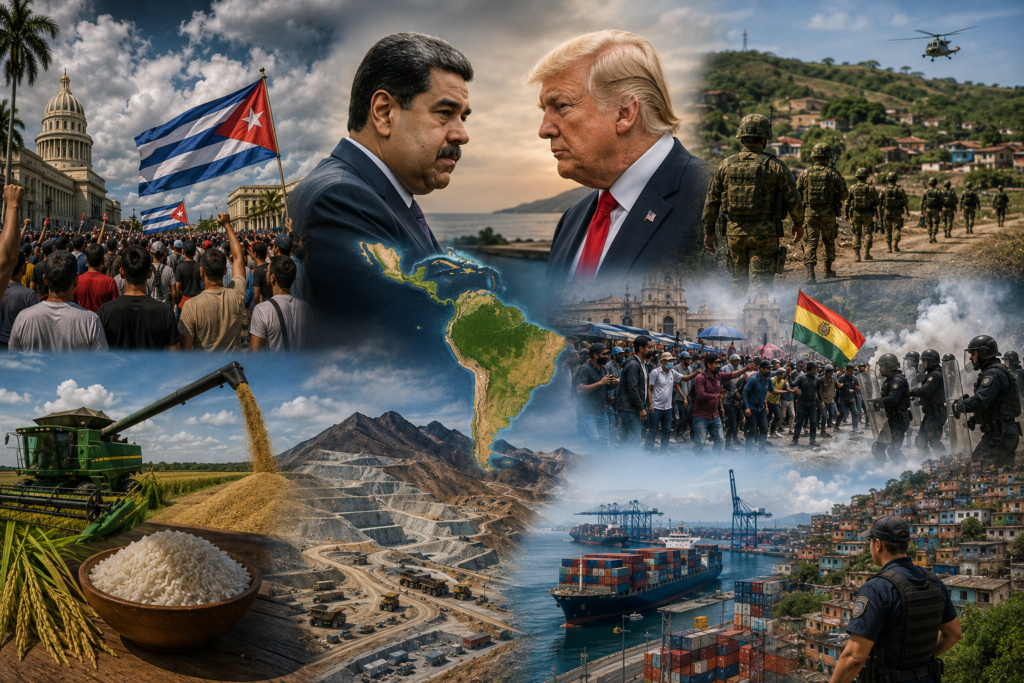
Image Credentials: Image Title: Latin America News Roundup: Today’s Key Headlines Across the Region. Source: (chatgpt.com) Date: May 2026. Attribution: This image was created using AI-generated imagery (chatgpt.com) by Open Chronicle and does not depict a real-world scene.
By Open Chronicle with agencies
Latin America entered the weekend facing a wave of political tensions, economic uncertainty, security concerns, and diplomatic realignments, as governments across the region responded to growing instability stretching from Cuba and Venezuela to Bolivia, Mexico, and Argentina.
One of the most closely watched developments centered on Cuba and Venezuela, where Washington’s increasingly aggressive posture has fueled speculation about broader geopolitical consequences in the Caribbean and South America. Reports emerged that CIA Director John Ratcliffe reportedly accompanied an operative connected to the failed 2020 Maduro raid during a rare diplomatic meeting concerning Cuba, intensifying debate over the United States’ strategy toward Havana and Caracas.
The Trump administration’s pressure campaign against Cuba continued to escalate after demonstrations erupted outside the U.S. embassy in Havana, where thousands rallied in support of former Cuban leader Raúl Castro following his recent indictment in the United States. Cuban authorities have urged citizens to prepare for possible confrontation as tensions between Washington and Havana continue to rise.
Analysts across the region increasingly compare Washington’s approach toward Cuba with previous strategies used against Venezuela, although several experts argue that Havana’s political structure and regional alliances may prevent a Venezuelan-style outcome.
Meanwhile, Venezuela itself remains under growing strain. Political observers warned that the country is approaching another critical phase of instability as economic pressures, sanctions, and diplomatic isolation deepen. At the same time, the United States carried out a “rapid response” military exercise at its embassy in Caracas, further fueling speculation about possible contingency planning in the region.
In Bolivia, mass protests intensified against President Rodrigo Paz, with demonstrators demanding his resignation amid worsening economic conditions and accusations of neoliberal reforms that critics say have deepened social inequality. Clashes between protesters and police were reported in several cities as the political crisis continued to expand.
Colombia also faced renewed security challenges after authorities deployed hundreds of soldiers to the country’s southwest following violent land disputes that left at least seven people dead. Security concerns remained a major issue ahead of future elections, even as new polling showed a right-wing presidential candidate emerging as a leading contender for a potential runoff vote.
Across the region, economic developments painted a mixed picture. Uruguay captured nearly two-thirds of Mercosur’s annual rice export quota to the European Union, highlighting the country’s growing agricultural competitiveness. Mexico and the EU also formally advanced a major new trade agreement designed to diversify commercial ties amid rising global tariff tensions.
Argentina, meanwhile, found itself balancing political uncertainty with major economic ambitions. President Javier Milei promoted a new copper development strategy high in the Andes as part of efforts to attract foreign investment and boost exports. However, the country also faced criticism and ridicule after an experimental artificial intelligence initiative designed to forecast political and economic trends reportedly failed during early testing.
Brazil remained in focus for both economic and security reasons. Police dismantled illegal cryptocurrency mining operations, including facilities hidden deep within the Amazon region, while new polling suggested former President Jair Bolsonaro may be losing ground politically after fresh scandal allegations involving financial networks close to his allies.
Natural disasters also affected multiple countries across Latin America over the past 24 hours. A series of earthquakes struck Mexico, Ecuador, Peru, Argentina, Chile, Costa Rica, Nicaragua, and El Salvador, though no major casualties were immediately reported.
Elsewhere, authorities in Honduras investigated two separate mass shootings that killed at least 25 people, underscoring the continuing violence linked to organized crime and gang activity in Central America.
Regional public health and environmental concerns also remained prominent. Experts warned that rising global food costs and climate instability could threaten agricultural production throughout Mexico and South America, while scientists continued efforts to protect endangered banana crops from disease and climate pressures.
As geopolitical rivalries intensify and domestic crises deepen, Latin America increasingly finds itself navigating a complicated landscape shaped by economic transformation, foreign pressure, political unrest, and shifting global alliances.