
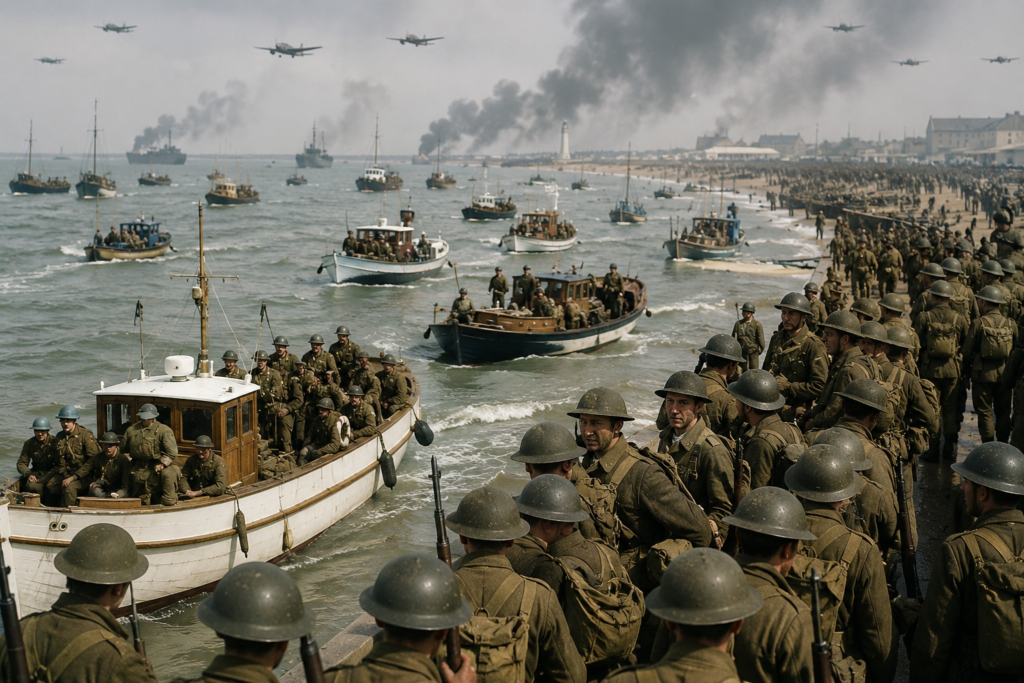
Image Credentials: Image Title: Today in History – Dunkirk Evacuation Began as Allied Forces Escaped Nazi Advance. Source: (chatgpt.com) Date: May 2026. Attribution: This image was created using AI-generated imagery (chatgpt.com) by Open Chronicle and does not depict a real-world scene.
By Open Chronicle
On May 26, 1940, one of the most dramatic rescue operations in military history began as British and Allied troops started evacuating from the French port city of Dunkirk during World War II.
The evacuation, later known as Operation Dynamo, unfolded under intense pressure as German forces rapidly advanced across France. The British Expeditionary Force, alongside French and Belgian troops, had become trapped near the coast after weeks of fierce fighting against Nazi Germany’s blitzkrieg offensive.
A crucial turning point came when Adolf Hitler ordered German armored divisions to halt near a line of canals roughly 15 miles from Dunkirk. Historians have long debated the reasons behind the decision, which unexpectedly gave Allied troops a narrow window to organize a massive escape across the English Channel.
During the first 24 hours, nearly 8,000 soldiers were evacuated. Over the following days, the operation expanded dramatically as hundreds of naval vessels, merchant ships, and civilian boats crossed repeatedly between England and the beaches of northern France.
The evacuation became famous for the participation of around 700 civilian vessels, later remembered as the “little ships of Dunkirk.” Fishermen, ferry operators, pleasure boat owners and volunteers risked enemy fire and dangerous waters to help transport stranded soldiers to larger ships offshore or directly back to Britain.
Meanwhile, the Royal Air Force battled German aircraft overhead in an effort to protect the evacuation fleet and the troops waiting on the beaches.
Against overwhelming odds, the operation succeeded in rescuing 338,226 Allied soldiers by the time the evacuation ended in early June 1940. Although much of the Allied military equipment had to be abandoned in France, the successful withdrawal preserved a large portion of Britain’s trained army and allowed the United Kingdom to continue the fight against Nazi Germany.
The evacuation of Dunkirk quickly became a symbol of resilience, unity and determination during one of the darkest periods of the war. British Prime Minister Winston Churchill later described the event as a “miracle of deliverance,” while also warning that wars are not won by evacuations alone.
Today, the story of Dunkirk remains one of the defining moments of World War II and a lasting example of civilian and military cooperation under extraordinary circumstances.