
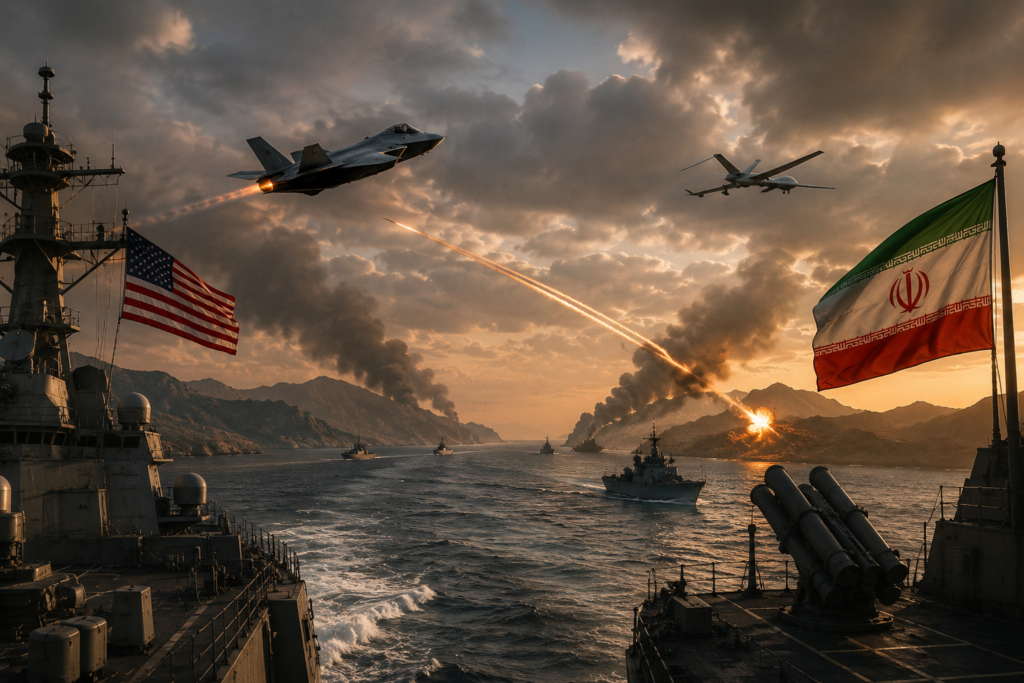
Image Credentials: Image Title: US and Iran Clash Near Strait of Hormuz Despite Signs of Diplomatic Progress. Source: (chatgpt.com) Date: May 2026. Attribution: This image was created using AI-generated imagery (chatgpt.com) by Open Chronicle and does not depict a real-world scene.
By Open Chronicle with agencies
Tensions between the United States and Iran escalated once again overnight after military forces from both sides exchanged strikes near the Strait of Hormuz, even as officials in Washington and Tehran continued to speak publicly about progress toward a possible interim peace agreement.
The confrontation unfolded only hours after US President Donald Trump reaffirmed that negotiations to extend the current ceasefire and reopen the strategically vital waterway were advancing. The latest violence highlighted the fragile and contradictory nature of the ongoing diplomacy, with military operations and peace talks now unfolding simultaneously.
According to the US military, American forces carried out what they described as self-defense strikes in southern Iran, targeting missile launch positions and boats allegedly attempting to deploy naval mines near the Strait of Hormuz. Iranian authorities, meanwhile, said the Islamic Revolutionary Guard Corps responded after detecting what it called hostile American aircraft entering Iranian airspace.
BREAKING: 🇺🇸 🇮🇷 US strikes Iran.
IRGC boats were caught red-handed planting mines in the Strait of Hormuz.
CENTCOM hit back, destroying the vessels and a missile site in Bandar Abbas.
Per Fox: ceasefire is NOT broken.
20% of global oil flows through that strait. pic.twitter.com/52p7iosG24
— Crypto Rover (@cryptorover) May 26, 2026
Iranian state-linked media reported that the IRGC fired on an American F-35 fighter jet and several drones. Tehran claimed it successfully downed an MQ-9 Reaper drone while forcing other aircraft to retreat from the area. Iranian media also stated that several Iranian personnel were killed during attacks near Larak Island, located in the Strait of Hormuz.
Despite the exchange, neither side announced a suspension of negotiations.
US Secretary of State Marco Rubio, speaking during a visit to India, acknowledged that negotiations remained complicated. He said there was still “a lot of talking back and forth” over specific wording in the draft framework currently under discussion.
The latest violence came shortly before Iranian Supreme Leader Mojtaba Khamenei issued a warning that “the nations and lands of the region will no longer be a shield for American bases,” reinforcing concerns that the region could quickly return to broader conflict if negotiations collapse.
The talks follow months of escalating confrontation that began after US and Israeli strikes on Iranian military and government facilities earlier this year. Iran responded by effectively closing the Strait of Hormuz, one of the world’s most important energy chokepoints. The disruption severely impacted global oil and gas markets, driving energy prices sharply higher and fueling inflation concerns worldwide.
Brent crude prices rose again on Tuesday, climbing nearly four percent to just below $100 per barrel, though markets remain cautiously optimistic that a temporary agreement could still emerge.
At the center of negotiations is a proposed interim arrangement that would reportedly extend the current ceasefire for approximately two more months while both sides attempt to negotiate a broader settlement.
Among the key issues under discussion are the reopening of the Strait of Hormuz, the release of billions of dollars in frozen Iranian funds, sanctions relief, and Iran’s stockpile of highly enriched uranium. Washington wants Tehran to either surrender or destroy uranium stocks that could potentially be used in a future nuclear weapons program.
Iran has publicly resisted those demands, though officials have signaled that transferring uranium stocks to a third country, potentially Russia or China, may remain an option.
Another major obstacle involves freedom of navigation through the Strait of Hormuz. The United States, European governments, and Gulf Arab states insist that international shipping must move freely through the waterway. Iranian officials, however, have suggested they may seek navigation fees or enhanced oversight for vessels crossing the strait.
Regional dynamics are also complicating negotiations. Iran continues to insist that any agreement must include a ceasefire in Lebanon, where fighting between Israel and Hezbollah militants remains intense. Israeli Prime Minister Benjamin Netanyahu said Monday that Israel would intensify operations in Lebanon and reiterated that Israeli forces must retain freedom of military action against threats linked to Hezbollah and Iran.
Arab states, including Saudi Arabia, Qatar, and the United Arab Emirates, are reportedly urging Washington to maintain diplomatic efforts, fearing renewed warfare could destabilize the Gulf region once again.
Trump also continued pressing for an expansion of the Abraham Accords, urging more Muslim-majority countries to normalize relations with Israel as part of a wider regional framework tied to any eventual Iran agreement. Analysts, however, say such ambitions remain difficult while the Palestinian issue remains unresolved.
Meanwhile, senior Iranian officials traveled to Doha this week for consultations with Qatari authorities. Iranian Parliament Speaker Mohammad Bagher Ghalibaf and Central Bank Governor Abdolnaser Hemmati were expected to discuss the potential release of frozen Iranian financial assets and broader economic arrangements connected to the talks.
Even if a temporary agreement is reached, diplomats acknowledge that much more difficult negotiations over Iran’s nuclear program would still follow. Officials on both sides privately admit that the risk of renewed war remains significant if those talks break down.