
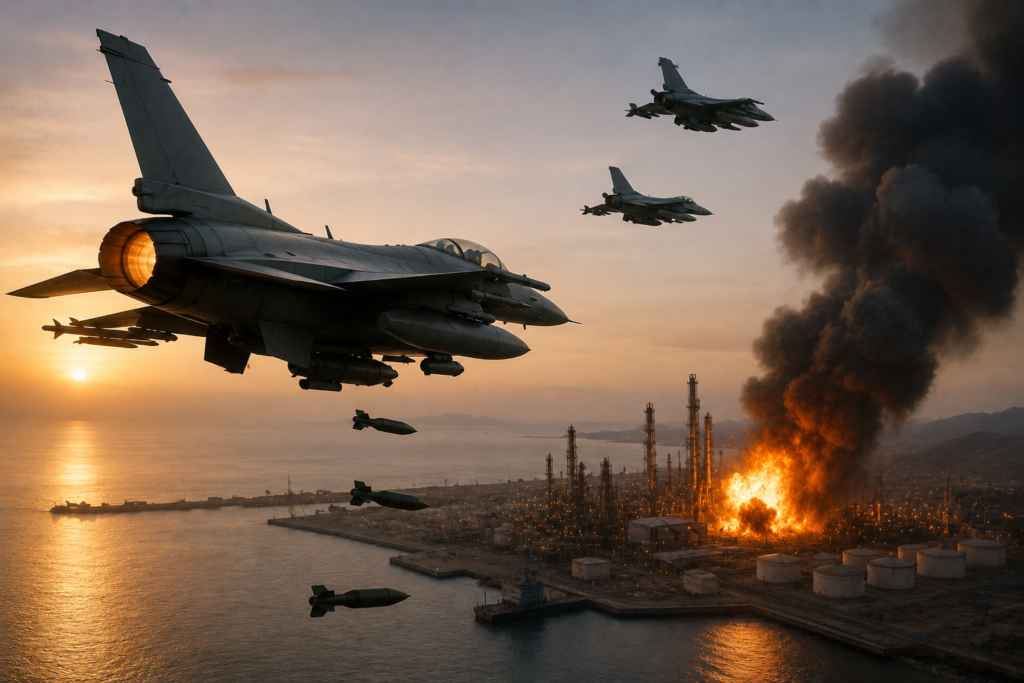
Image Credentials: Image Title: UAE Conducted Dozens of Airstrikes on Iran with US and Israeli Intelligence Support, Report Says. Source: (chatgpt.com) Date: May 2026. Attribution: This image was created using AI-generated imagery (chatgpt.com) by Open Chronicle and does not depict a real-world scene.
By Open Chronicle with agencies
The United Arab Emirates carried out dozens of airstrikes against Iranian targets during the recent regional conflict, coordinating closely with the United States and Israel and relying on intelligence provided by both countries, according to a report published by The Wall Street Journal.
The reported campaign continued throughout the war and concluded one day after the ceasefire between the United States and Iran was announced in early April. The strikes were among the most significant direct military actions ever undertaken by the UAE against Iran and underscored the increasingly complex security dynamics across the Gulf region.
According to sources cited by the report, Emirati forces targeted a range of Iranian military and energy-related facilities in retaliation for extensive Iranian attacks on Emirati infrastructure. During the conflict, Iran reportedly launched more than 2,800 missiles and drones at the UAE, a larger number than those directed at any other country involved in the confrontation, including Israel.
Initially, Gulf states publicly stated that they would not allow their territories, military bases, or airspace to be used for offensive operations against Iran. However, the scale of Iranian attacks on regional energy facilities and strategic infrastructure reportedly led some governments to reconsider their positions.
The UAE’s retaliatory campaign allegedly focused on several strategic locations, including the islands of Qeshm and Abu Musa in the Strait of Hormuz, facilities near Bandar Abbas, and an oil refinery on Lavan Island in the Persian Gulf.
One of the most controversial operations reportedly targeted the Asaluyeh petrochemical complex, one of Iran’s most important energy hubs. According to the report, the strike was conducted in cooperation with Israel and drew significant international criticism due to concerns about potential impacts on global energy markets and regional stability.
The attack on Asaluyeh also reportedly prompted intervention from US President Donald Trump, who urged Israel to refrain from targeting additional energy infrastructure. Concerns had been growing that strikes against major energy facilities could further disrupt global oil supplies and intensify economic uncertainty.
The revelations provide new insight into the level of coordination among the UAE, Israel, and the United States during the conflict, highlighting how regional alliances evolved in response to escalating Iranian military actions. They also illustrate how the conflict expanded beyond direct US-Iran tensions into a broader regional confrontation involving multiple Gulf states.
Although the ceasefire remains in place, the report suggests that the war fundamentally reshaped security calculations across the Middle East, with Gulf countries increasingly willing to participate in direct military responses when critical national infrastructure comes under attack.