
Image: from Voice of Mexico X @VOMexico
By Open Chronicle with agencies
Romania has confirmed that the drone, which struck a residential apartment building in the eastern city of Galați, was Russian, prompting renewed calls for stronger NATO support and faster deployment of military equipment to the alliance’s southeastern flank.
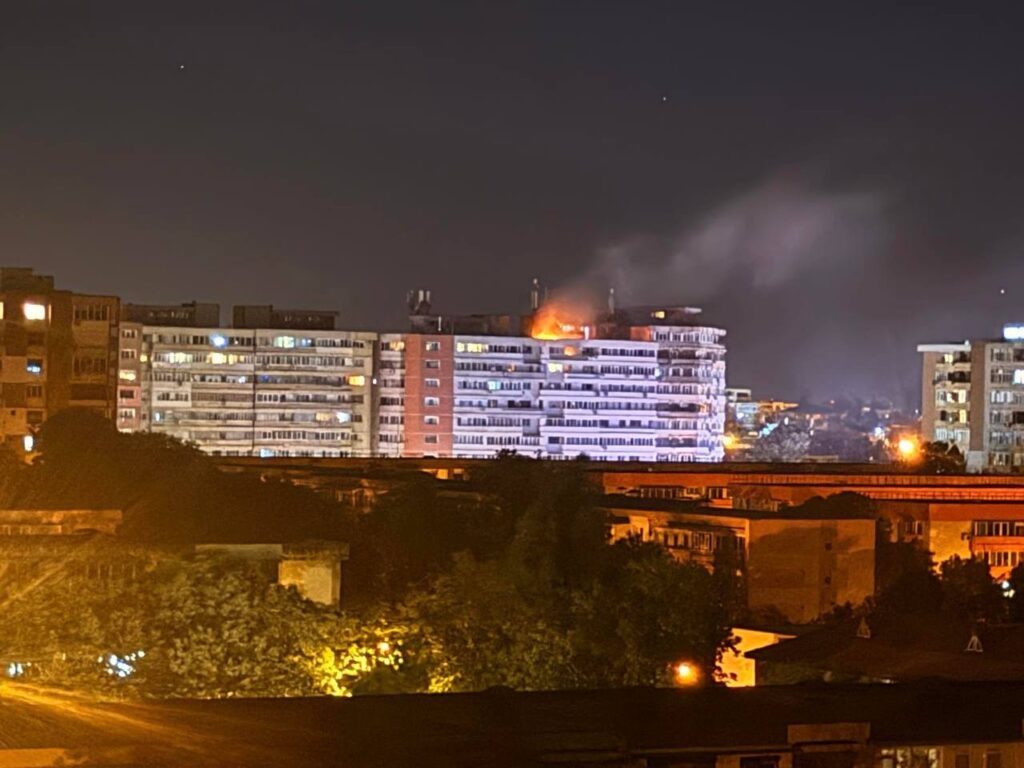
The incident, which injured two people and caused significant damage to a residential building near Romania’s border with Ukraine, has been described by Romanian officials as a serious violation of national sovereignty and a dangerous escalation of the conflict spilling beyond Ukraine’s borders.
Speaking to POLITICO, Romanian Foreign Minister Oana Toiu said authorities had completed their assessment of the drone and reached a definitive conclusion.
“This is an unacceptable and blatant violation of our airspace,” Toiu said. “We have confirmation it is a Russian drone.”
Growing Security Concerns on NATO’s Eastern Flank
The strike occurred during another large-scale wave of Russian drone attacks targeting Ukrainian infrastructure and civilian areas near the Romanian border.
Romanian military authorities reported that radar systems detected the drone entering Romanian airspace before it ultimately crashed into the roof of an apartment building in Galați. The impact triggered a fire and forced the evacuation of dozens of residents.
In response, Romania scrambled two F-16 fighter jets and a military helicopter to monitor the situation. According to Romanian officials, military pilots were authorized to engage and destroy any drones that posed an immediate threat.
The attack marks one of the most serious incidents involving Russian military equipment entering Romanian territory since the start of Russia’s full-scale invasion of Ukraine in February 2022.
Calls for Accelerated NATO Assistance
Following the incident, Toiu revealed that NATO’s Supreme Allied Commander Europe, General Alexus Grynkewich, had agreed in principle to earlier Romanian proposals aimed at strengthening military capabilities within the country.
Romania is now expected to request that those deployments be accelerated.
The country has increasingly advocated for a stronger NATO presence along the Black Sea region, arguing that repeated violations of allied airspace demonstrate the need for enhanced defensive capabilities.
Romanian officials view the latest incident as further evidence that frontline NATO states require faster access to air defense systems, surveillance assets, and counter-drone technologies.
Diplomatic Retaliation Against Russia
Although Bucharest stopped short of invoking NATO’s Article 4 consultation mechanism, which would trigger urgent alliance discussions regarding security concerns, Romanian authorities announced a series of diplomatic measures against Moscow.
“We have summoned the Russian ambassador,” Toiu said, adding that Romania intends to close Russia’s general consulate in Constanța.
Romanian authorities also confirmed that the Russian consul general will be expelled from the country.
The measures represent one of the strongest diplomatic responses Romania has taken since the beginning of the war in neighboring Ukraine.
NATO Response and Operational Challenges
A NATO military official, speaking anonymously, indicated that allied aircraft were fully prepared to respond to the incident.
“The planes were primed and ready and had all the necessary authorities,” the official said.
However, the fact that the drone struck a densely populated urban area complicated any potential interception effort.
Military planners have long warned that engaging drones above residential districts carries significant risks, including falling debris and unintended civilian casualties.
Putin Rejects Responsibility
The Kremlin has denied responsibility for the incident.
Russian President Vladimir Putin suggested that the drone may have been Ukrainian rather than Russian and accused European governments of exploiting such incidents to justify increased military spending and confrontation with Moscow.
“After all, we know that Ukrainian drones flew to Finland, and to Poland, and Ukrainian drones flew somewhere in the Baltic countries,” Putin said.
He argued that previous incidents initially blamed on Russia had later been found to involve other actors.
According to AFP, Putin also stated that Russia “has never threatened and is not threatening European countries,” despite growing concerns among NATO members regarding repeated airspace violations and military activity near alliance borders.
A Pattern of Incidents
The Galați strike is not an isolated event.
Romanian authorities report that Russian drones or drone debris have entered Romanian airspace at least 28 times since the beginning of Russia’s full-scale invasion of Ukraine in 2022.
Most previous incidents involved crashes in sparsely populated areas or the discovery of debris near the border. The strike on a residential building represents a significant escalation due to its direct impact on civilians and urban infrastructure.
As the war in Ukraine continues and Russian attacks increasingly target areas close to NATO territory, Romanian officials argue that the alliance must adapt more rapidly to emerging threats.
For Bucharest, the latest incident serves as a reminder that the security challenges created by the conflict are no longer confined to Ukraine’s borders.