
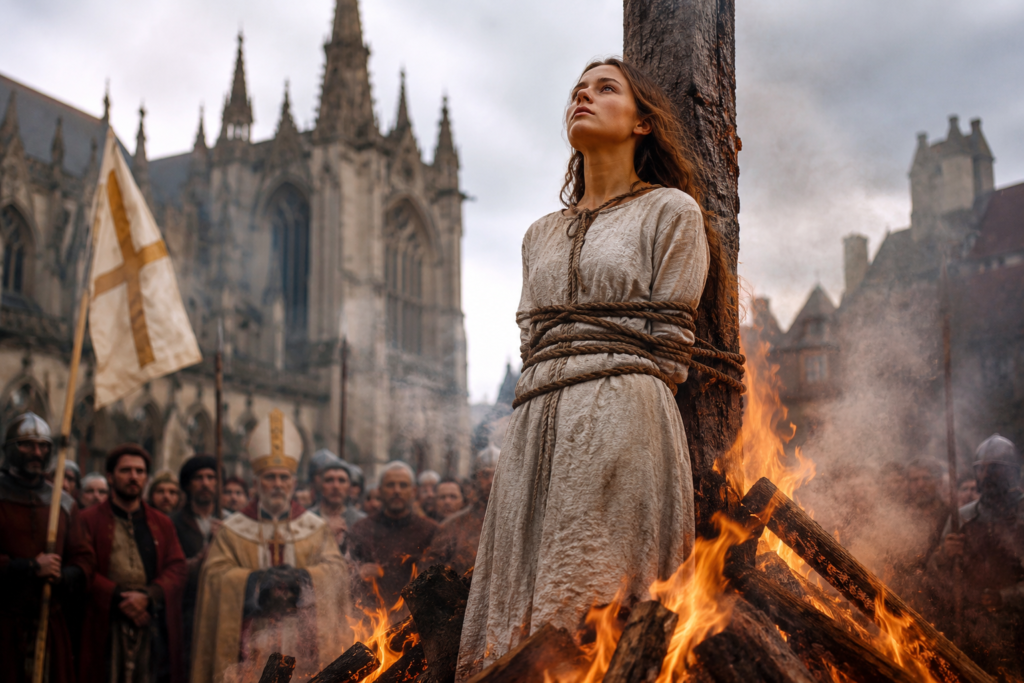
Image Credentials: Image Title: Today in History, May 30: Joan of Arc Burned at the Stake. Source: (chatgpt.com) Date: May 2026. Attribution: This image was created using AI-generated imagery (chatgpt.com) by Open Chronicle and does not depict a real-world scene.
By Open Chronicle
On May 30, 1431, Joan of Arc was executed by burning at the stake in Rouen, France, after being convicted of heresy and other charges by an ecclesiastical court aligned with English interests during the Hundred Years’ War. Her death marked one of the most dramatic and controversial episodes in medieval European history.
Born into a peasant family in northeastern France around 1412, Joan claimed from an early age to have received divine visions instructing her to support the French crown and help drive English forces from French territory. At a time when France faced military setbacks and political uncertainty, her message gained the attention of supporters of the future King Charles VII.
Despite having no formal military training, Joan became a symbol of resistance and determination. In 1429, she played a crucial role in lifting the English siege of the city of Orléans, a turning point that revitalized French morale and strengthened the position of Charles VII. Her successes contributed to the king’s coronation at Reims later that year, an event that reinforced the legitimacy of the French monarchy.
Joan’s military career, however, was brief. In 1430, she was captured by Burgundian forces allied with England and eventually handed over to English authorities. She was put on trial in Rouen, where church officials accused her of heresy, witchcraft, and wearing male military clothing, among other charges.
The trial has long been criticized by historians as politically motivated. Joan defended herself with remarkable confidence and intelligence despite her youth and lack of formal education. Nevertheless, she was found guilty and sentenced to death.
On the morning of May 30, 1431, Joan was taken to the marketplace in Rouen and burned at the stake. Witnesses reported that she repeatedly called upon the name of Jesus as the flames consumed her. She was believed to be only nineteen years old.
Twenty-five years later, a retrial ordered by Pope Callixtus III overturned the original verdict, declaring her innocent and recognizing that the earlier proceedings had been deeply flawed. Centuries afterward, Joan’s legacy continued to grow. In 1920, she was canonized as a saint by the Catholic Church.
Today, Joan of Arc remains one of France’s most celebrated historical figures, remembered as a symbol of faith, courage, patriotism, and resilience in the face of overwhelming adversity.