
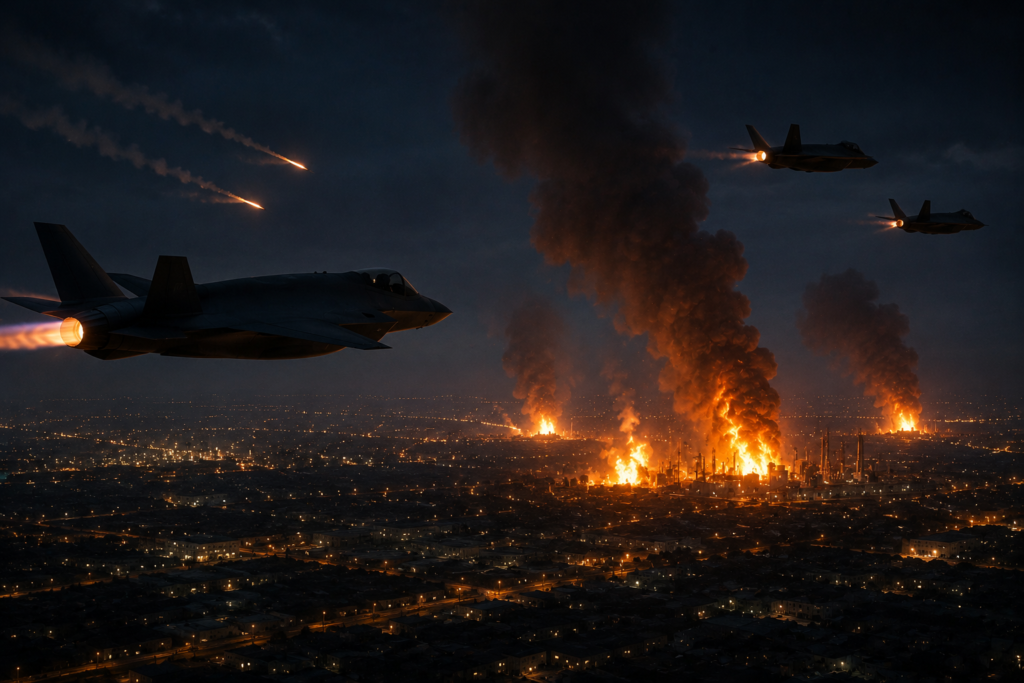
Image Credentials: Image Title: U.S. Launches New Strikes on Iran as Washington and Tehran Exchange Warnings. Source: (chatgpt.com) Date: June 2026. Attribution: This image was created using AI-generated imagery (chatgpt.com) by Open Chronicle and does not depict a real-world scene.
By Open Chronicle with agencies
The United States has launched a new wave of military strikes against targets inside Iran, marking a significant escalation in the rapidly deteriorating confrontation between Washington and Tehran. The attacks come just one day after the U.S. military carried out operations linked to the crash of an American Army helicopter near the Strait of Hormuz, an incident President Donald Trump has blamed on Iran.
In a statement posted on social media Wednesday evening, U.S. Central Command (CENTCOM) confirmed that American forces had begun striking “multiple targets in Iran” in response to what it described as “Iran’s unwarranted and continued aggression.”
The announcement follows several days of mounting tensions in the Gulf region, where both countries have exchanged accusations over attacks on military assets and maritime security.
Pentagon Signals Determination to Increase Pressure
Earlier on Wednesday, U.S. Defense Secretary Pete Hegseth indicated that military action was imminent, saying the United States was prepared to hit Iran “hard” if necessary.
Speaking to reporters, Hegseth argued that the strikes were not intended to reignite a broader conflict but to reinforce Washington’s negotiating position.
“Those strikes that will happen tonight will be strong; they will be clear,” Hegseth said. “If they have to happen tomorrow night, they will be strong and they will be clear.”
The defense secretary added that the objective was to establish conditions that would help secure the type of agreement the Trump administration is seeking from Tehran, particularly regarding Iran’s nuclear ambitions and regional military activities.
President Trump had earlier reiterated that any military response was linked to what he claims was the Iranian downing of a U.S. Army AH,64 Apache helicopter near the Strait of Hormuz. The aircraft crashed earlier this week, although official investigations into the precise cause of the incident remain ongoing.
Iran Rejects Pressure Tactics
At the United Nations, Iran strongly condemned the latest U.S. actions and warned that military threats would only undermine diplomatic efforts.
Addressing the U.N. Security Council, Iran’s ambassador, Amir Saeid Iravani, insisted that lasting negotiations cannot be achieved through force or intimidation.
“No sustainable deal can be reached through threats, intimidation, or the use of force,” Iravani said. “Iran has never negotiated under pressure and will never submit to coercion.”
The ambassador argued that Washington’s long-standing strategy of combining sanctions and military pressure with diplomacy had repeatedly failed and urged the United States to engage based on “mutual respect, sovereign equality, and full adherence to international law.”
Diplomatic Efforts Under Growing Strain
The latest exchange of strikes places renewed strain on already fragile efforts to reach a diplomatic agreement between the two countries. In recent weeks, the Trump administration has repeatedly stated that a negotiated settlement remains possible, while simultaneously warning that military action would follow if Iran failed to comply with U.S. demands.
The current crisis was intensified by the helicopter incident near the Strait of Hormuz, one of the world’s most strategically important waterways for global energy supplies. The waterway handles a substantial share of international oil and liquefied natural gas exports, making any military escalation in the region a matter of global concern.
While Washington insists its latest operations are defensive and aimed at restoring deterrence, Tehran argues that the strikes represent a violation of international law and could further destabilize the Middle East.
As of Wednesday night, neither side had indicated any willingness to back down, raising concerns among international observers that the confrontation could continue to escalate despite ongoing calls for diplomacy.