
Image: from GENERAL OF THE U.S. ARMY TOM S. GATES ★ X @GENTomSGates83
By Open Chronicle with agencies
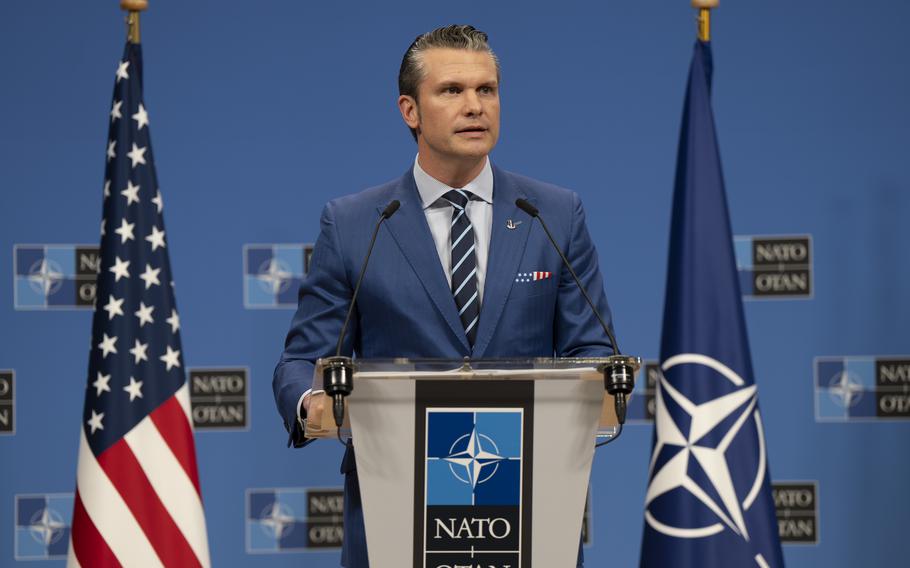
U.S. Defense Secretary Pete Hegseth delivered a blunt and controversial message to NATO allies on Thursday, announcing a six-month Pentagon review of American military deployments in Europe while demanding that European nations assume greater responsibility for their own defense.
Speaking at NATO headquarters in Brussels, Hegseth said the review would assess whether allied countries are moving quickly enough toward taking primary responsibility for European security, warning that some nations would meet expectations while others would fall short.
“This will be a real review,” Hegseth told defense ministers. “It will be designed to ensure that NATO is moving fast and irreversibly toward Europe leading and stepping up to take primary responsibility for the defense of Europe.”
The announcement adds another layer of uncertainty to transatlantic relations as European governments continue adapting to shifting signals from the administration of President Donald Trump regarding America’s future military role on the continent.
🇺🇸 US Defense Secretary Pete Hegseth sharply criticized NATO allies during a roundtable meeting with defense ministers in Brussels
🗣️ Hegseth said NATO had shifted from military strength toward 'distraction, deindustrialization, and demilitarization,' with the focus on 'gender… pic.twitter.com/u2j5luT6Lk
— Anadolu English (@anadoluagency) June 18, 2026
Growing Questions Over U.S. Commitment
For months, Washington has sent mixed messages about its long-term military posture in Europe. While some U.S. officials have emphasized continued cooperation with allies, others have suggested that American resources should increasingly be redirected toward the Indo-Pacific region to prepare for potential challenges involving China.
The Pentagon’s review is expected to evaluate troop deployments, military infrastructure, and the level of support European countries provide to U.S. forces stationed across the continent.
German Chancellor Friedrich Merz responded by acknowledging that Europe has long understood the possibility of an eventual reduction in American forces.
“We know that we must do more, and we are doing it,” Merz said.
Sharp Criticism of European Allies
Hegseth’s speech went beyond military planning and included criticism of several European policies.
He accused some NATO members of failing to grant American forces adequate access to military bases and airspace during operations against Iran, describing such restrictions as “shameful.”
“These allies put America’s sons and daughters at risk by denying predictable access, basing, and overflight that never should have been in question,” he said.
The Pentagon chief also criticized European migration policies, welfare systems, climate initiatives, and gender equality programs, arguing that many governments had neglected defense spending in favor of domestic political priorities.
His remarks echoed themes frequently raised by Vice President JD Vance and other senior figures in the Trump administration, who have argued that Europe has become overly dependent on American security guarantees.
Europe Increases Defense Spending
Many European officials reject the suggestion that the continent is failing to strengthen its defenses.
According to NATO Secretary General Mark Rutte, European allies and Canada increased defense spending by approximately $90 billion last year, representing a 20 percent rise compared with 2024.
Several NATO members are also expanding military recruitment, purchasing new equipment, and modernizing their armed forces in response to Russia’s ongoing war against Ukraine and growing security concerns across Europe.
Despite Hegseth’s criticism, NATO officials stressed that allied efforts to strengthen collective defense have accelerated significantly in recent years.
Ukraine and NATO Planning
Hegseth’s visit to Brussels was notable not only for its tone but also for its brevity. It marked his first NATO meeting of the year after skipping an earlier gathering, and he departed before Ukrainian President Volodymyr Zelenskyy addressed allies regarding additional military support.
The Pentagon’s review comes as NATO commanders work on contingency plans following Washington’s decision earlier this month to scale back certain military commitments that would traditionally support alliance operations during a crisis.
The United States has signaled that future planning must account for the possibility of simultaneous conflicts in different regions, particularly if tensions rise in the Indo-Pacific.
Nuclear Deterrence Remains Unchanged
While questions surround conventional troop levels, Washington indicated that one critical element of NATO’s security architecture will remain intact.
The United States does not intend to withdraw its nuclear weapons from Europe, which continue to form a central component of NATO’s deterrence strategy.
In a rare move, NATO’s Nuclear Planning Group issued its first public statement in nearly two decades following Thursday’s meeting. The group reaffirmed that the alliance’s nuclear forces remain the ultimate guarantee of collective security and pledged continued modernization of NATO’s nuclear capabilities.
Rutte sought to downplay concerns over potential troop reductions, arguing that planning models do not necessarily reflect how allies would respond during an actual conflict.
“If war breaks out, we will all maximize what we need to do to make sure we can fight the war,” he said.
A Turning Point for NATO?
Hegseth’s remarks highlight a broader transformation in the relationship between the United States and its European allies. Washington’s growing focus on burden sharing and strategic competition with China is forcing NATO members to rethink long-standing assumptions about American military leadership in Europe.
The outcome of the Pentagon review could have significant implications for troop deployments, defense planning, and the future balance of responsibilities within the alliance.
For European governments already increasing defense spending at record levels, the message from Washington was clear: future American commitments may increasingly depend on how quickly Europe demonstrates its ability to defend itself.