
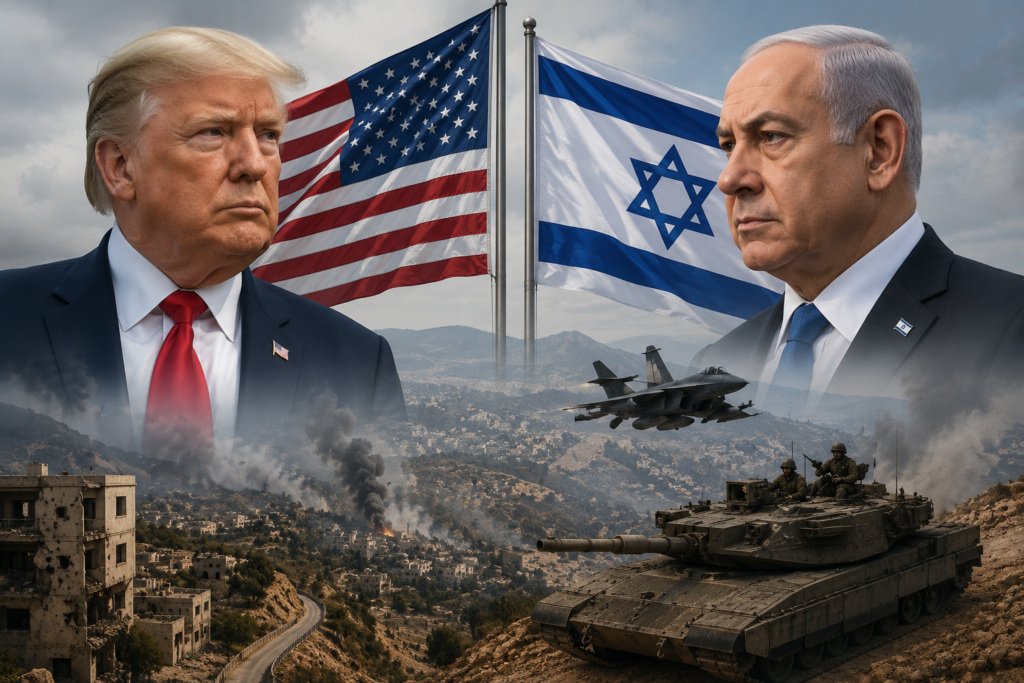
Image Credentials: Image Title: US Reportedly Ends Unrestricted Authorization for Israeli Operations in Lebanon. Source: (chatgpt.com) Date: June 2026. Attribution: This image was created using AI-generated imagery (chatgpt.com) by Open Chronicle and does not depict a real-world scene.
By Open Chronicle with agencies
The United States has reportedly informed Israel that a previous authorization allowing unrestricted military operations in Lebanon has expired, signaling a potential shift in Washington’s approach to regional security and diplomacy.
According to Israeli broadcaster Channel 13, citing a senior Israeli official, Washington recently conveyed a message stating that the authorization previously granted for broad Israeli military activity in Lebanon was no longer in effect.
The development comes amid ongoing efforts by the United States to manage multiple regional crises, including tensions surrounding Iran, the Strait of Hormuz, and broader stability across the Middle East.
New Restrictions on Military Operations
The report suggests that the administration of US President Donald Trump has introduced limitations on Israeli military actions, not only in Lebanon but also in other regional theaters.
The reported move appears to contrast with recent statements by Israeli Prime Minister Benjamin Netanyahu, who maintained that Israeli forces retained complete operational freedom in southern Lebanon.
According to Channel 13, Israel’s political leadership has already issued updated directives to the military defining where operations may and may not be conducted.
The report indicated that military activity is now restricted in several key areas, including the Lebanese capital, Beirut, and the southern district of Tyre.
Washington and Tel Aviv Differ on Lebanon Strategy
Israeli newspaper Maariv reported growing differences between Washington and Tel Aviv over how to handle the situation in Lebanon.
According to the newspaper, US officials view southern Lebanon within a broader strategic framework that includes maritime security in the Strait of Hormuz, global energy markets, ongoing discussions regarding Iran’s nuclear program, and efforts to secure wider diplomatic progress in the region.
Israeli officials, however, reportedly fear that a premature military withdrawal from southern Lebanon could be interpreted as a victory for Hezbollah and weaken Israel’s deterrence posture.
The differing assessments highlight the challenges facing both allies as they attempt to balance military objectives with diplomatic considerations.
Continuing Tensions in Southern Lebanon
Fighting between Israel and Hezbollah has left large parts of southern Lebanon devastated.
According to Lebanese authorities, Israel’s military campaign since March 2025 has resulted in more than 4,000 deaths, over 12,000 injuries, and the displacement of more than one million people.
Despite ceasefire efforts and ongoing diplomatic initiatives, Israeli forces continue to maintain positions in parts of southern Lebanon, including territories held for decades as well as areas captured during the 2023–2024 conflict.
Recent diplomatic discussions involving the United States, Qatar, Pakistan, Lebanon, and Iran have sought to establish mechanisms aimed at preventing renewed escalation and maintaining fragile ceasefire arrangements.
Regional Diplomacy Takes Center Stage
The reported US decision comes at a time when Washington is pursuing broader diplomatic initiatives across the Middle East.
Progress in US-Iran negotiations, concerns over maritime security in the Persian Gulf, and efforts to stabilize Lebanon have increasingly become interconnected elements of a wider regional strategy.
Analysts suggest that limiting military escalation in Lebanon could help create conditions more favorable for diplomatic breakthroughs elsewhere in the region.
Whether the reported restrictions will significantly alter Israel’s military posture in Lebanon remains uncertain, but the development underscores the growing importance of diplomacy as regional powers attempt to prevent further conflict across multiple fronts.
For now, attention will focus on how Israel responds to the reported American position and whether ongoing ceasefire mechanisms can prevent a return to large-scale hostilities in southern Lebanon.