
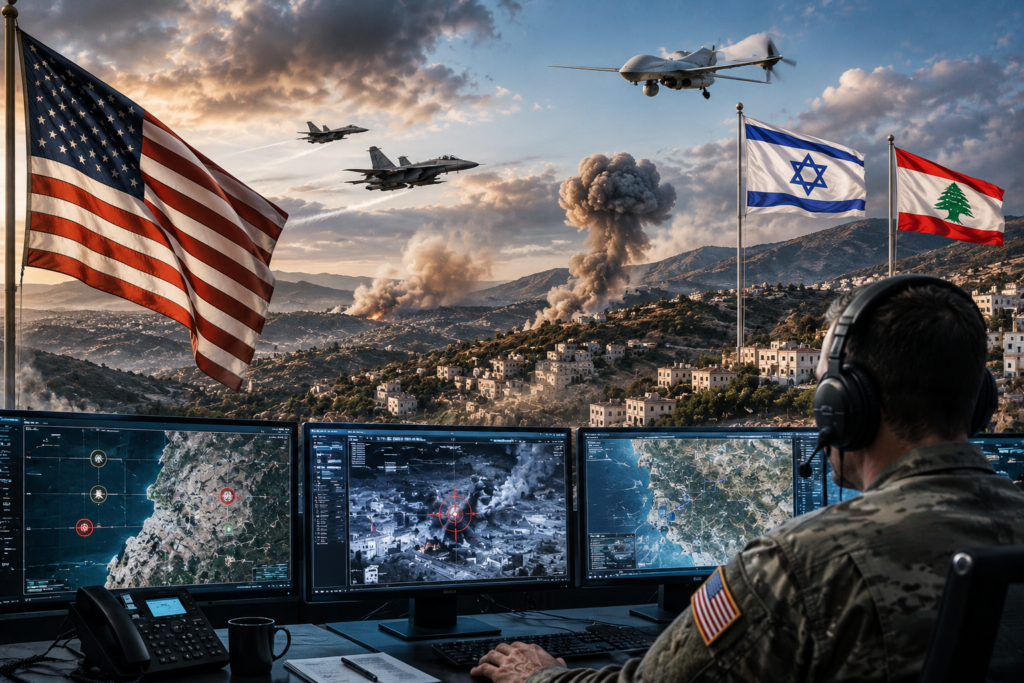
Image Credentials: Image Title: US Launches Real-Time Monitoring Mechanism to Track Fighting in Lebanon. Source: (chatgpt.com) Date: June 2026. Attribution: This image was created using AI-generated imagery (chatgpt.com) by Open Chronicle and does not depict a real-world scene.
By Open Chronicle with agencies
The United States has established a new monitoring mechanism through the US Central Command (CENTCOM) to track military activity between Israel and Hezbollah in Lebanon in real time, as diplomatic efforts intensify to preserve a fragile ceasefire and prevent renewed regional escalation.
According to a US official, the initiative is intended to provide policymakers in Washington with immediate and accurate information about developments on the ground while supporting broader negotiations aimed at securing long-term stability between Israel and Lebanon.
CENTCOM Monitoring System Activated
The monitoring mechanism was created following discussions held by US Secretary of State Marco Rubio with Israeli Prime Minister Benjamin Netanyahu and Lebanese President Joseph Aoun.
According to the US official, the conversations focused on strengthening the existing ceasefire framework and laying the groundwork for future negotiations.
“The US started a monitoring mechanism via CENTCOM so that our policymakers have real-time and accurate information about fighting in Lebanon,” the official said.
The official added that Washington’s objective remains the creation of conditions that would allow Israel and Lebanon to negotiate directly as sovereign states and pursue a durable peace and security arrangement.
Direct Talks Scheduled in Washington
The announcement comes ahead of a new round of direct talks between Israeli and Lebanese representatives scheduled to take place in Washington from June 23 to June 25.
The negotiations will be facilitated by the United States and are expected to focus on ceasefire implementation, border security, military de-escalation and broader regional stability.
US officials indicated that additional details regarding the monitoring mechanism will be released in the coming days.
Linked to Wider Regional Diplomacy
The new initiative emerges amid a broader diplomatic effort involving the United States, Iran, Qatar and Pakistan.
Following the conclusion of recent US-Iran negotiations in the Swiss resort of Bürgenstock, mediators Qatar and Pakistan announced the creation of a separate “de-confliction cell” involving the United States, Iran and Lebanon.
The mechanism is designed to support compliance with the cessation of military operations outlined in the Islamabad Memorandum of Understanding and reduce the risk of accidental escalation.
US-Iran Framework Influences Lebanon Talks
The Lebanon initiative is closely connected to the wider diplomatic process currently underway between Washington and Tehran.
Last week, the United States and Iran remotely signed a memorandum of understanding establishing a 60-day negotiation period aimed at resolving several major disputes, including Iran’s nuclear program, its enriched uranium stockpile, and broader regional security concerns.
The 14-point framework also calls for an immediate and permanent cessation of military operations across multiple fronts, including Lebanon, the removal of the US naval blockade on Iran, and guarantees for the safe passage of commercial shipping through the Strait of Hormuz.
Efforts to Prevent Renewed Conflict
The establishment of CENTCOM’s monitoring system reflects growing concern among international mediators that isolated incidents could rapidly reignite wider conflict in Lebanon.
Recent months have seen repeated exchanges of fire between Israeli forces and Hezbollah despite ceasefire arrangements and diplomatic initiatives.
By providing real-time battlefield assessments and improving communication among key actors, US officials hope the new mechanism can reduce misunderstandings and support efforts to maintain stability.
As negotiations continue in Washington and diplomatic engagement expands across the region, Lebanon remains a critical test of whether recent progress in US-Iran talks can translate into lasting security gains on the ground.
For now, the monitoring mechanism represents another step in an increasingly complex international effort to prevent the conflict from escalating into a broader regional confrontation.