
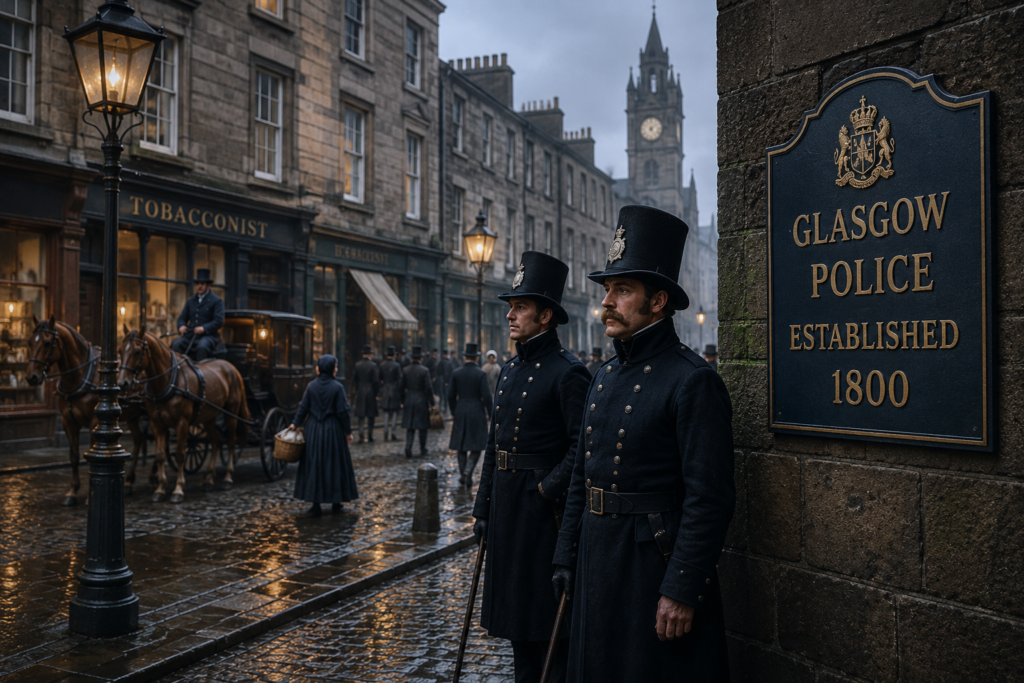
Image Credentials: Image Title: US Strikes Iran Again as Tit for Tat Attacks Dramatically Reignite Gulf Tensions. Source: (chatgpt.com) Date: June 2026. Attribution: This image was created using AI-generated imagery (chatgpt.com) by Open Chronicle and does not depict a real-world scene.
By Open Chronicle
June 30, 1800
On this day in 1800, the city of Glasgow established what is widely regarded as the world’s first modern municipal police force. Created under the Glasgow Police Act, the new organization introduced a professional, publicly funded approach to urban policing that would influence police services across Britain and, eventually, around the world.
At the turn of the nineteenth century, Glasgow was experiencing rapid growth as a result of the Industrial Revolution. Expanding trade, manufacturing, and population brought prosperity to the city but also increased concerns about crime, public disorder, and sanitation. Traditional methods of maintaining order, which relied on unpaid watchmen, local constables, and military assistance, were proving inadequate for a growing industrial centre.
To address these challenges, the Glasgow Police Act established a permanent body of salaried officers responsible for patrolling the streets, preventing crime, and maintaining public order. Unlike earlier systems, the force was organized under municipal authority, with clearly defined duties and regular supervision. Prevention, rather than simply responding to crime after it occurred, became a central principle of the new service.
The Glasgow Police also carried out responsibilities beyond law enforcement. Officers monitored street lighting, removed public nuisances, enforced local regulations, and helped improve urban cleanliness, reflecting the broader role of municipal authorities in the early nineteenth century.
Although London’s Metropolitan Police, founded by Sir Robert Peel in 1829, would become the model for modern policing in many countries, the Glasgow force demonstrated nearly three decades earlier that a professional civilian police service could operate successfully within a large city. Many historians therefore regard Glasgow as the birthplace of modern municipal policing.
The success of the Glasgow model encouraged other towns and cities throughout Britain to establish organized police forces. During the nineteenth century, these principles spread across Europe, North America, and the wider British Empire, shaping policing systems that remain influential today.
Modern police organizations have evolved considerably since 1800, adopting new technologies, investigative methods, and community policing strategies. Yet many of the core ideas introduced in Glasgow, including regular patrols, public accountability, professional training, and crime prevention, continue to form the foundation of law enforcement worldwide.