
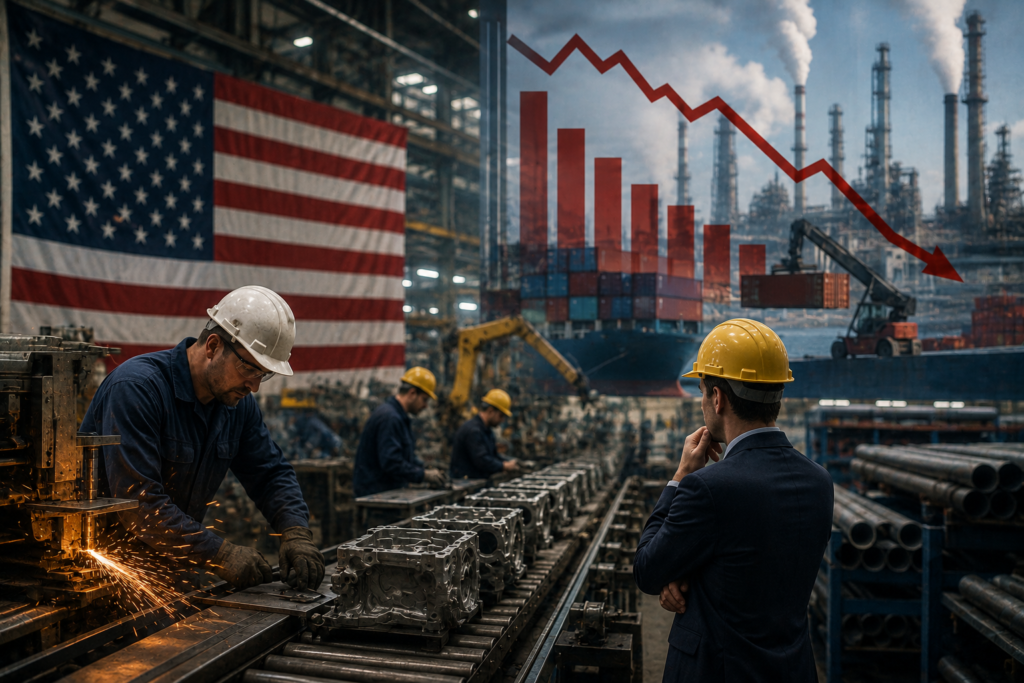
Image Credentials: Image Title: U.S. Manufacturing Jobs Decline Despite Trump’s Claims of an Industrial Renaissance. Source: (chatgpt.com) Date: July 2026. Attribution: This image was created using AI-generated imagery (chatgpt.com) by Open Chronicle and does not depict a real-world scene.
By Open Chronicle with Agencies
President Donald Trump continues to describe the United States as enjoying an unprecedented economic expansion, but federal data presents a more complicated picture for American manufacturing.
While the administration has promoted tariffs, deregulation and tax reductions as the foundation of a new industrial era, manufacturing employment and factory construction have weakened during Trump’s second term. The growing gap between political claims and economic indicators is raising questions about whether Washington’s trade strategy is producing the promised revival of domestic industry.
Manufacturing investment falls sharply
Construction spending in the American manufacturing sector fell by 26.4 percent between Trump’s inauguration and May 2026, reaching an annualized level of approximately $174.8 billion.
That was the lowest figure recorded since February 2023, when the economy was still moving through its post-pandemic recovery. The decline suggests that businesses have become more cautious about investing in new factories, expanding production lines, or committing capital to long-term industrial projects.
The White House has repeatedly highlighted corporate announcements involving large investment commitments. However, critics argue that announcements do not necessarily translate into new construction, production capacity, or employment.
Some highly publicized investment plans have included previously scheduled spending, established supplier relationships, or projects that were already underway before being presented as new manufacturing victories.
Factory employment remains below earlier levels
The Bureau of Labor Statistics recorded a decline of 2,000 manufacturing jobs in May, followed by an increase of 3,000 in June.
Despite the modest June improvement, manufacturing employment remained approximately 38,000 jobs below its level one year earlier. It was also around 75,000 jobs lower than in January 2025, when Trump returned to office.
The majority of those losses occurred after the administration introduced its wide-ranging tariff programme in April 2025. Since that announcement, the sector has lost an estimated 68,000 positions.
A White House spokesperson defended the administration’s record, arguing that tariffs, deregulation and tax cuts would support an eventual manufacturing recovery. Officials have also pointed to recent monthly employment gains as evidence that the sector may be stabilizing.
Tariffs create higher costs and uncertainty
Trump has long argued that tariffs protect American workers by discouraging imports and encouraging companies to manufacture more goods inside the United States.
However, manufacturers that depend on imported metals, components, machinery, and raw materials have faced higher production costs. Tariffs on steel, aluminium and Chinese products remain in force, even after the U.S. Supreme Court invalidated other parts of the administration’s trade programme.
Companies must also account for the possibility of sudden new tariffs or disputes with trading partners. That uncertainty makes it more difficult to calculate the future cost of a factory, determine where supply chains should be located, or estimate whether a long-term investment will remain profitable.
The administration has continued threatening individual countries with trade restrictions, further increasing concern among exporters and industrial companies.
Iran conflict increases shipping expenses
The conflict involving the United States and Iran has added another layer of pressure on American manufacturers.
Disruption in and around the Strait of Hormuz has affected supplies of oil and industrial materials, including aluminium and fertilizer. Wider concerns about maritime security have also increased insurance and transportation costs.
The price of shipping a standard 40-foot container from China to the American West Coast rose from approximately $1,700 before the conflict to around $6,687, according to an index maintained by logistics company Freightos.
Higher freight costs are particularly damaging for manufacturers that rely on complex international supply chains. Even products assembled in the United States often contain parts imported from Asia, Europe or Latin America.
The broader economy shows signs of slowing
Manufacturing weakness is occurring within a broader economic environment marked by slower growth and weak consumer confidence.
The U.S. economy expanded at an annualized rate of 2.1 percent during the first quarter of 2026. The Federal Reserve Bank of Atlanta estimated that growth may have slowed to around 1.3 percent in the second quarter.
Consumer confidence also fell to a record low in May before recovering slightly in June. Although wages have continued to rise, higher prices for gasoline, food and other essentials have reduced much of the benefit for households.
These conditions may reduce demand for manufactured products while making companies more reluctant to increase investment.
Corporate promises face scrutiny
The Trump administration has frequently pointed to announcements from major corporations as evidence that its industrial policies are working.
Apple, for example, announced a multi-year U.S. spending programme valued at hundreds of billions of dollars. However, some of the spending included longstanding relationships with domestic suppliers rather than entirely new production commitments.
The company’s agreement to purchase American-made components from established suppliers illustrates the challenge of distinguishing genuinely new investment from spending that businesses may have undertaken regardless of changes in government policy.
Analysts argue that actual construction spending and employment data provide a clearer measure of industrial expansion than public announcements made at political events.
America still needs an industrial strategy
The United States continues to face intense competition from China, which became the world’s largest exporter of manufactured goods more than a decade ago.
Large-scale infrastructure investment, extensive supply chains and lower production costs in several industries support China’s advantage. Reversing that position would require sustained investment in workforce training, transportation, energy, research, and advanced manufacturing.
Tariffs could form part of such a strategy when they are carefully designed to support critical industries. However, unpredictable trade restrictions can also weaken domestic producers by increasing the cost of imported materials and encouraging retaliation against American exports.
The central challenge is therefore not simply whether the United States should protect manufacturing, but whether it can develop a coherent and predictable policy capable of supporting investment over many years.
For now, the official figures indicate that the manufacturing renaissance repeatedly promised by the Trump administration has not yet appeared in either factory employment or construction spending.