
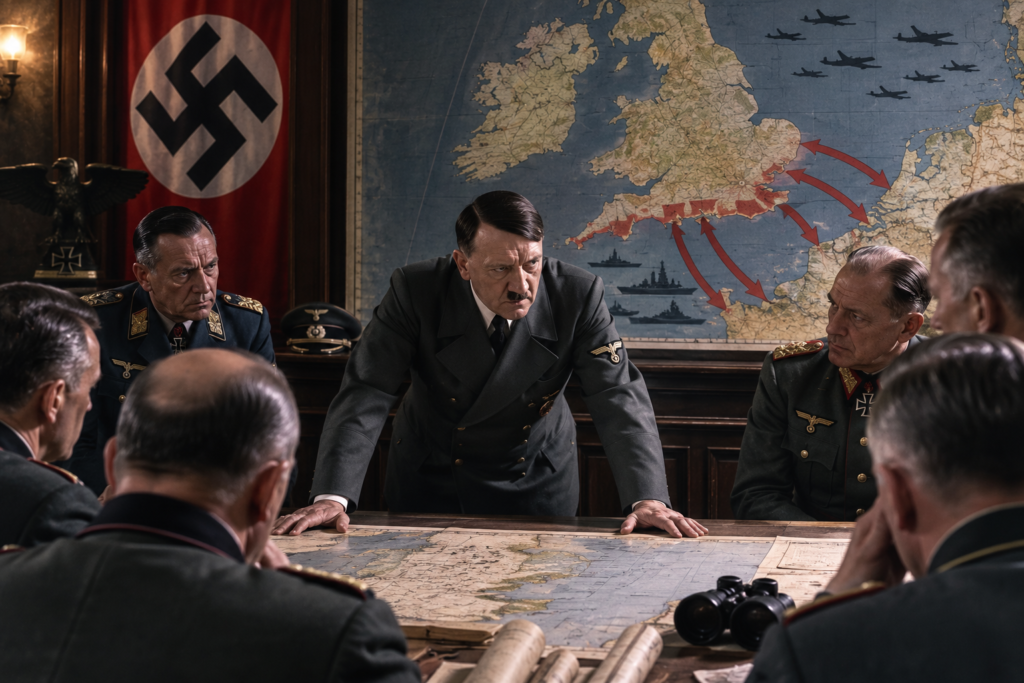
Image Credentials: Image Title: Today in History, July 15: Adolf Hitler Orders Preparations for the Invasion of Britain, Operation Sea Lion. Source: (chatgpt.com) Date: July 2026. Attribution: This image was created using AI-generated imagery (chatgpt.com) by Open Chronicle and does not depict a real-world scene.
By Open Chronicle
16 July 1940
On 16 July 1940, German leader Adolf Hitler issued Directive No. 16, ordering the German armed forces to begin preparations for Operation Sea Lion (Unternehmen Seelöwe), the planned invasion of Great Britain. Although the operation was never carried out, it represented one of the most ambitious military plans of the Second World War and marked a critical turning point in the conflict between Nazi Germany and the United Kingdom.
The directive came just weeks after Germany’s rapid victories across Western Europe. Following the invasion of France in May 1940, German forces defeated Allied armies with remarkable speed. France formally surrendered on 22 June, leaving Britain standing alone against Nazi Germany in Western Europe.
Confident after his military successes, Hitler hoped Britain might seek a negotiated peace. When Prime Minister Winston Churchill rejected any possibility of surrender or compromise, Germany began considering an amphibious invasion across the English Channel.
Directive No. 16 instructed the Wehrmacht to prepare for an assault on southern England. The objective was to land German forces along the British coastline, establish a secure bridgehead, and defeat British resistance before the country could recover or receive substantial assistance from overseas. The operation required close coordination between the German Army, Navy, and Luftwaffe, making it one of the most complex military operations ever planned.
Despite the confidence expressed in the directive, Operation Sea Lion faced enormous challenges from the outset. The German Navy had suffered significant losses during the campaign in Norway and lacked sufficient landing craft and escort vessels to transport and protect an invasion force across the Channel. Britain’s Royal Navy remained the strongest naval force in the world and posed a serious threat to any attempted crossing.
Recognising these difficulties, Hitler made one condition absolutely clear: the invasion could proceed only if the Luftwaffe first achieved complete air superiority over southern England. Destroying the Royal Air Force became an essential prerequisite for any landing.
This requirement led directly to the Battle of Britain, which began in the summer of 1940. German aircraft launched sustained attacks against British airfields, radar stations, and industrial targets in an effort to eliminate the RAF. However, Britain’s integrated air defence system, combined with the determination of RAF Fighter Command and the effectiveness of radar technology, prevented Germany from gaining control of the skies.
As the battle continued, German losses mounted while the Royal Air Force remained operational. By September 1940, it had become increasingly clear that air superiority could not be achieved. On 17 September, Hitler postponed Operation Sea Lion indefinitely, and although the plan technically remained in existence for some time, preparations gradually ceased as Germany shifted its strategic focus toward the Soviet Union.
Operation Sea Lion has remained one of history’s greatest “what if” scenarios. Military historians continue to debate whether Germany possessed the logistical capability to carry out a successful invasion even if air superiority had been obtained. Many conclude that the combined strength of the Royal Navy, Britain’s coastal defences, and the logistical challenges of crossing the English Channel would have made the operation extraordinarily difficult.
The cancellation of Operation Sea Lion proved to be one of the defining moments of the Second World War. Britain’s survival ensured that the country remained a base for Allied operations throughout the conflict, eventually serving as the launching point for the liberation of Western Europe through the Normandy landings in 1944.
Today, Hitler’s order of 16 July 1940 stands as a reminder of the immense strategic importance of the Battle of Britain. The failure of Operation Sea Lion prevented the invasion of the British Isles, preserved Britain’s role in the Allied war effort, and significantly influenced the course of twentieth-century history.