
Image Credentials: Image Title: China’s Arctic Intelligence Strategy: How Scientific Access, Satellite Infrastructure and Commercial Presence Are Reshaping the High North. Source: (chatgpt.com) Date: July 2026. Attribution: This image was created using AI-generated imagery (chatgpt.com) by Open Chronicle and does not depict a real-world scene.
By Open Chronicle News Desk with Agencies
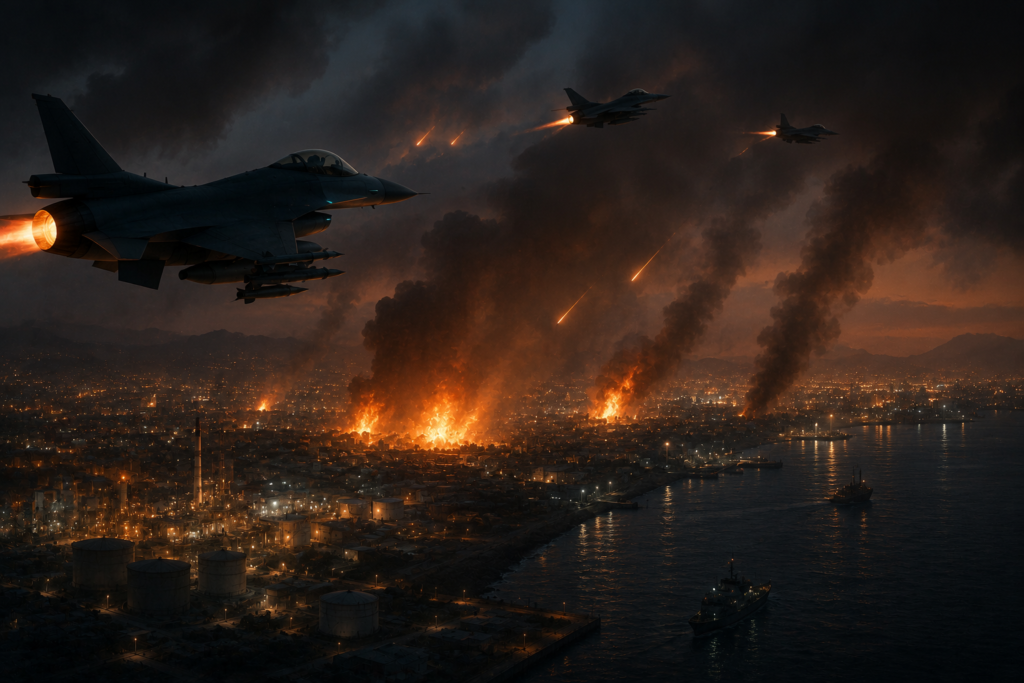
The United States has completed a sixth consecutive night of military strikes against Iran, as the confrontation between Washington and Tehran continues to intensify and concerns grow over the security of commercial shipping and the wider stability of the Middle East.
US Central Command, or CENTCOM, said on Thursday that American forces had carried out another wave of offensive operations targeting Iranian military assets. According to the command, the latest strikes focused on coastal surveillance installations, air defense sites, military logistics infrastructure, and maritime capabilities.
CENTCOM said the operations were conducted under the direction of the US commander in chief and were intended to further reduce Iran’s military capabilities. The command also linked the campaign to what Washington describes as recent Iranian attacks against commercial shipping, placing maritime security at the center of the US justification for the continuing strikes.
Military campaign enters sixth consecutive night
The continuation of American operations for a sixth night indicates that the campaign has developed into a sustained effort rather than a limited retaliatory action.
The targets identified by CENTCOM suggest that US military planners are seeking to weaken several interconnected elements of Iran’s defensive and offensive infrastructure. Strikes against coastal surveillance systems could reduce Tehran’s ability to track activity in strategically important waters, while attacks on air defenses may increase the freedom of operation available to American aircraft and drones.
Targeting logistics infrastructure, meanwhile, could disrupt Iran’s ability to move equipment and sustain military units. Operations against maritime capabilities appear particularly significant amid escalating tensions surrounding the Strait of Hormuz, one of the world’s most strategically important shipping corridors.
Separate reporting from Iranian media cited by Anadolu indicated that US attacks during the latest wave struck locations across southern and southeastern Iran. Reports included attacks on bridges and areas around Bandar Abbas, Bandar Khamir, Qeshm Island, Sirik, Bushehr, Ahvaz, and Iranshahr. Iranian reports said casualties and infrastructure damage had occurred, although claims from the different sides could not all be independently verified.
Strait of Hormuz remains at the center of confrontation
The military escalation is increasingly connected to the struggle for control and security around the Strait of Hormuz.
The narrow waterway linking the Persian Gulf with the Gulf of Oman is a critical route for global energy exports and international commercial shipping. Any prolonged military confrontation in or around the strait could therefore have consequences extending far beyond Iran and the United States.
CENTCOM’s emphasis on attacks against Iranian maritime capabilities and coastal surveillance infrastructure suggests that Washington is attempting to reduce Tehran’s ability to threaten or disrupt vessels operating in the region.
The growing military activity also raises the possibility of further retaliatory operations. Regional states hosting American military facilities face particular risks as the confrontation expands geographically.
Regional security fears deepen
The escalation is already affecting the broader Gulf region. Bahrain and Qatar issued security alerts early Friday, while Kuwait said its air defenses were responding to missile and drone attacks. The developments followed Iranian claims of retaliatory attacks against US military positions in the region.
The expanding exchange of strikes increases the risk that countries hosting American forces could become more directly involved in the confrontation, even if their governments seek to avoid becoming active participants.
For Washington, the continuing campaign appears designed to impose mounting military costs on Tehran while protecting shipping and American regional interests. For Iran, however, continued attacks on its territory could strengthen pressure for further retaliation against US forces and facilities across the Middle East.
With US operations now extending through six consecutive nights, the conflict is entering an increasingly dangerous phase. The immediate question is whether sustained military pressure can force a change in Iranian behavior or whether it will instead trigger a broader cycle of strikes and counterstrikes across the Gulf and the wider region.