
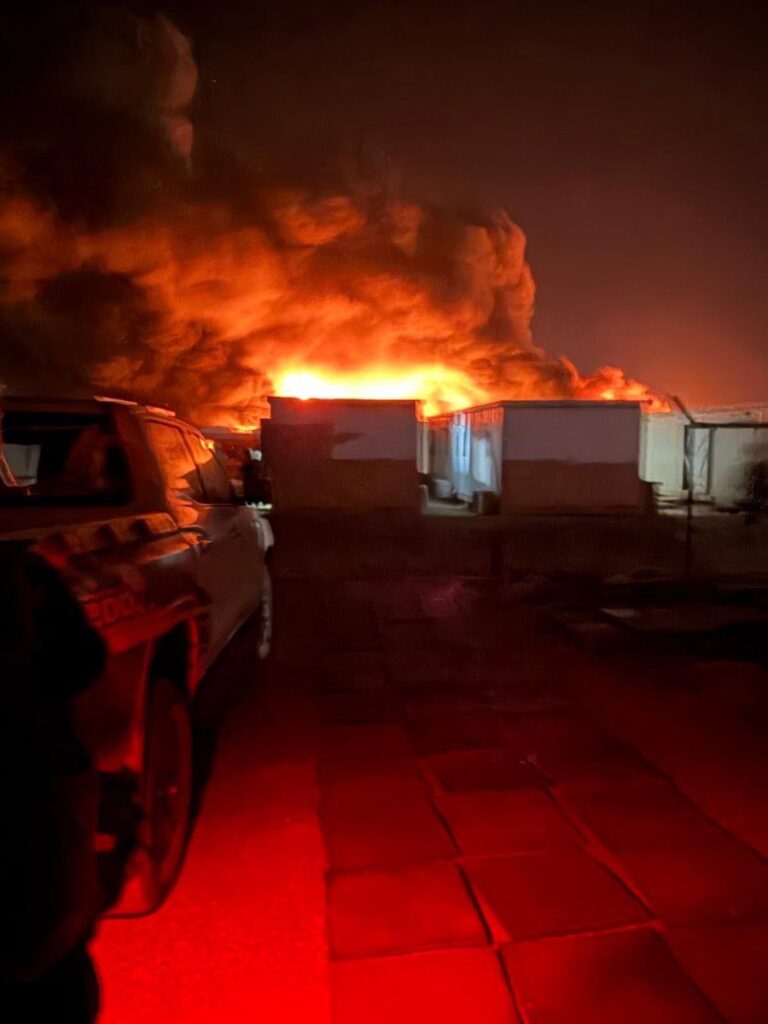
Image: from Global War Monitor X @GWarMonitor
By Open Chronicle News Desk with Agencies
Two American service members have been killed and a third remains missing following an Iranian attack on a United States military base in Jordan, marking the first US deaths from hostile fire since a truce with Iran took effect in early April.
The attack represents a significant escalation in the conflict and comes after a week of the heaviest fighting since hostilities began in February. The latest casualties are likely to intensify pressure on Washington to respond, with US President Donald Trump vowing to change the direction and scale of American military action.
First US deaths since April truce
The deaths are the first suffered by American forces from hostile fire since the early-April ceasefire temporarily reduced confrontation between the United States and Iran.
The truce had offered a brief period of relative calm, but recent exchanges have steadily eroded the agreement. Military installations, air defense systems, and strategic infrastructure have once again become targets across the region.
The attack in Jordan now raises concerns that the conflict may be entering a more dangerous phase, particularly as US forces remain deployed at several bases throughout the Middle East.
Third service member missing
US authorities confirmed that two service members were killed in the attack, while a third remains unaccounted for.
Search and recovery operations are continuing, although no further details have been released about the missing soldier or the exact condition of the base following the strike.
The incident is expected to prompt a detailed review of force protection measures at American military facilities in Jordan and neighboring countries.
Trump promises a change in strategy
President Trump said the deaths would lead to a shift in US military action, signaling that Washington may be preparing a stronger response.
Although the president did not immediately provide specific operational details, his remarks suggested that the administration is considering changes to the intensity, targets, or geographical scope of the campaign against Iran.
The deaths of American personnel are likely to increase domestic political pressure for retaliation, while also raising fears of a broader regional war.
Eighth consecutive night of US strikes
Saturday marked the eighth consecutive night of American strikes on Iran.
Iranian media reported explosions in several coastal cities, indicating that the US campaign has continued to reach multiple areas of the country.
The sustained strikes suggest that Washington is attempting to weaken Iran’s military capabilities, disrupt its command structure and reduce its ability to launch further attacks against US bases and allied states.
However, the continued Iranian response demonstrates that Tehran retains the capacity to conduct attacks beyond its own borders.
Military and civilian infrastructure targeted
The latest escalation follows several days of attacks on both military installations and civilian infrastructure across the Middle East.
Power facilities, transport networks, military bases, and strategic sites have reportedly been affected, increasing the humanitarian and economic consequences of the conflict.
The growing range of targets has raised concern among regional governments that the confrontation is becoming harder to contain.
Jordan, which hosts American military personnel and has attempted to maintain a careful diplomatic balance, now finds itself directly affected by the fighting.
Jordan is drawn deeper into conflict
The attack on a US base places Jordan in an increasingly difficult security position.
The country is a close partner of Washington and plays an important role in regional military and intelligence cooperation. At the same time, Jordan has sought to avoid becoming a central battlefield in the confrontation between the United States and Iran.
The deaths of American soldiers on Jordanian territory could lead to greater US military activity in the country and increased security around strategic facilities.
It may also heighten concerns among Jordanian officials about possible further Iranian attacks.
Risk of wider regional escalation
The combination of American casualties, continued US strikes, and Iranian attacks across the region has significantly increased the risk of a wider conflict.
A major US retaliation could trigger further Iranian strikes against American bases, allied governments or commercial infrastructure.
Such escalation could also affect shipping routes, energy markets, and civilian populations throughout the Middle East.
Diplomatic efforts to restore the April truce now appear increasingly difficult, with both sides accusing the other of violating the agreement and expanding military operations.
A dangerous turning point
The deaths of the two US service members may become a turning point in the conflict.
For Washington, the attack presents both a military and political challenge. The administration must decide how to respond forcefully without triggering an uncontrolled regional war.
For Iran, the strike demonstrates its willingness and ability to target American forces despite sustained US attacks.
With a third American soldier still missing and military exchanges continuing, the situation remains highly unstable. The next steps taken by Washington and Tehran may determine whether the conflict remains limited or expands into a much broader confrontation.