
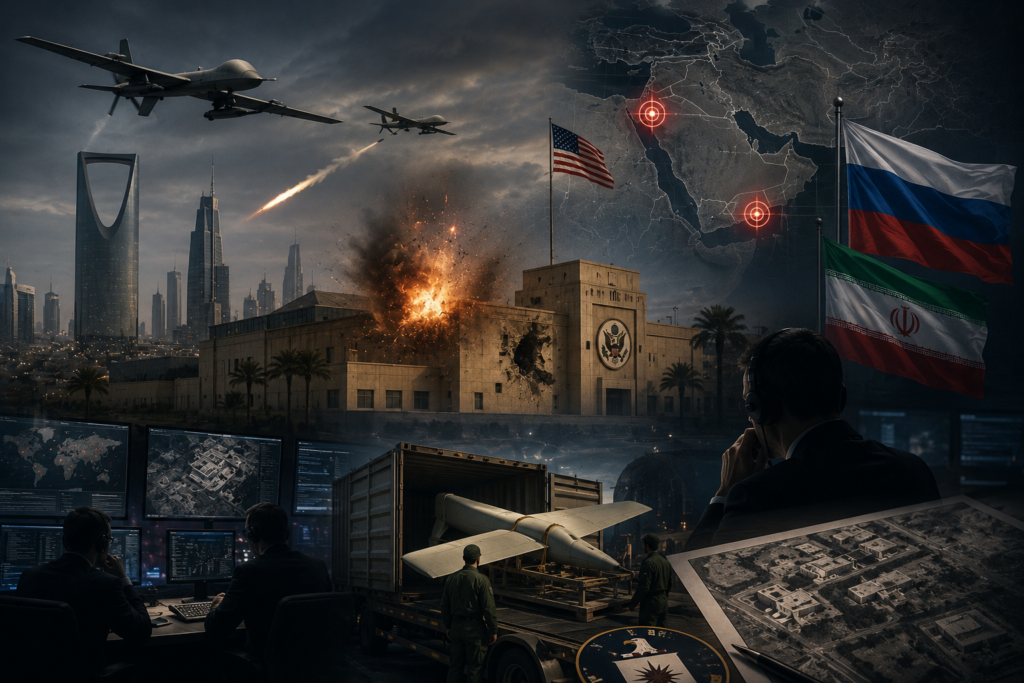
Image Credentials: Image Title: U.S. Intelligence Examines Possible Russian Role in Iranian Strikes on CIA Facilities. Source: (chatgpt.com) Date: July 2026. Attribution: This image was created using AI-generated imagery (chatgpt.com) by Open Chronicle and does not depict a real-world scene.
By Open Chronicle News Desk with Agencies
U.S. intelligence agencies are investigating whether Russia assisted Iran in carrying out a series of drone attacks against CIA facilities in the Middle East, amid growing concerns that Moscow may have provided advanced targeting data or technological support for the operations.
According to multiple officials familiar with classified assessments, American analysts have not reached definitive conclusions regarding Russia’s involvement. However, the sophistication and precision of the strikes have prompted an extensive intelligence review into the possibility that Moscow played a direct or indirect role.
The investigation reflects mounting concerns over the increasingly close military partnership between Russia and Iran as tensions between Tehran and Washington continue to escalate.
Precision attacks raise questions
The inquiry was launched after several Iranian drone attacks successfully struck facilities linked to the Central Intelligence Agency across the Gulf region.
Among the sites reportedly targeted were the CIA station located within the U.S. Embassy in Riyadh, Saudi Arabia, and another intelligence facility in eastern Iraq.
Officials familiar with the investigation said additional CIA-related locations may also have been hit, although the precise number and locations remain classified.
One source described the total as “more than one and fewer than a dozen” facilities.
The attacks caused significant concern within the U.S. intelligence community because of their apparent accuracy against some of America’s most sensitive overseas installations.
Intelligence points to possible Russian assistance
According to officials familiar with the investigation, analysts are examining whether Iran received Russian intelligence or technical assistance before launching the attacks.
One internal assessment produced by a Western intelligence agency reportedly concluded that Russia likely played a role in identifying regional CIA facilities.
The document’s exact authorship has not been publicly disclosed.
Several intelligence officials cautioned that the evidence remains circumstantial and that investigators have not yet established direct proof linking Moscow to the operations.
Nevertheless, the effectiveness of the attacks has intensified scrutiny of Russia’s expanding defence cooperation with Tehran.
Russian-enhanced Shahed drones
Two Western officials briefed on intelligence findings believe the strike on the U.S. Embassy compound in Riyadh involved upgraded versions of Iran’s Shahed drones that had been enhanced with Russian technology.
According to their assessment, the operation unfolded in two stages.
The first drone reportedly created an opening in a vulnerable section of the embassy’s exterior wall.
A second drone then flew through the breach before detonating inside the compound.
Although the attack caused damage, officials said no deaths or injuries were reported.
Analysts described the operation as unusually sophisticated, suggesting a level of planning and technical capability beyond previous Iranian drone attacks.
Improved navigation systems
Intelligence officials are also examining reports that Russia supplied Iran with the Kometa-M satellite navigation system, significantly improving the accuracy of Iranian drones.
The navigation package is believed to offer greater precision while being more resistant to electronic jamming than earlier Iranian guidance systems.
Reports that Moscow transferred the technology to Tehran first emerged earlier this year.
The Kremlin denied those reports, dismissing them as false.
If confirmed, analysts believe the technology would substantially improve the effectiveness of Iran’s long-range unmanned aerial systems.
Targeting intelligence under investigation
Another central question for U.S. investigators is whether Russia may have provided precise targeting information for the attacks.
Officials cautioned that alternative explanations remain possible.
Some analysts believe Iranian forces may have intended to strike the broader U.S. Embassy compound in Riyadh rather than specifically targeting the CIA station located inside.
However, other intelligence experts argue that successfully identifying highly classified CIA facilities would likely require access to advanced intelligence capabilities possessed by only a handful of countries.
That possibility has reinforced concerns regarding Moscow’s potential role.
Expanding Russia-Iran partnership
Russia and Iran have steadily expanded military cooperation since the outbreak of the war in Ukraine.
Tehran has supplied Moscow with thousands of attack drones, while Russia has reportedly assisted Iran with missile technology, satellite capabilities and military training.
Should investigators conclude that Russia directly supported attacks against CIA facilities, it would represent a significant escalation in cooperation between the two countries against U.S. interests.
Officials also note that concerns intensified after recent Iranian missile attacks on a U.S. military base in Jordan, where ballistic missiles struck army barracks, killing two American soldiers.
Sensitive intelligence sites
CIA facilities overseas include official CIA stations located within U.S. embassies, as well as a broader network of safe houses, logistics centres, surveillance facilities and operational bases.
The locations of many of these installations remain among the most closely guarded secrets within the U.S. intelligence community.
Because of their sensitive nature, officials declined to identify the specific facilities affected by the recent attacks.
Analysts urge caution
Despite growing suspicions, intelligence officials emphasise that the investigation remains ongoing.
No public evidence has yet conclusively demonstrated that Russia provided targeting intelligence or operational support specifically for the attacks on CIA facilities.
Daniel Hoffman, a former CIA station chief, said such cooperation would nonetheless be consistent with the strategic interests shared by Moscow and Tehran.
“They share an interest in trying to reduce or eliminate U.S. influence altogether in their self-designated spheres of influence,” Hoffman said.
As investigators continue reviewing intelligence, the findings could have significant implications for U.S. policy toward both Russia and Iran, potentially influencing future sanctions, intelligence operations and broader security cooperation among Washington’s allies in the Middle East.