
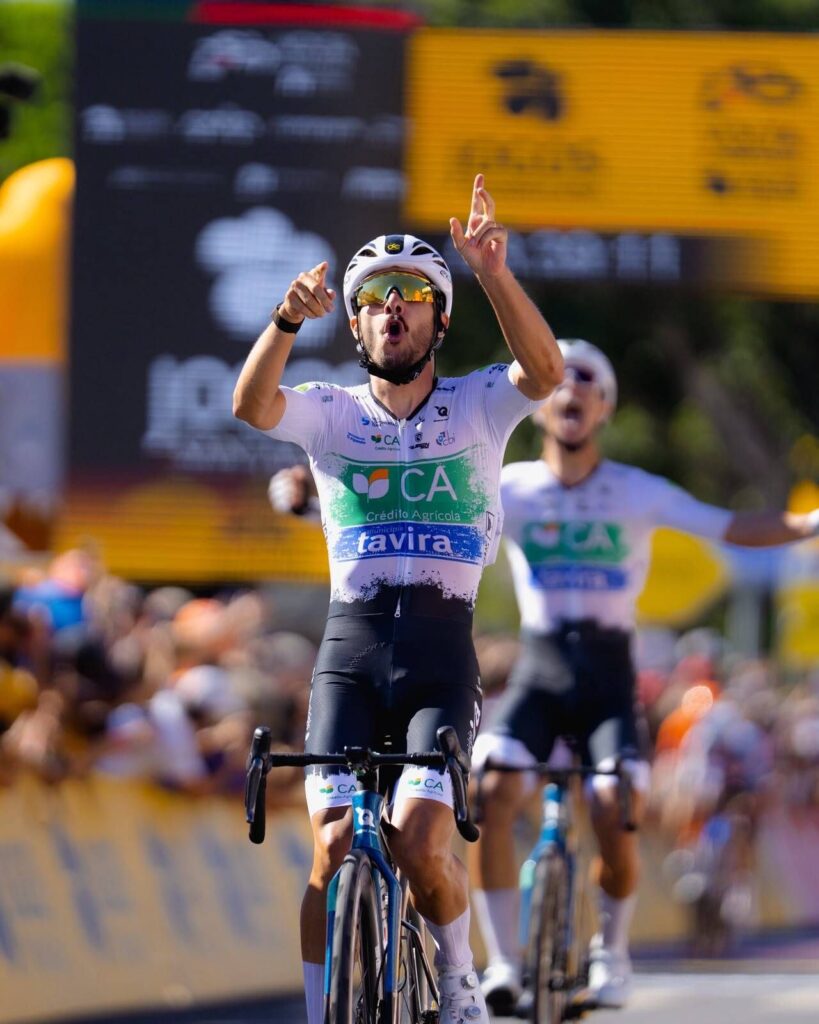
Image: from Volta a Portugal X @VoltaPortugal
By Open Chronicle with agencies
Portuguese cycling enjoyed a memorable afternoon at the 2026 Volta a Portugal, as Francisco Campos claimed the first professional victory of his career in Queluz and Rui Oliveira took control of the general classification after a remarkably selective opening road stage.
Campos, representing Team Tavira Crédito Agrícola, emerged from a three-rider move in the closing kilometres and defeated Spaniard Daniel Cavia of Burgos Burpellet BH in a tight sprint. Campos’ teammate Carlos Salgueiro completed a superb day for Tavira by finishing third after playing a decisive role in setting up the victory.
Only a short distance behind them, Oliveira crossed the line fourth for UAE Team Emirates XRG.
He did not get the stage victory he had been pursuing, but his performance delivered an even bigger prize: the Portuguese Olympic track champion became the new leader of the Volta a Portugal.
After two days of racing, the Grandíssima has a Portuguese rider in yellow.
ISTO ACABOU MESMO DE ACONTECER 🤩
Campos ganha a 1.ª etapa da Volta a Portugal 2026 🥇https://t.co/fdkj9iISOa | Desde 1979 a fazer história#ciclismodetavira #Tavira #Algarve #creditoagricola #portugal pic.twitter.com/EFbVqw0mFN— Clube de Ciclismo de Tavira (@TeamTaviraCA) August 6, 2026
Francisco Campos finally gets his victory
For Campos, the victory carried particular significance.
The 28-year-old from Penafiel had entered his fourth consecutive Volta a Portugal still searching for his first professional win. His previous best result at the race had been third place on Stage 8 in 2025.
His best result earlier in the 2026 season had also been third, at the Clássica de Viana do Castelo.
That long wait ended in Queluz.
The opening road stage took the peloton from Lourinhã to Queluz, covering 157.1 kilometres through terrain that became increasingly difficult as the race approached Sintra.
Strong northerly winds combined with the climbs around Sintra and an aggressive final phase to transform what could have been a relatively controlled opening stage into a highly selective race.
By the closing kilometres, the main peloton had been dramatically reduced.
Then came the decisive move.
Campos and Salgueiro found themselves at the front alongside Cavia, with a small but crucial advantage over the disorganised chasing group.
Tavira suddenly had a two-against-one tactical advantage.
Salgueiro sacrifices his chance for Campos
Carlos Salgueiro played the finale perfectly.
Rather than contesting the victory himself, he committed to Campos, driving the group toward the finish before launching his teammate for the sprint.
Cavia tried to respond, but the numerical advantage proved decisive.
Campos accelerated toward the line and narrowly defeated the Spaniard, while Salgueiro held on for third.
It was an important victory not only for Campos but also for Team Tavira Crédito Agrícola, one of Portugal’s historic cycling structures.
The team left Queluz with a stage victory, two riders on the podium and Salgueiro elevated into third place in the overall classification.
Rui Oliveira turns disappointment into yellow
Behind the leading trio, another major story was developing.
Rui Oliveira had begun the stage just four seconds behind his UAE Team Emirates XRG teammate Julius Johansen, who had won Wednesday’s 6.5 kilometre prologue in Lisbon.
UAE spent considerable energy controlling the day’s early breakaway and defending Johansen’s yellow jersey.
But the difficult finale changed the hierarchy within the team.
Johansen was unable to remain with the leading riders during the decisive section around São Pedro de Sintra, approximately 20 kilometres from the finish.
Oliveira survived.
With most of the pure sprinters also distanced, the Portuguese rider found himself at the front of the reduced chasing group.
He finished fourth and secured enough time to take the yellow jersey.
It was another impressive performance from Oliveira after his near miss in Lisbon, where he had occupied the provisional lead for more than an hour before Johansen beat his time late in the prologue.
Once again, the elusive first professional road victory escaped him.
This time, however, Oliveira left with the race lead.
Rafael Reis is only three seconds behind
Oliveira’s advantage is anything but comfortable.
After the first road stage, Rafael Reis of Anicolor Campicarn sits second overall, only three seconds behind the new leader.
Salgueiro’s excellent performance propelled him into third place at nine seconds.
That means the opening two days have already produced a tightly packed general classification, with bonus seconds and small splits potentially becoming significant as the race heads south.
For Oliveira, wearing yellow will therefore bring immediate responsibility.
UAE Team Emirates XRG arrived at the Volta with one of the strongest squads in the race. After controlling the opening two days, the team must now defend its lead against Anicolor Campicarn and a collection of Portuguese and international challengers.
General Classification after Stage 1
| Pos. | Rider | Team | Gap |
|---|---|---|---|
| 1 | Rui Oliveira | UAE Team Emirates XRG | Leader |
| 2 | Rafael Reis | Anicolor Campicarn | +3 sec |
| 3 | Carlos Salgueiro | Team Tavira Crédito Agrícola | +9 sec |
The most important development is the small margin separating Oliveira and Reis. Only three seconds divide the yellow jersey from second place, leaving the race wide open ahead of the longer stages.
Campos takes control of the points classification
Campos’ victory also gave him the leadership of the points classification.
The Portuguese rider will therefore wear the orange jersey after collecting the maximum reward from the Queluz finish.
It adds another dimension to a breakthrough day for Campos.
He arrived at the finish still waiting for his first professional victory. He left with a Volta a Portugal stage win and the lead in one of the race’s principal classifications.
Points Classification
Leader: Francisco Campos, Team Tavira Crédito Agrícola
The orange jersey now belongs to the Stage 1 winner.
Oscar Rotta takes the mountains jersey
The day’s climbing also led to a change in the mountains classification.
Oscar Rotta, riding for Feira dos Sofás Boavista, collected enough points during the stage to become the new leader of the competition.
He will wear the blue jersey on Stage 2.
Mountains Classification
Leader: Oscar Rotta, Feira dos Sofás Boavista
With considerably more difficult terrain still to come, the mountains competition remains in its earliest phase and is likely to change substantially once the Volta reaches its major climbs.
Adrià Pericas becomes best young rider
UAE Team Emirates XRG lost Johansen’s overall lead but retained control of another important classification.
Spanish prospect Adrià Pericas became the new leader of the young rider competition.
Pericas finished the stage in 36th position but accumulated enough overall advantage to take possession of the white jersey.
Young Rider Classification
Leader: Adrià Pericas, UAE Team Emirates XRG
The result gives UAE both the yellow and white jerseys heading into Stage 2.
Anicolor takes over the team classification
There was also an important change in the team competition.
Anicolor Campicarn moved into first place, replacing UAE Team Emirates XRG at the top.
The Portuguese squad now holds a 14-second advantage over Euskaltel Euskadi, which sits second.
Team Classification
| Pos. | Team | Gap |
| 1 | Anicolor Campicarn | Leader |
| 2 | Euskaltel Euskadi | +14 sec |
Anicolor’s strength is particularly significant because the team also has Rafael Reis only three seconds behind Oliveira in the individual classification.
That combination gives the Portuguese squad several tactical options as the race develops.
Classification leaders after Stage 1
| Classification | Leader | Team |
| General, Yellow Jersey | Rui Oliveira | UAE Team Emirates XRG |
| Points, Orange Jersey | Francisco Campos | Team Tavira Crédito Agrícola |
| Mountains, Blue Jersey | Oscar Rotta | Feira dos Sofás Boavista |
| Young Rider, White Jersey | Adrià Pericas | UAE Team Emirates XRG |
| Teams | Anicolor Campicarn | Portugal |
After only the prologue and one road stage, five different competitive stories are already developing across the Volta.
Johansen’s yellow jersey disappears in Sintra
One of the most significant consequences of the stage was the fall of prologue winner Julius Johansen.
The Danish rider had produced a superb performance in Lisbon, completing the opening 6.5 kilometre test in 7:12 and beating Oliveira by four seconds.
But the yellow jersey was put under considerable pressure as the first road stage became increasingly selective.
The Sintra sector ultimately proved decisive.
Once Johansen lost contact with the front group, UAE’s tactical priority effectively shifted toward Oliveira, who was still positioned among the leading riders.
It was a reminder that the Volta can begin reshaping its classification long before the famous mountain finishes arrive.
The GC contenders begin positioning themselves
The opening stage did not decide the Volta, but it offered the first meaningful indications about the riders capable of surviving difficult and unpredictable racing.
Defending champion Artem Nych remains one of the central figures in the battle for overall victory, while Anicolor’s strength gives the Portuguese team considerable influence over the race’s tactical direction.
The margins remain small enough that no serious overall contender can yet be discounted.
What has changed is the structure of the race.
UAE now has the responsibility of defending yellow, while Anicolor has both the team classification and a rider sitting only three seconds from the overall lead.
That could become an important tactical confrontation over the coming stages.
Stage 2: Sines to Albufeira
The peloton now turns south for Stage 2, a 180.4 kilometre journey between Sines and Albufeira.
On paper, the route is significantly less demanding than the roads around Sintra.
There are no major climbs expected to transform the general classification, making a bunch sprint one of the most likely outcomes.
But the stage contains another danger: wind.
The route remains exposed for long sections along the southwest Alentejo and Algarve corridors. Strong coastal winds could produce echelons and rapidly turn what appears to be a straightforward stage into another tactical battle.
The approach to Albufeira should also be fast and aggressive.
After seeing the expected sprinters eliminated before Queluz, the sprint teams are unlikely to make the same mistake twice.
For Oliveira, the equation is different.
He now has a yellow jersey to protect, a three second advantage over Rafael Reis and one of the strongest teams in the race surrounding him.
And after finishing second in Lisbon and fourth in Queluz, another question follows the Portuguese rider toward the Algarve.
Can Rui Oliveira finally secure that elusive first professional road victory while wearing the leader’s jersey?
The answer may come sooner rather than later.
For now, however, Stage 1 belongs to Francisco Campos.
Four consecutive Volta appearances, years of waiting and several near misses culminated in one perfectly executed sprint in Queluz.
At 28 years old, Francisco Campos is finally a professional winner.
And Rui Oliveira is the new leader of the Volta a Portugal 2026.