
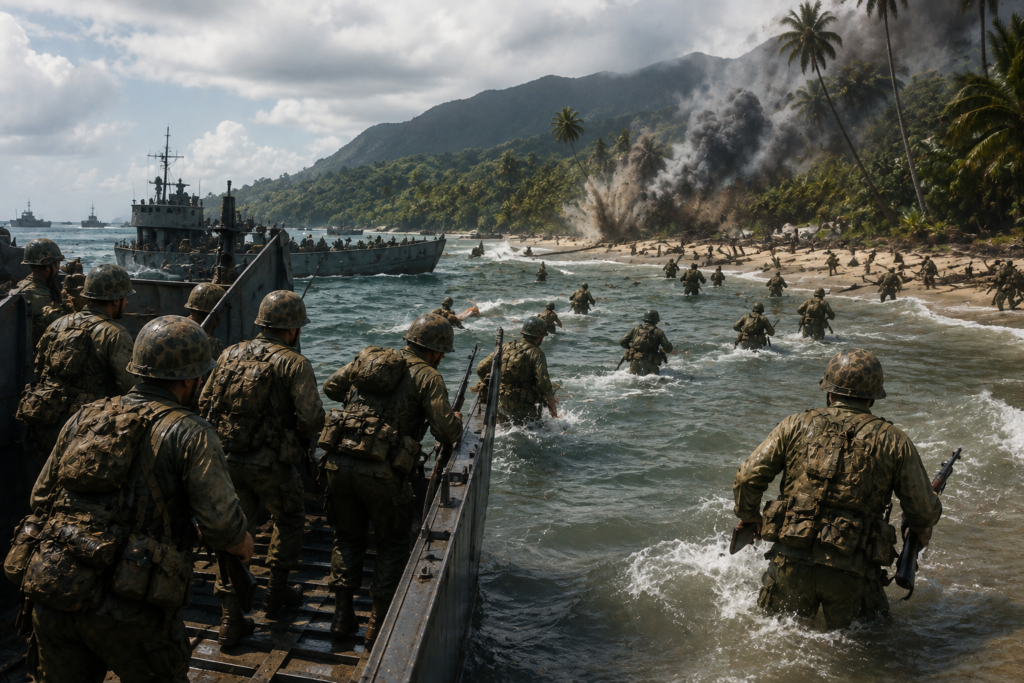
Image Credits: 1942 United States Marines Land on Guadalcanal, Beginning a Major Allied Offensive in the Pacific. AI-generated illustration created by Open Chronicle using ChatGPT (OpenAI). August 2026. This image is illustrative and does not depict a real-world scene.
By Open Chronicle
7 August 1942
On 7 August 1942, United States Marines landed on Guadalcanal and nearby islands in the Solomon Islands, launching the first major Allied offensive against Imperial Japan during the Second World War. The landings began the Guadalcanal Campaign, a brutal six-month struggle fought across jungle, sea and sky that became a decisive turning point in the Pacific War.
Only eight months had passed since the Japanese attack on Pearl Harbor brought the United States directly into the conflict. During the first half of 1942, Japanese forces had expanded rapidly across Southeast Asia and the western Pacific, capturing the Philippines, Malaya, Singapore, the Dutch East Indies and numerous strategically important islands.
The momentum began to change after the Battle of the Coral Sea in May and the decisive American victory at the Battle of Midway in June 1942, where Japan lost four fleet aircraft carriers. Allied commanders now had an opportunity to move from defensive operations toward a sustained offensive.
Their attention turned to the Solomon Islands.
The Strategic Importance of Guadalcanal
Guadalcanal lies in the southern Solomon Islands, northeast of Australia. In the summer of 1942, Japanese forces began constructing an airfield on the island at Lunga Point.
The development alarmed Allied commanders.
Once operational, the airfield could potentially support Japanese aircraft threatening the maritime routes connecting the United States with Australia and New Zealand. It could also strengthen Japan’s defensive perimeter and provide a base for further operations in the South Pacific.
The Allies therefore decided to seize Guadalcanal before construction could be completed.
The operation, codenamed Operation Watchtower, would become the first major American amphibious offensive of the war.
The Marines Go Ashore
At dawn on 7 August 1942, an Allied naval force approached the Solomon Islands carrying approximately 16,000 troops, most belonging to the 1st Marine Division under Major General Alexander Vandegrift.
American aircraft and warships bombarded Japanese positions before landing craft began carrying Marines toward the beaches.
The initial landings took place on Guadalcanal, Tulagi and several nearby islands.
On Guadalcanal itself, the Marines encountered surprisingly limited resistance. The Japanese construction personnel working around the unfinished airfield withdrew into the jungle, allowing American forces to establish a beachhead rapidly.
By the following day, the Marines had captured the airfield.
They renamed it Henderson Field in honour of Major Lofton Henderson, a Marine aviator killed during the Battle of Midway.
Possession of the airfield would become the central objective of the entire campaign.
Japan Responds
Japanese commanders initially underestimated the scale of the Allied operation. Once they understood that a substantial American force had landed on Guadalcanal, they began sending troops to retake the island.
The resulting campaign became a prolonged struggle for control of Henderson Field.
Japanese infantry repeatedly attempted to break through the American defensive perimeter. Battles at the Tenaru River, Edson’s Ridge, the Matanikau River and Henderson Field produced fierce close-range combat under extraordinarily difficult conditions.
The tropical environment created additional dangers. Heavy rain, dense jungle, extreme heat, malaria, dysentery and shortages of food and medicine affected soldiers on both sides.
Guadalcanal became as much a battle against disease and exhaustion as against the enemy.
The Cactus Air Force
Control of Henderson Field gave the Allies an important advantage.
Aircraft operating from the airfield became collectively known as the Cactus Air Force, using the Allied codename for Guadalcanal.
Marine, Navy and Army pilots flew fighters, dive bombers and reconnaissance aircraft from the primitive airstrip. During daylight hours they attacked Japanese ships attempting to deliver troops and supplies to the island.
Japan increasingly relied on fast destroyers travelling down the Solomon Islands at night to reinforce its forces. Allied personnel called these nocturnal supply missions the Tokyo Express.
The contrast became one of the defining features of the campaign. American aircraft often controlled the waters around Guadalcanal during daylight, while Japanese warships frequently dominated them after darkness fell.
A Naval Campaign of Extraordinary Intensity
Guadalcanal was not simply a land battle.
The surrounding waters became the scene of some of the most intense naval warfare of the Second World War.
On the night of 8 to 9 August, Japanese cruisers achieved a devastating victory at the Battle of Savo Island, sinking several Allied cruisers. It was one of the worst defeats in the history of the United States Navy and its allies.
Further naval engagements followed, including the Battle of the Eastern Solomons, the Battle of Cape Esperance, the Battle of the Santa Cruz Islands and the enormous Naval Battle of Guadalcanal in November.
Both sides suffered severe losses.
So many ships were sunk in the waters north of Guadalcanal that the area became known as Ironbottom Sound.
The Battle for Henderson Field
The Japanese made repeated attempts to recapture Henderson Field.
One of the largest came in October 1942, when Japanese troops launched coordinated attacks against the American perimeter. The fighting was intense, but the Marines and supporting U.S. Army units held their positions.
The failure of the offensive placed Japan in an increasingly difficult strategic position.
Supplying troops on Guadalcanal had become extraordinarily expensive. Allied aircraft and warships disrupted Japanese reinforcement efforts, while soldiers ashore suffered severe shortages of food and medical supplies.
By late 1942, many Japanese troops were starving.
The campaign was becoming unsustainable.
Japan Abandons Guadalcanal
In December 1942, Japanese leaders concluded that Guadalcanal could no longer be recovered at an acceptable cost.
Rather than sacrifice additional forces, Imperial General Headquarters authorised the evacuation of surviving troops.
During Operation Ke, Japanese destroyers successfully removed thousands of soldiers from the island during January and early February 1943.
On 9 February 1943, American commanders declared Guadalcanal secure.
The campaign had lasted approximately six months.
More than 24,000 Japanese military personnel died, many from combat, disease and starvation. Allied forces suffered approximately 7,000 deaths across the land, naval and air battles associated with the campaign.
Dozens of warships and hundreds of aircraft were also lost.
A Turning Point in the Pacific War
Guadalcanal fundamentally altered the strategic balance in the Pacific.
Until 1942, Japanese forces had largely determined where and when major operations occurred. After Guadalcanal, Japan increasingly found itself defending territory against a growing Allied offensive.
The campaign also demonstrated the importance of combined operations involving land forces, naval power and aviation.
For the United States, the victory provided valuable experience in amphibious warfare that would later be used during campaigns across the Central and Southwest Pacific.
American forces subsequently advanced through the Solomon Islands while General Douglas MacArthur’s forces moved through New Guinea. These offensives gradually isolated the major Japanese base at Rabaul and pushed Allied forces closer to Japan.
Guadalcanal therefore represented more than the capture of a remote Pacific island.
The Marine landings on 7 August 1942 marked the moment when the Allies began a sustained offensive against the Japanese Empire. After months of desperate fighting, the campaign demonstrated that Japanese expansion could not only be stopped, but reversed.
The long Allied advance across the Pacific had begun.