
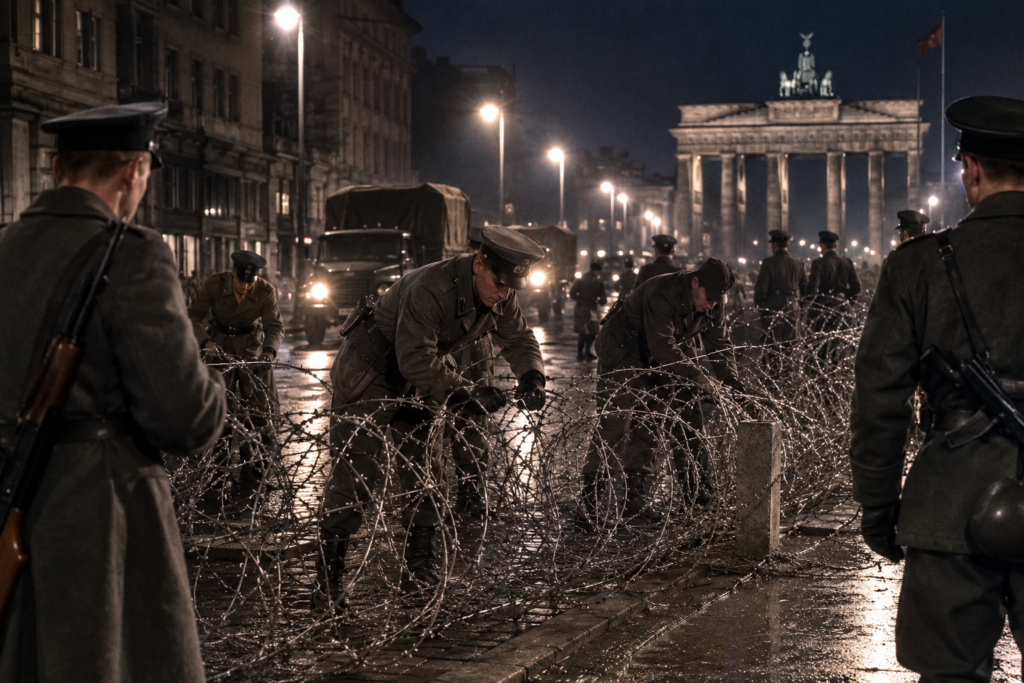
Image Credits: August 12, 1961: The Final Preparations for the Berlin Wall. AI-generated illustration created by Open Chronicle using ChatGPT (OpenAI). August 2026. This image is illustrative and does not depict a real-world scene.
By Open Chronicle History Desk
On August 12, 1961, East German authorities entered the final phase of a secret operation that would transform Berlin overnight and create one of the most powerful symbols of the Cold War.
For years, the divided city had represented one of the most dangerous fault lines between the Western powers and the Soviet bloc. Although East and West Germany had developed into increasingly separate political systems, Berlin remained an unusual opening in the Iron Curtain. Residents of East Berlin could still cross into the western sectors, and hundreds of thousands of East Germans had used the city as an escape route to the West.
By the summer of 1961, the scale of that exodus had become a crisis for the German Democratic Republic.
On August 12, the East German leadership prepared to close the route.
A Divided City at the Heart of the Cold War
Germany had been divided into occupation zones after the defeat of Nazi Germany in 1945. Berlin, although situated deep inside the Soviet occupation zone, was itself divided between the Soviet Union, the United States, Britain and France.
That arrangement eventually produced two German states.
The Federal Republic of Germany emerged in the western zones in 1949, while the German Democratic Republic was established in the Soviet-controlled east.
Berlin remained divided.
West Berlin developed into a Western enclave surrounded by East German territory, while East Berlin became the political centre of the GDR.
The contrast between the two systems was visible within a single city.
The Exodus from East Germany
The East German government faced a particularly serious problem during the 1950s and early 1960s.
Millions of people left the GDR for the West.
Berlin offered one of the easiest escape routes. East Germans could travel to East Berlin, cross into one of the western sectors and then continue into West Germany.
Many of those leaving were young and professionally trained. Doctors, engineers, technicians, teachers and skilled workers were among those abandoning the East.
For the East German leadership, the migration represented both an economic crisis and a political embarrassment.
The continuing departures suggested that significant numbers of citizens were willing to abandon the socialist state for life in the West.
By 1961, the situation had become increasingly difficult to sustain.
The Decision to Close the Border
East German leader Walter Ulbricht had repeatedly pressed the Soviet leadership for permission to restrict movement through Berlin.
Only weeks earlier, on June 15, 1961, Ulbricht had famously declared that nobody intended to build a wall.
Behind the scenes, however, plans for sealing the border were developing.
Soviet leader Nikita Khrushchev eventually approved measures designed to stop the movement of East German citizens through Berlin without directly challenging the Western military presence in West Berlin.
The operation required secrecy.
East German authorities prepared police units, soldiers, construction workers, transport personnel and large quantities of barbed wire.
The objective was to close the border rapidly before either the population or the Western powers could react.
August 12, 1961
On Saturday, August 12, the final political and operational preparations were made.
East German authorities prepared to implement the border closure during the night.
Security forces received instructions. Transport connections were prepared for interruption. Units were positioned around Berlin.
The operation was designed to begin while most residents were asleep.
Shortly before midnight, East German police and military forces started moving toward the boundary separating the Soviet sector from the western sectors of Berlin.
What had previously been a complicated but permeable border was about to become a physical barrier.
The Night Berlin Was Divided
During the early hours of August 13, East German forces began closing streets and railway connections between East and West Berlin.
Barbed wire was stretched across roads.
Barricades appeared.
Railway services were interrupted.
Soldiers and police guarded crossing points.
Residents awakening on Sunday morning discovered that the geography of their city had changed overnight.
Families suddenly found themselves separated.
Workers could no longer reach jobs on the opposite side of the border.
Friends and relatives who had routinely travelled between the sectors discovered that movement was now severely restricted.
The initial barrier was relatively crude.
It would not remain that way.
From Barbed Wire to Concrete
During the following days and weeks, East German authorities began replacing sections of the temporary barriers with more permanent structures.
What became known as the Berlin Wall gradually evolved into an elaborate border system.
Concrete walls, fences, watchtowers, patrol roads, lighting systems and other security installations were constructed.
In many areas, buildings near the border were evacuated or demolished.
Windows and doors facing West Berlin were sealed.
The border eventually became one of the most heavily guarded frontiers in the world.
East German authorities officially described it as an “anti-fascist protective barrier”, presenting the structure as a defence against Western aggression.
Its practical purpose was unmistakable.
It prevented East German citizens from freely leaving for the West.
Escape Attempts
The closing of the border did not end attempts to escape.
Instead, it made them increasingly dangerous.
People tried to cross through tunnels, hidden compartments in vehicles, improvised balloons and other methods.
Some attempted to climb or cross the barriers directly.
Others tried to swim across waterways forming part of the border.
Several escape attempts succeeded.
Others ended in arrest, injury or death.
Among the most famous victims was Peter Fechter, an 18-year-old East German who was shot while attempting to cross the Wall in August 1962. He fell near the barrier and died after lying wounded in view of observers on both sides.
His death became an enduring symbol of the human cost of Berlin’s division.
A Symbol of the Cold War
The Berlin Wall quickly became more than a border.
It represented the political and ideological division of Europe.
On one side stood the Soviet-backed German Democratic Republic and the wider Warsaw Pact system.
On the other stood West Berlin, protected by the United States, Britain and France and politically connected to West Germany.
The Wall became one of the most recognisable physical manifestations of the Iron Curtain.
Its presence also made Berlin one of the most dangerous potential flashpoints of the Cold War.
American and Soviet tanks confronted each other at Checkpoint Charlie in October 1961, demonstrating how quickly tensions surrounding the divided city could escalate into a confrontation between nuclear powers.
Kennedy and Berlin
The political importance of West Berlin remained enormous.
In June 1963, United States President John F. Kennedy visited the city and delivered one of the defining speeches of the Cold War.
Standing before a huge crowd, Kennedy declared solidarity with the people of West Berlin and famously stated:
“Ich bin ein Berliner.”
The speech reinforced the symbolic importance of the city within the broader confrontation between East and West.
More than two decades later, another American president would use the Wall as the setting for another famous Cold War message.
In June 1987, Ronald Reagan stood near the Brandenburg Gate and challenged Soviet leader Mikhail Gorbachev to open the border.
Two years later, events moved faster than almost anyone expected.
The Fall of the Wall
By 1989, communist governments across Eastern Europe were facing growing political pressure.
Reform movements were spreading.
Hungary had begun dismantling restrictions along its border with Austria, creating another route through which East Germans could reach the West.
Large demonstrations erupted across East Germany.
On November 9, 1989, confusion surrounding new travel regulations produced an extraordinary chain of events.
Thousands of East Berliners approached border crossings demanding passage.
Overwhelmed guards eventually opened the checkpoints.
Crowds poured across the border.
Berliners climbed onto the Wall, celebrated together and began physically dismantling the structure that had divided their city for more than 28 years.
The images travelled around the world.
Less than a year later, Germany was reunified.
Why August 12 Matters
August 13 is remembered as the day the border was physically sealed.
But August 12 represents the final moment before Berlin changed.
The preparations made that day transformed political decisions into an operation that would divide streets, neighbourhoods and families for nearly three decades.
The Berlin Wall became one of the defining structures of the twentieth century.
Its construction demonstrated how the Cold War could reshape everyday life with extraordinary speed. Its fall demonstrated how quickly seemingly permanent political systems could unravel.
The events prepared on August 12, 1961, therefore belong to a much larger story, the division of Europe after the Second World War, the confrontation between the Soviet Union and the Western powers, and the eventual collapse of the Cold War order.