
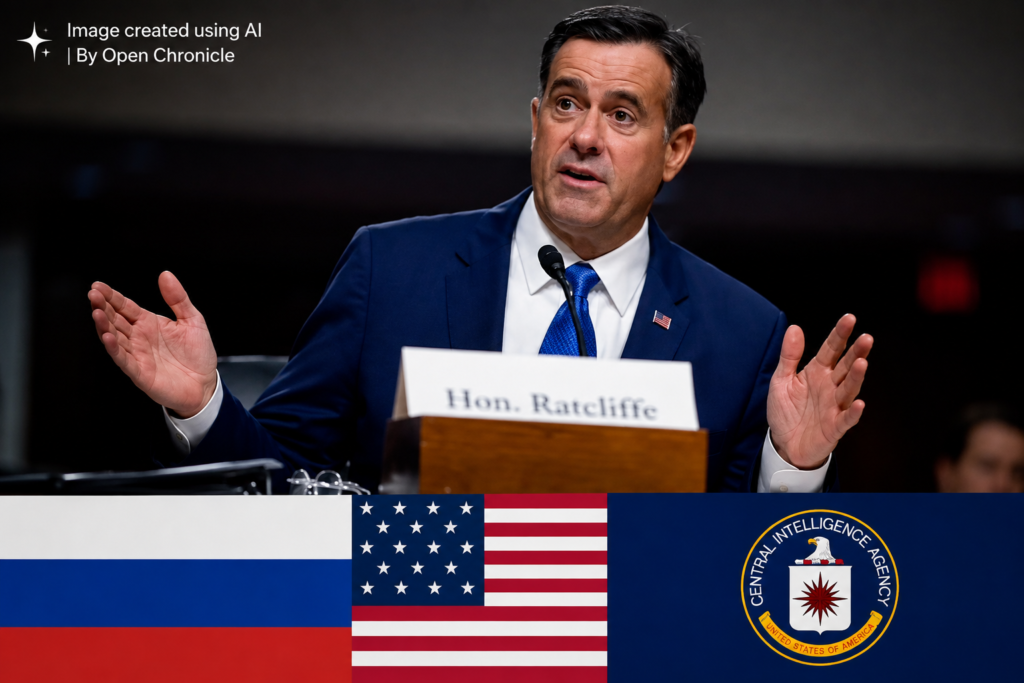
By Open Chronicle Newsdesk with agencies
CIA Director John Ratcliffe made an unannounced visit to Moscow on August 25, an extraordinary journey by one of the most senior figures in the United States intelligence establishment at a moment of heightened tension between Washington and the Kremlin.
US officials familiar with the trip confirmed that Ratcliffe travelled to the Russian capital but did not disclose whom he met or what was discussed. Neither the CIA nor the White House immediately provided a public explanation for the visit.
The secrecy surrounding the journey has inevitably generated speculation about its purpose. Russia’s war against Ukraine remains unresolved, diplomatic efforts have struggled to produce a breakthrough, and Washington is simultaneously increasing pressure on Iran, one of Moscow’s most important strategic partners.
There is currently no public evidence establishing which of these issues, if any, dominated Ratcliffe’s discussions.
What is clear is that visits to Moscow by serving CIA directors are exceptionally rare, making the journey significant regardless of its precise purpose.
‼️‼️🇺🇸🇷🇺🇪🇺 CIA Director John Ratcliffe may have made his surprise trip to Moscow to personally warn Vladimir Putin against a planned or potential Russian attack on Europe.
According to The Wall Street Journal, the official purpose of Ratcliffe’s unexpected visit has still not… pic.twitter.com/VnK6ryuaHW
— Visioner (@visionergeo) August 25, 2026
An Unusual Flight Into Moscow
The first visible indication that something unusual was taking place came from the movement of a US military transport aircraft.
Flight tracking data showed a US Air Force C-17A Globemaster III travelling from the United States through Latvia before continuing to Moscow’s Vnukovo Airport.
The aircraft appeared to have originated from the Washington area, travelling through Joint Base Andrews before eventually reaching Riga and then Moscow.
It landed in the Russian capital early on August 25 and departed later the same day.
A C-17 operating under a military transport callsign does not by itself reveal the nature of a mission. The aircraft can carry personnel, equipment, vehicles and other cargo.
But a US military aircraft travelling from NATO territory directly into Russian airspace and landing in Moscow requires coordination and appropriate clearances.
Confirmation that Ratcliffe was aboard provides an explanation for at least part of a flight that had already attracted considerable attention.
CIA Director John Ratcliffe's Moscow visit is raising questions about whether Washington is delivering a direct warning over potential Russian escalation against Europe and NATO.
The timing is notable, with growing Russian aggression across Europe involving increased drone… pic.twitter.com/pDUmJHNpUs
— GMI (@Global_Mil_Info) August 25, 2026
CIA Directors Rarely Go to Moscow
The importance of the visit is reinforced by historical precedent.
The most recent publicly known Moscow visit by a CIA director was made by Ratcliffe’s predecessor, William Burns, in November 2021.
Burns travelled to Russia as the United States became increasingly concerned about Moscow’s military preparations around Ukraine.
Three months later, Russia launched its full scale invasion.
The circumstances surrounding Ratcliffe’s journey are different, but the precedent demonstrates why a visit by a CIA director carries unusual diplomatic weight.
Senior American and Russian intelligence officials have maintained channels of communication despite the deterioration in bilateral relations.
Direct meetings at this level, however, remain exceptional.
Intelligence channels can sometimes perform diplomatic functions that conventional diplomacy cannot. They can transmit warnings, explore proposals, negotiate sensitive exchanges or clarify intentions while allowing governments to maintain public distance from the discussions.
The question is what Washington wanted to communicate in Moscow on August 25.
Ukraine Is the Most Obvious Possibility
Russia’s war against Ukraine inevitably stands near the top of the list.
The Trump administration has continued attempting to find a path toward negotiations, but efforts to achieve a settlement have stalled.
President Donald Trump’s summit with Vladimir Putin in Alaska in August 2025 failed to produce an end to the conflict, and fundamental disagreements remain over the conditions under which negotiations could proceed.
Ukraine and the United States have pushed for arrangements that would prevent further Russian advances and establish a basis for negotiations.
Moscow continues to insist on territorial and political conditions that Kyiv considers unacceptable.
Ratcliffe’s visit could therefore represent an attempt to determine whether there is any remaining space for negotiation.
But without details from Washington or Moscow, that remains a possibility rather than an established explanation.
Intelligence Channels Can Go Where Diplomacy Cannot
The involvement of the CIA director would not necessarily mean the mission concerned intelligence matters alone.
Intelligence chiefs have historically served as discreet diplomatic intermediaries during periods of extreme tension.
The reason is practical.
Intelligence services maintain communication channels even when normal political relations deteriorate.
Those channels can be particularly valuable when governments need to exchange messages without immediately creating a public diplomatic process.
A CIA director can also communicate directly with senior Russian security officials possessing access to Putin and the Kremlin’s decision making apparatus.
If Washington wanted to deliver a sensitive message, test Russian intentions or establish parameters for further discussions, Ratcliffe would be a plausible intermediary.
Iran May Be the Other Major Issue
Ukraine is not the only potential explanation.
Ratcliffe arrived in Moscow as the United States dramatically intensified economic pressure against Iran.
Treasury Secretary Scott Bessent announced a new campaign intended to sever Iran’s international economic connections, warning countries and companies maintaining business relationships with Tehran that they could face American measures.
Russia presents an obvious obstacle to any attempt to isolate Iran.
Moscow and Tehran have developed extensive military, economic and political ties.
Their relationship strengthened considerably during the Ukraine war, particularly as Russia increasingly relied upon Iranian designed unmanned aerial systems and the two countries expanded defence cooperation.
For Washington, Russian assistance to Iran has therefore become an increasingly important strategic issue.
Could Washington Be Warning Moscow?
One possibility is that Ratcliffe carried a direct message concerning the limits of Russian support for Tehran.
Bradley Bowman, senior director of the Center on Military and Political Power at the Foundation for Defense of Democracies, suggested that Washington has reasons to press Moscow over assistance that could strengthen Iranian military capabilities.
Potential areas of concern include satellite launch assistance, intelligence, targeting information, drone technology and other forms of military cooperation.
If the United States is attempting to increase Iran’s economic and military isolation, Russian cooperation could significantly affect the effectiveness of that strategy.
Convincing Moscow to distance itself from Tehran would nevertheless be extraordinarily difficult.
Russia has strategic reasons for maintaining the relationship, particularly as confrontation with Western governments continues over Ukraine.
1/ The unexpected and apparently brief visit of CIA Director John Ratcliffe to Moscow has caused confusion among Russian warbloggers. They suggest that he was sent in place of the usual "diplomatic clowns" to deliver an ultimatum to the Kremlin. ⬇️pic.twitter.com/yTCR6fVlhl
— ChrisO_wiki (@ChrisO_wiki) August 25, 2026
Ukraine and Iran Are Increasingly Connected
The two issues may also be less separate than they initially appear.
The wars and confrontations surrounding Ukraine and Iran increasingly intersect through military technology, sanctions, energy and geopolitical alignment.
Russia and Iran have exchanged military knowledge and developed closer strategic cooperation.
The United States is simultaneously attempting to support Ukraine, constrain Russia and isolate Iran.
China represents another major variable because its economic relationships can reduce the effectiveness of Western attempts to isolate both Moscow and Tehran.
Ratcliffe’s Moscow mission could therefore concern a broader strategic bargain rather than a single issue.
Washington could theoretically combine pressure and incentives across several areas.
That does not mean such a bargain exists. There is currently no public evidence demonstrating one.
But the overlapping strategic interests make the possibility impossible to dismiss.
A Message Directly to Putin?
Another unanswered question is whether Ratcliffe met Vladimir Putin.
No such meeting has been confirmed.
The Kremlin initially indicated that it had no information regarding the aircraft’s arrival and said no meetings between Putin and representatives of the US administration were scheduled.
That does not exclude meetings elsewhere within the Russian state.
Ratcliffe could have met officials from Russian intelligence services, the Security Council, military structures, diplomatic representatives or other senior officials.
Intelligence diplomacy frequently operates precisely because it can occur outside conventional political channels.
Until either government provides additional information, claims that Ratcliffe personally met Putin would be speculation.
Ratcliffe’s Reputation Makes the Visit More Interesting
The identity of the American envoy adds another dimension.
Ratcliffe is not generally associated with a conciliatory approach toward Moscow.
He has supported maintaining strong US intelligence assistance to Ukraine and has advocated continued American involvement in helping Kyiv resist Russian military operations.
That makes his selection for such a sensitive mission particularly notable.
A government seeking to communicate seriousness may deliberately choose an official perceived as sceptical of the other side.
Ratcliffe also has direct access to Trump.
Whatever message he carried could therefore be understood in Moscow as having presidential authority behind it.
Moscow’s Accusations Against Washington
The visit also comes against a background of increasingly sharp Russian accusations concerning American involvement in Ukrainian operations.
Russian officials have accused the United States of assisting Ukrainian long range strikes through intelligence and other forms of support.
Foreign Minister Sergei Lavrov has raised questions about the extent of American involvement in attacks against targets deep inside Russian territory.
Washington and its allies maintain that their assistance is intended to help Ukraine defend itself against Russia’s invasion.
The disagreement nevertheless creates another potential subject for intelligence level discussions.
Direct communication can become especially important when military operations risk creating misunderstandings between nuclear armed powers.
Even governments engaged in confrontation have an interest in preventing unintended escalation.
Americans Detained in Russia Could Also Be on the Agenda
Another possibility concerns Americans imprisoned or detained in Russia.
The CIA has previously participated in negotiations surrounding prisoner exchanges between Washington and Moscow.
One of the most significant occurred in 2024, when Wall Street Journal reporter Evan Gershkovich, RFE/RL journalist Alsu Kurmasheva and former US Marine Paul Whelan were released as part of a major exchange.
Ratcliffe was also involved in negotiations surrounding Russian American Ksenia Karelina, who spent more than a year imprisoned in Russia.
Sensitive prisoner negotiations often require discreet channels.
It is therefore possible that detained Americans formed part of the Moscow discussions even if the principal purpose of the trip concerned broader geopolitical questions.
Carrots, Sticks or Both?
The fundamental question is whether Ratcliffe went to Moscow carrying an offer, a warning or some combination of the two.
Washington has reasons to communicate on several fronts.
It wants movement toward ending the war in Ukraine.
It wants to prevent Russia from strengthening Iran.
It wants to manage escalation between American and Russian forces and interests.
It may want progress involving detained Americans.
Moscow has its own objectives.
The Kremlin wants sanctions relief, recognition of Russian security interests, influence over Ukraine’s future and limits on Western military involvement near Russia.
The overlap creates opportunities for negotiation, but also enormous obstacles.
Any agreement touching Ukraine would ultimately require Ukrainian participation and would carry major implications for European security.
Any understanding concerning Iran would affect the broader Middle Eastern balance of power.
That makes the secrecy surrounding the mission understandable.
Intelligence Diplomacy Returns to Centre Stage
The Ratcliffe visit also illustrates a broader transformation in contemporary diplomacy.
When official relations between major powers deteriorate, intelligence services often become increasingly important rather than less important.
They provide governments with channels capable of operating beneath the political surface.
The CIA and its Russian counterparts can exchange warnings while presidents publicly condemn one another.
They can discuss prisoners while sanctions remain in place.
They can explore possible agreements without committing governments to formal negotiations.
During dangerous periods, these channels can help prevent strategic competition from becoming uncontrolled escalation.
The irony is that the worse relations become, the more valuable discreet communication can become.
A Rare Mission at a Critical Moment
For now, the most important facts remain limited.
John Ratcliffe travelled to Moscow.
The journey was unannounced.
A US military aircraft transported him into Russia after travelling through Latvia.
He departed later the same day.
American officials have not publicly identified whom he met or what was discussed.
Everything beyond those facts must be treated cautiously.
But the absence of information does not make the visit insignificant.
CIA directors do not routinely travel to Moscow, particularly during a period when the United States and Russia are confronting one another across some of the world’s most dangerous geopolitical fault lines.
Ukraine provides one possible explanation.
Iran provides another.
Prisoner negotiations, intelligence deconfliction or a combination of several issues could also have been involved.
The visit may eventually prove to have been a narrow intelligence mission.
It could also mark the beginning of a new diplomatic channel between Washington and Moscow.
Until more information emerges, its precise purpose remains deliberately concealed.
What can already be said is that, on August 25, one of Donald Trump’s most senior national security officials travelled directly into the Russian capital at a moment when the strategic relationship between the United States and Russia extends far beyond Ukraine.
From Kyiv to Tehran, from sanctions to intelligence cooperation and from prisoner exchanges to the danger of escalation between nuclear powers, Washington and Moscow have more to discuss than their public confrontation might suggest.
Sometimes the most consequential diplomacy does not begin with a summit.
It begins with an aircraft landing quietly in Moscow.