
Department: World | United States | Justice & Security
By Open Chronicle with agencies
By Open Chronicle with agencies
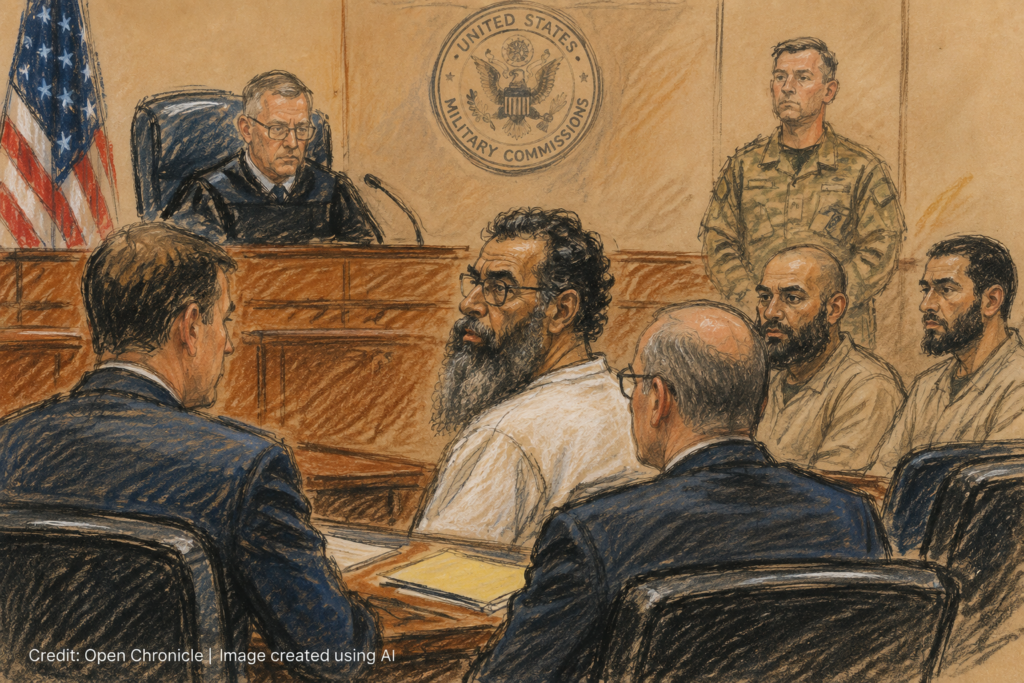
A U.S. military judge has scheduled the trial of Khalid Sheikh Mohammed, the alleged mastermind of the September 11, 2001 attacks, and three co defendants for June 2028, setting a new date in one of the longest running and most consequential terrorism prosecutions in American history.
A U.S. Air Force judge issued the order on Wednesday, directing that Mohammed and the other defendants face a military tribunal over their alleged roles in the attacks that killed nearly 3,000 people in New York, Washington and Pennsylvania.
The decision establishes a timetable for proceedings that have been delayed for years by complex legal disputes involving evidence, interrogation methods, questions surrounding the admissibility of statements made by the defendants and the structure of the military commission system itself.
More Than Two Decades After September 11
Mohammed has long been described by U.S. authorities as the principal architect of the September 11 attacks.
The attacks began when 19 hijackers seized four commercial aircraft on the morning of September 11, 2001. Two planes were flown into the towers of the World Trade Center in New York, while another struck the Pentagon outside Washington.
A fourth aircraft, United Airlines Flight 93, crashed in Pennsylvania after passengers and crew members attempted to regain control of the plane.
The attacks killed nearly 3,000 people and transformed U.S. foreign and security policy, triggering the American led war in Afghanistan and the broader global campaign against al Qaeda and other militant organisations.
Mohammed was captured in Pakistan in March 2003 and subsequently held in secret CIA detention facilities before being transferred to the U.S. military prison at Guantanamo Bay, Cuba, in 2006.
A Case Marked by Years of Legal Disputes
Efforts to bring Mohammed and his co-defendants to trial have repeatedly encountered legal and procedural obstacles.
One of the most difficult issues has concerned the treatment of detainees while they were held in CIA custody. Mohammed was subjected to waterboarding and other coercive interrogation techniques, creating extensive legal disputes over whether statements and evidence obtained during or following those interrogations can be used in court.
Defence lawyers have argued that the defendants’ treatment compromised the integrity of subsequent interrogations and evidence. Prosecutors have sought to establish a case capable of proceeding within the military commission system.
The proceedings have consequently remained in the pretrial stage for years.
June 2028 Trial Date
The new order represents an important procedural step by establishing June 2028 as the planned beginning of the military tribunal.
However, the complexity of the prosecution means further legal challenges could still affect the timetable before jury selection and substantive proceedings begin.
If the schedule holds, the trial will begin almost 27 years after the September 11 attacks and approximately 25 years after Mohammed was captured.
The extraordinary length of the case has made the prosecution one of the most closely scrutinised proceedings in the history of the U.S. military commission system.
For relatives of those killed on September 11, the trial could represent a long awaited opportunity for the allegations against the defendants to be examined before a tribunal. At the same time, the proceedings are expected to renew debate over Guantanamo Bay, CIA interrogation practices, defendants’ rights and the use of military courts for major terrorism cases.
More than a quarter century after the attacks reshaped international security and American foreign policy, the scheduled June 2028 proceedings could finally move one of the defining legal cases arising from September 11 into its trial phase.