
By Open Chronicle Sports
NASCAR Cup Series | Daytona International Speedway | August 29, 2026
DAYTONA BEACH, Fla. — There are races that end a season, and then there are races that blow the doors off everything that came before them.
Daytona did the latter.
Under the lights at Daytona International Speedway, with 400 miles of superspeedway racing standing between the NASCAR Cup Series field and the start of The Chase, Ryan Preece produced the defining upset of the 2026 regular season.
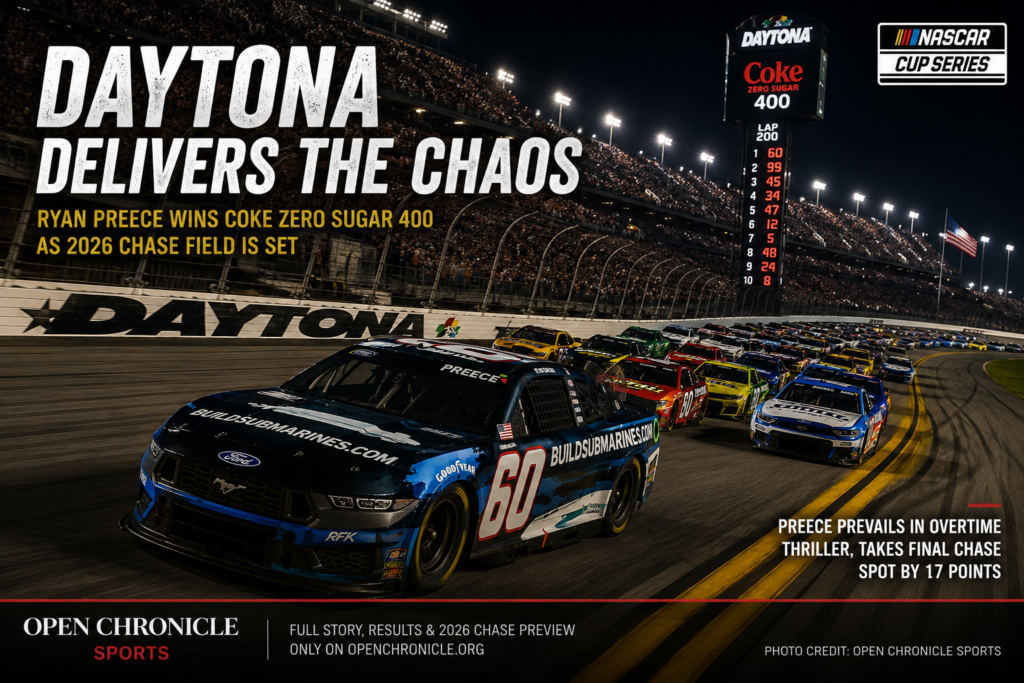
Preece won the Coke Zero Sugar 400 in overtime, survived a chaotic final lap and turned a 31-point deficit entering the night into the 16th and final position in NASCAR’s championship field.
For a driver who had waited through 248 previous Cup Series starts without a points-paying victory, the breakthrough could hardly have arrived on a bigger stage.
Preece crossed NASCAR’s scoring line just 0.024 seconds ahead of Daniel Suárez when the caution ended the race, giving the RFK Racing driver his first Cup Series points victory and one of the most consequential wins of the year.
And just like that, the regular season was over.
The Chase was set.
One Night at Daytona Changed Everything
The numbers entering Daytona did not favor Preece.
Shane van Gisbergen arrived holding the 16th and final provisional Chase position, 31 points ahead of Preece. Under NASCAR’s revised 2026 championship system, winning alone did not automatically guarantee postseason qualification.
Points mattered.
Every stage mattered.
Every position mattered.
And Daytona, perhaps more than any other track on the schedule, is capable of destroying a carefully constructed points advantage in seconds.
That is exactly what happened.
Van Gisbergen appeared determined to control his own destiny early, winning Stage 1 and strengthening his position. Preece, meanwhile, was involved in an incident near the end of the stage with Chris Buescher and Kyle Larson and was forced to recover from damage.
The night appeared to be moving away from him.
It wasn’t.
Preece and the No. 60 RFK Racing team stayed alive.
Then Daytona began doing what Daytona does.
Strategy changed. Drafting alliances shifted. Fuel calculations became critical. Cars moved from the front to the middle of the pack and back again. Every restart carried the possibility that someone’s season could disappear in a cloud of tire smoke.
Van Gisbergen stopped for fuel on Lap 157 and took four tires, leaving him deep in the field for the overtime restart.
That decision proved decisive.
He was caught in the final-lap accident and finished 28th.
Preece was still there.
The Final Lap
Zane Smith led as the field thundered toward Turn 2 on the final lap.
Then everything broke loose.
Contact involving Tyler Reddick sent Smith spinning and triggered the kind of multi-car crash that has become inseparable from Daytona’s superspeedway mythology.
Cars scattered across the backstretch.
Preece escaped.
Daniel Suárez escaped.
When NASCAR displayed the caution, officials determined that Preece had been ahead.
The margin was 0.024 seconds.
Ryan Preece had won at Daytona.
Suárez finished second, Tyler Reddick third, Michael McDowell fourth and Ricky Stenhouse Jr. fifth.
For Preece, however, the finishing order represented something far larger than a first-place trophy.
He had erased the deficit to van Gisbergen and claimed the final position in The Chase by 17 points.
A season had turned in one lap.
Ryan Preece Finally Has His Cup Victory
Few NASCAR victories arrive without a story behind them.
Preece’s story had been building for years.
The 35-year-old had travelled through different organizations and different opportunities while trying to establish himself permanently at NASCAR’s highest level.
Daytona was his 249th Cup Series start.
The victory finally placed his name among NASCAR Cup Series winners.
But even that does not fully explain its significance.
Preece did not simply win a race.
He won the regular-season finale.
He won at Daytona.
He delivered RFK Racing its first Cup victory of 2026.
And he transformed himself from a driver outside the championship field into one of the 16 men who will race for NASCAR’s biggest prize.
For the No. 60 team, there could hardly have been a more dramatic way to enter September.
The Other Side of Daytona
Every great Daytona story has another side.
For Shane van Gisbergen, Saturday night was brutal.
The Trackhouse Racing driver entered the race above the cutline and strengthened his position by winning Stage 1.
For much of the night, the mathematics appeared manageable.
But Daytona rarely respects mathematics.
His late fuel stop dropped him into traffic for overtime, and when the final accident erupted, there was nowhere to go.
The 28th-place result left van Gisbergen 17 points behind Preece.
His Chase opportunity was gone.
Brad Keselowski was also eliminated from championship contention, while Bubba Wallace and Austin Cindric successfully secured their postseason places.
Wallace clinched during Stage 1.
Cindric followed.
Preece took the final ticket.
Sixteen drivers remained.
Denny Hamlin Was the Standard of the Regular Season
Daytona supplied the spectacular ending, but the story of NASCAR’s 2026 regular season cannot be told without Denny Hamlin.
The Joe Gibbs Racing veteran enters The Chase as NASCAR’s No. 1 seed.
His summer run was extraordinary.
Hamlin won three consecutive races at Nashville Superspeedway, Michigan International Speedway and Pocono Raceway, a streak he had never previously achieved during his long Cup career.
By the time the series reached New Hampshire, Hamlin had done enough to secure the top seed before Daytona even began.
That matters enormously under NASCAR’s restored Chase format.
Hamlin begins the postseason with 2,100 points, 25 ahead of second-seeded Ryan Blaney.
For a driver whose career contains almost every major NASCAR accomplishment except a Cup Series championship, 2026 represents another enormous opportunity.
This time, however, Hamlin enters the championship fight from the front.
Ryan Blaney Remains Right There
If Hamlin was the regular season’s benchmark, Ryan Blaney ensured he never became comfortable.
The Team Penske driver won at Phoenix, EchoPark Speedway and New Hampshire during the regular season and earned the No. 2 Chase seed.
Even Daytona contained another reminder of his superspeedway ability.
Blaney won Stage 2 after making a late pass on Chase Elliott.
His race ultimately ended with a 33rd-place finish after he was collected in the final-lap accident, but the larger championship picture was already secure.
Blaney will start The Chase with 2,075 points.
Only Hamlin begins ahead of him.
The Contenders Behind Them
The championship battle is considerably deeper than the first two positions.
Tyler Reddick enters The Chase seeded third after another season that demonstrated the speed of the No. 45 23XI Racing Toyota.
Ty Gibbs is fourth, continuing his emergence as one of NASCAR’s most important young drivers.
Chase Briscoe gives Joe Gibbs Racing another major championship threat from fifth.
Christopher Bell starts sixth.
Then comes an intimidating collection of established Cup Series stars.
Kyle Larson is seventh.
Chase Elliott is eighth.
Two-time champion Joey Logano is ninth.
Chris Buescher completes the top 10.
Behind them, Daniel Suárez enters as the No. 11 seed following one of the strongest regular seasons of his Cup career, highlighted by victory in the Coca-Cola 600.
Carson Hocevar is 12th.
William Byron, remarkably, reaches The Chase as the 13th seed despite going through the entire regular season without a victory.
Bubba Wallace is 14th.
Austin Cindric is 15th.
And then there is Ryan Preece.
Sixteenth.
Last man in.
Daytona winner.
The 16 Drivers Racing for the 2026 NASCAR Cup Series Championship
The Chase begins with the following order:
1. Denny Hamlin
2. Ryan Blaney
3. Tyler Reddick
4. Ty Gibbs
5. Chase Briscoe
6. Christopher Bell
7. Kyle Larson
8. Chase Elliott
9. Joey Logano
10. Chris Buescher
11. Daniel Suárez
12. Carson Hocevar
13. William Byron
14. Bubba Wallace
15. Austin Cindric
16. Ryan Preece
The field contains champions, perennial contenders, emerging stars and one driver who forced his way through the door at the final possible moment.
That combination should make the next 10 races fascinating.
2026 Regular Season Review
A Different NASCAR
The 2026 season represented more than another championship campaign.
NASCAR fundamentally changed the way its champion would be determined.
The elimination-style playoff system was replaced by the return of The Chase, beginning a new era in the Cup Series.
The most significant philosophical change concerned qualification.
Winning a race no longer automatically guaranteed a postseason position.
Instead, NASCAR placed renewed importance on performance across the complete 26-race regular season.
The top 16 drivers in points advanced.
Consistency mattered again.
Bad weekends became more expensive.
Stage points became strategically important.
A spectacular victory could transform a season, but it could no longer erase months of poor results by itself.
The result was a regular season in which drivers watched the standings almost as carefully as they watched the race leader.
Hamlin’s Summer Statement
The defining performance stretch belonged to Denny Hamlin.
Winning NASCAR Cup races is difficult.
Winning three consecutive Cup races is exceptional.
Hamlin did it at three very different tracks.
Nashville.
Michigan.
Pocono.
At Nashville, he recovered from an early penalty and eventually won a dramatic Joe Gibbs Racing battle.
At Michigan, the momentum continued.
At Pocono, another victory completed the three-race sweep and reinforced his reputation as one of the finest drivers in the track’s history.
By the middle of summer, the No. 11 Toyota had become the car everyone else was measuring themselves against.
Blaney’s Challenge
Ryan Blaney’s three regular-season victories ensured Hamlin did not dominate the championship conversation alone.
Phoenix demonstrated his short-track and intermediate strength.
EchoPark added another victory.
New Hampshire arrived late enough in the regular season to reinforce his championship credentials immediately before Daytona.
Penske therefore enters The Chase with its leading driver positioned exactly where the organization wants him.
Close enough to attack.
A Season of Depth
One of the most striking features of 2026 has been the number of organizations represented near the front.
Joe Gibbs Racing sends Hamlin, Gibbs, Briscoe and Bell into The Chase.
Hendrick Motorsports has Larson, Elliott and Byron.
Team Penske is represented by Blaney, Logano and Cindric.
23XI Racing has Reddick and Wallace.
RFK Racing sends Buescher and, after Daytona, Preece.
Spire Motorsports has Suárez and Hocevar.
That organizational spread matters.
The championship is not simply one team against another.
It is a battle involving different manufacturers, different technical philosophies and very different driver profiles.
William Byron’s Strange Road to The Chase
William Byron provides perhaps the clearest example of what changed under NASCAR’s 2026 rules.
He did not win during the regular season.
Under the previous championship culture, that statistic would have dominated the conversation.
In 2026, the broader body of work mattered.
Byron accumulated enough points across the season to qualify and enters The Chase seeded 13th.
His season illustrates precisely what NASCAR wanted from the new structure.
Winning remains enormously important.
Consistency has value again.
Suárez Finds a New Home
Daniel Suárez also produced one of the year’s most interesting stories.
His move to Spire Motorsports has generated one of the strongest regular seasons of his Cup career.
Victory in the rain-shortened Coca-Cola 600 provided the headline moment, but his Chase qualification was built across the season rather than guaranteed by that single win.
He enters the postseason 11th.
Spire also sends Carson Hocevar into The Chase in 12th.
For an organization still building toward NASCAR’s traditional powerhouse teams, placing two cars inside the championship field represents another important step forward.
Daytona Was the Perfect Ending
After 25 races, five drivers arrived at Daytona fighting for the final three Chase positions.
Bubba Wallace.
Austin Cindric.
Shane van Gisbergen.
Ryan Preece.
Brad Keselowski.
Only three could advance.
Wallace made it.
Cindric made it.
Preece produced the drive of his Cup career to take the last position.
Van Gisbergen and Keselowski were left outside.
There could hardly have been a more appropriate place to settle it.
Daytona has always existed somewhere between racetrack and roulette wheel.
Drivers need speed.
They need drafting partners.
They need patience.
They need aggression.
And eventually, they usually need luck.
Preece found all of them when he needed them most.
Now Comes The Chase
The regular season is finished.
The points have been reset.
The field has been reduced to 16 championship contenders.
And unlike NASCAR’s previous elimination format, there will be no rounds progressively removing drivers from contention.
The Chase is a 10-race championship.
The points keep accumulating.
Every race matters.
Every mistake travels with the driver to the next track.
Hamlin begins with the advantage.
Blaney begins close behind.
Reddick, Gibbs and Briscoe occupy the next three positions.
Larson, Elliott and Logano bring championship experience.
Wallace, Cindric and Hocevar bring opportunity.
And Preece arrives carrying perhaps the greatest momentum of anyone in the field.
The postseason begins September 6 with one of NASCAR’s great races, the Southern 500 at Darlington Raceway.
Daytona rewarded survival.
Darlington rewards precision.
From there, NASCAR’s championship will travel through 10 races before a champion finally emerges.
Twenty-six regular-season races have established the contenders.
Now the championship begins.
And after what happened at Daytona, predicting how it ends would be a dangerous business.