
By Open Chronicle with agencies
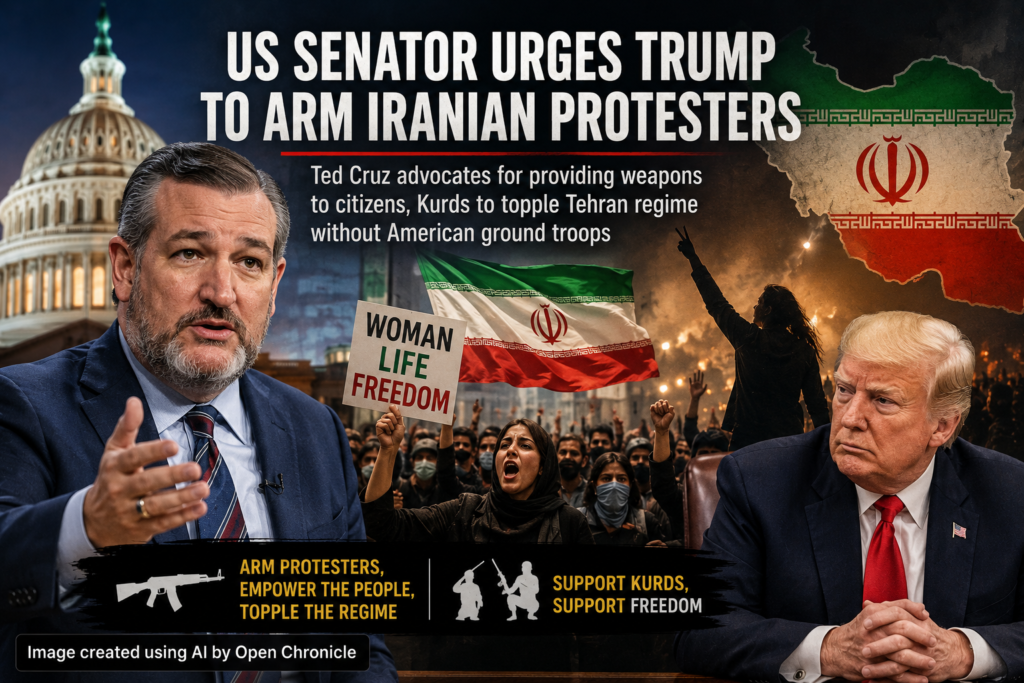
US Senator Ted Cruz has called on President Donald Trump’s administration to provide weapons directly to Iranian protesters and Kurdish groups, arguing that armed resistance could help bring about political change in Tehran without requiring the deployment of American ground forces.
Speaking to NBC News on Sunday, Cruz said Washington should give Iranians opposing the government the means to confront the country’s security forces.
“What I’ve been urging is for President Trump … to arm the protesters, the people of Iran,” Cruz said.
The Republican senator argued that civilians could not reasonably be expected to challenge heavily armed government forces with improvised weapons alone.
Cruz said his preferred strategy would place Iranians themselves at the centre of any attempt to overthrow the current political system, rather than involving US troops directly on Iranian territory.
Cruz argues against US ground intervention
The senator’s comments underline an increasingly consequential debate in Washington over how far the United States should go in supporting opponents of the Iranian government.
Cruz presented the supply of weapons as an alternative to direct American military intervention. His argument is that sufficiently equipped opposition groups could exert pressure on Tehran while allowing Washington to avoid deploying ground forces.
Such a policy, however, would represent a major escalation in direct US involvement in Iran’s internal political struggle and could carry significant regional and diplomatic consequences.
The proposal comes amid heightened tensions involving Washington, Tehran and Israel, with the future of Iran’s political leadership increasingly becoming part of the wider strategic debate.
Questions over previous weapons effort
According to the information provided, Trump has previously discussed an attempt to send firearms to Iranian demonstrators through Kurdish intermediaries.
Trump said Washington had supplied “a lot” of weapons but claimed the Kurdish groups involved retained the firearms rather than delivering them to their intended recipients.
The president expressed disappointment over the episode, suggesting that previous efforts to support protesters directly had encountered serious difficulties.
Cruz nevertheless continues to advocate providing weapons to opposition forces, including Kurdish groups capable of challenging Tehran.
Regime change enters the debate
The question of Iran’s political future has become increasingly intertwined with US and Israeli military strategy.
When announcing attacks against Iran on February 28, Trump explicitly appealed to the Iranian population to seize an opportunity for political change once military operations had weakened the government.
“The hour of your freedom is at hand,” Trump told Iranians, adding that they should ultimately “take over your government.”
Israeli Prime Minister Benjamin Netanyahu has expressed a similar position, arguing that military pressure could create conditions in which Iranians themselves determine the future of their country.
The statements suggest that weakening the Iranian government politically, as well as militarily, has become an important element of the broader confrontation.
A potentially significant escalation
Providing weapons directly to protesters would move US policy beyond diplomatic support for demonstrations and economic or military pressure against Tehran.
It would also raise difficult questions about who would receive American weapons, how Washington could control their distribution and whether opposition factions could coordinate effectively against the Iranian state.
Iran is home to numerous political, ethnic and regional groups with differing objectives, making any programme to arm opposition forces particularly complex.
Tehran would also almost certainly portray such assistance as direct foreign intervention and evidence that Washington was attempting to overthrow the Iranian government.
Cruz’s proposal nevertheless reflects a view among some US policymakers that internal pressure could become a decisive element in determining Iran’s political future.
For now, the central question is whether the Trump administration is prepared to translate its public encouragement of Iranian opposition movements into a renewed programme of direct material and military support.