
Image: from Netram Defence Review X @NetramDefence
By Open Chronicle
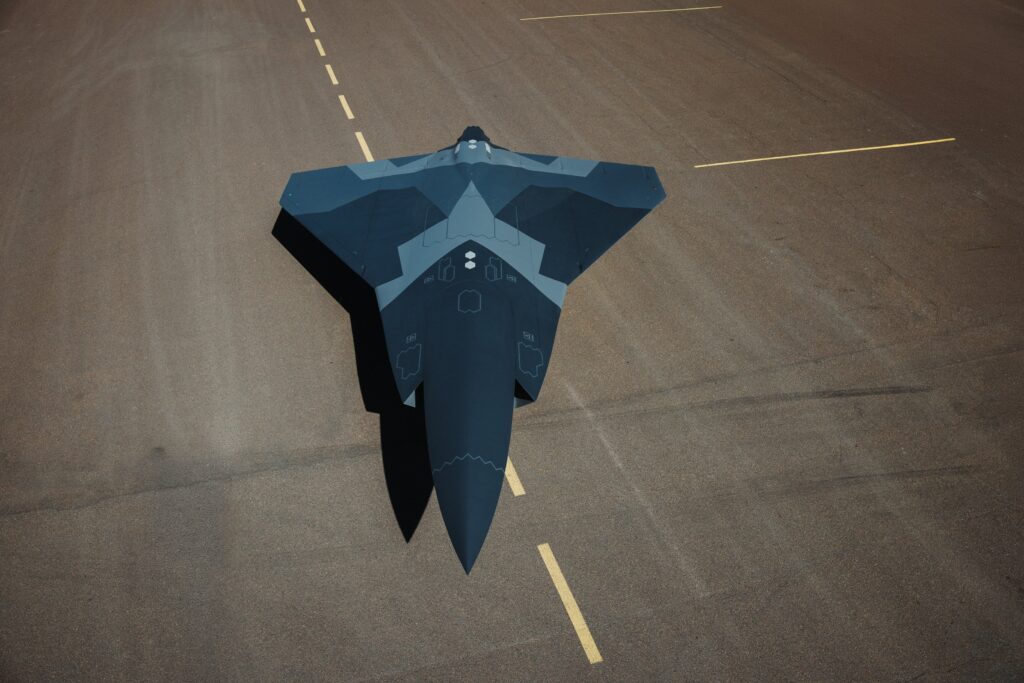
Swedish defence group Saab has unveiled a full scale model of the Saab A3, a proposed supersonic stealth uncrewed combat aircraft designed to operate alongside fighter jets and penetrate heavily defended airspace.
The aircraft forms part of Saab’s work on an Autonomous Collaborative Platform, or ACP, and is being explored within Sweden’s wider effort to define technologies and operational concepts for its next generation combat aviation system.
The A3 is envisaged as a high performance collaborative aircraft capable of supporting missions including electronic warfare, suppression of enemy air defences and precision strikes against targets protected by sophisticated air defence networks.
The concept also provides a clearer indication of how Sweden could eventually combine crewed fighters such as the Gripen E with autonomous combat aircraft.
#Actudéfense Saab présente le drone de combat supersonique A3 pour l’armée suédoise https://t.co/TDqiyyJvJ6
— Armées.com (@armeesmedia) August 25, 2026
A Supersonic Stealth Collaborative Aircraft
The A3 features a tailless configuration intended to reduce its radar signature while providing substantial internal volume for fuel, sensors and weapons.
Its design shares characteristics with an earlier Saab concept revealed in 2024, but the latest presentation places the aircraft within a more clearly defined development roadmap.
Rather than functioning simply as a conventional remotely piloted aircraft, the A3 is being conceived as part of an integrated combat air system in which autonomous platforms cooperate with crewed fighters and other military assets.
Potential missions would include operating ahead of crewed aircraft in highly contested environments where sophisticated surface to air missile systems and enemy fighters make operations particularly dangerous.
Electronic warfare could be another major role, potentially allowing an autonomous aircraft to support Gripen formations by disrupting hostile sensors, communications or air defence networks.
Part of Sweden’s Future Fighter Studies
Saab’s Autonomous Collaborative Platform programme is connected to Sweden’s Koncept för Framtida Stridsflygplan, or KFS, which translates as Future Fighter Aircraft Concept.
The programme is examining technologies that could shape Sweden’s combat aviation capabilities beyond the current Gripen generation.
Peter Nilsson, head of Saab’s Advanced Programs business unit, said the company and Sweden are currently exploring technologies intended to establish the foundations for future combat air systems.
Saab intends to fly uncrewed demonstrators possessing fighter like characteristics before 2030.
The programme therefore extends beyond developing a single aircraft. It is also intended to investigate autonomy, stealth, propulsion, sensors, materials and the integration of crewed and uncrewed platforms.
A1 Demonstrator Expected to Fly First
Before Saab can progress towards an operational A3, the company plans to use two experimental aircraft known as the A1 and A2.
Both demonstrators are being financed by Sweden’s Ministry of Defence.
The A1 is expected to conduct its maiden flight within approximately 15 months.
Significantly, it will use the GE Aerospace F414 engine, the same engine family powering Saab’s Gripen E/F fighter.
The engine should allow the demonstrator to reach supersonic speeds, giving Saab an opportunity to study the behaviour of an uncrewed stealth aircraft operating at fighter like performance levels.
The A1 will also incorporate an internal weapons bay.
However, Saab does not currently plan to conduct weapons release tests from the aircraft. Its principal purpose will instead be demonstrating that the company can design, manufacture and successfully operate a stealthy supersonic uncrewed aircraft.
A2 Will Push the Technology Further
The subsequent A2 demonstrator is expected to represent a more advanced stage of the programme.
Like the A1, it will use an F414 engine and incorporate an internal weapons bay. Unlike its predecessor, however, the A2 could potentially be used for weapons employment trials.
Saab also plans to evaluate additional technologies through the aircraft, including new materials and advanced sensors.
The progression from A1 to A2 therefore establishes a deliberate development sequence.
The A1 will primarily demonstrate the basic aircraft and flight technologies. The A2 will allow Saab to explore increasingly operational capabilities before deciding whether to proceed towards something resembling the proposed A3.
Saab’s existing contract covers development of the two demonstrators through 2030.
Designed to Operate With Gripen E
One of the most significant potential applications for the A3 would be operating alongside Sweden’s Gripen E fighters.
Collaborative uncrewed aircraft could extend the reach and survivability of conventional fighter formations by undertaking missions that would otherwise expose pilots and expensive crewed aircraft to significant danger.
A stealthy A3 could potentially penetrate contested airspace ahead of Gripen fighters, gather information, conduct electronic warfare or attack selected targets.
Multiple autonomous aircraft could also complicate an opponent’s air defence problem by forcing radar operators and missile batteries to track and prioritise more targets.
Saab nevertheless stresses that no decision has been made to acquire the A3.
“We have floated the view that this would be a great asset to the Gripen E, but right now there is no commitment,” Nilsson said.
Potential First Flight in Early 2030s
If the Swedish Armed Forces decide to support further development, Saab believes the A3 could make its first flight during the early 2030s.
Initial operational capability could potentially follow around the middle of that decade.
Cost will inevitably influence whether the concept progresses.
According to Saab’s current estimates, the life cycle cost of an Autonomous Collaborative Platform could be approximately one third of that of a Gripen.
That could allow Sweden to field larger numbers of combat aircraft without attempting to build an equivalent fleet composed entirely of sophisticated crewed fighters.
The concept is therefore not necessarily intended to replace Gripen. Instead, the aircraft could increase the combat power available to each crewed fighter.
Sweden Explores the Future of Air Combat
Saab’s unveiling of the A3 reflects a broader transformation underway in combat aviation.
Future fighter fleets are increasingly expected to operate as networks combining crewed aircraft, autonomous platforms, airborne sensors, electronic warfare systems and other assets sharing information across the battlespace.
For Sweden, the A1 and A2 demonstrators will provide practical experience with many of those technologies before major decisions about the country’s future fighter architecture are made.
The A3 represents the more ambitious destination of that development path, a supersonic, stealthy autonomous combat aircraft capable of accompanying Gripen fighters into some of the most dangerous areas of a future battlefield.
Whether it eventually enters production remains uncertain. Saab currently has funding for the A1 and A2 technology demonstrators, but no contract committing Sweden to serial development of the A3.
Even so, the full scale model provides the clearest indication yet of how Saab believes autonomous combat aircraft could become an integral part of Sweden’s future air power.