
By Open Chronicle
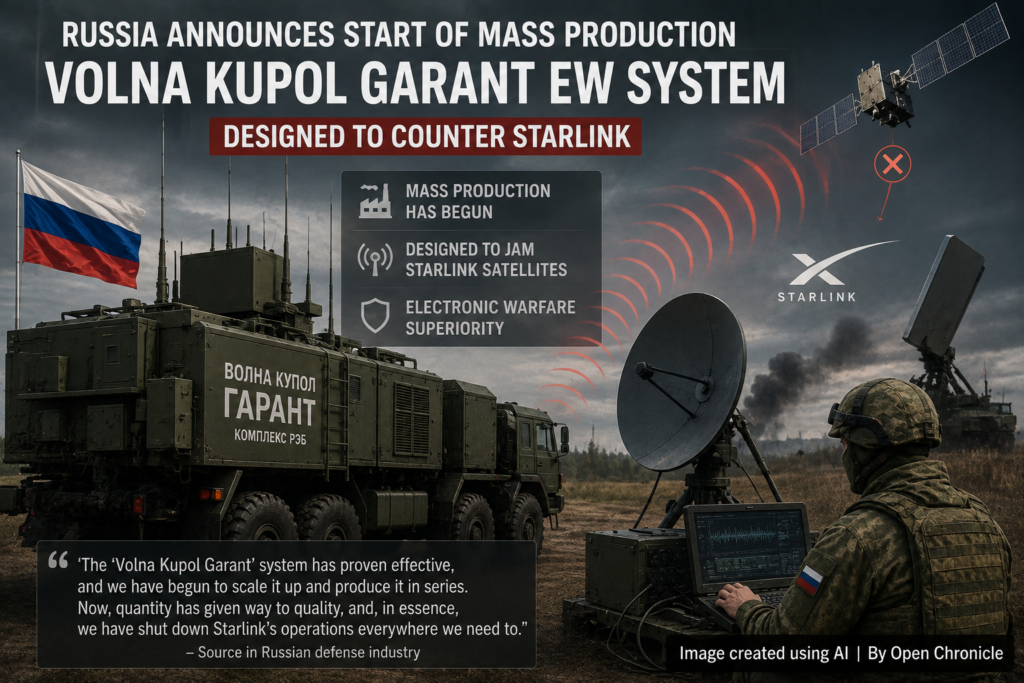
Russia has announced the start of mass production of a new electronic warfare system designed to disrupt Starlink satellite communications, highlighting the growing importance of space based connectivity and electronic warfare in modern conflicts.
The system, known as Volna Kupol Garant, has reportedly completed operational testing and is now being produced on a larger scale, according to information published by Russian state news agency TASS.
A source identified as being within Russia’s defence industry claimed that the system had demonstrated sufficient effectiveness to move into serial production.
According to the source, Russian forces have been able to disrupt Starlink communications in selected operational areas and are now expanding production of the equipment.
The claims have not been independently verified, and the information released publicly does not provide detailed technical evidence demonstrating the system’s effectiveness against Starlink.
Electronic Warfare Targets Satellite Connectivity
Starlink has become an important communications technology on the modern battlefield because its network of low Earth orbit satellites can provide broadband connectivity even where conventional terrestrial communications infrastructure has been destroyed or disrupted.
That capability has made satellite communications particularly valuable during the war in Ukraine.
For electronic warfare forces, however, disrupting such networks presents a different challenge from jamming traditional military radio communications.
Rather than necessarily interfering directly with satellites in orbit, electronic warfare systems can attempt to disrupt the radio frequency connection between satellite terminals on the ground and the satellites passing overhead.
The effectiveness of such operations depends on numerous factors, including frequency coverage, transmitter power, antenna configuration, distance from the targeted terminals and countermeasures incorporated into the communications network.
Moscow Claims Operational Success
The Russian defence industry source quoted by TASS presented Volna Kupol Garant as having already demonstrated operational effectiveness.
“The ‘Volna Kupol Garant’ system has proven effective, and we have begun to scale it up and produce it in series,” the source said.
The source further claimed that Russia had effectively disrupted Starlink “everywhere we need to.”
That assertion should be treated cautiously. No independently verifiable data was provided alongside the announcement to establish the geographical extent, duration or reliability of the reported disruption.
It is also unclear from the information released whether Volna Kupol Garant is intended primarily for protecting individual military positions, creating larger electronic warfare zones or operating as part of a broader network of Russian jamming systems.
Starlink and the Electronic Warfare Contest
The announcement reflects a technological contest that has developed alongside conventional fighting.
Satellite communications networks offer military units resilient connectivity across large areas without requiring extensive fixed infrastructure. Electronic warfare forces, meanwhile, attempt to identify vulnerabilities in those connections and deny communications during critical periods.
This produces a continuous cycle of adaptation.
When jamming becomes effective, communications providers and military operators can respond through software changes, modifications to frequencies, improvements in antennas and other techniques intended to increase resistance to interference.
Electronic warfare systems must subsequently adapt to those countermeasures.
The result is not necessarily permanent communications denial, but an evolving competition between jammers and increasingly resilient satellite networks.
Mass Production Could Increase Battlefield Presence
The transition from experimental or limited production to serial manufacturing could be significant if Russia is able to deploy Volna Kupol Garant systems in substantial numbers.
Electronic warfare equipment distributed across multiple sectors could potentially create overlapping areas of interference, complicating the use of satellite terminals close to the front.
Quantity is particularly important because electronic warfare systems have geographical limitations. A single jammer cannot necessarily disrupt communications across an entire theatre of operations.
A larger network could therefore allow Russian forces to concentrate electronic warfare coverage around strategically important positions, command centres or sections of the battlefield.
However, without independent information regarding the system’s range, output, deployment numbers and operational performance, it remains impossible to determine how significant the new system will become.
Satellite Communications Become a Battlefield Priority
Russia’s announcement demonstrates how access to satellite connectivity has become an increasingly important dimension of warfare.
Communications networks are essential for command and control, intelligence distribution, battlefield coordination and the operation of increasingly connected military systems.
As those networks become more dependent on satellites, electronic warfare capabilities designed to interfere with satellite links are likely to receive greater investment.
Volna Kupol Garant therefore represents part of a wider effort to contest the electromagnetic environment rather than simply another standalone weapons system.
Whether Russia’s claims of widespread success against Starlink can be independently demonstrated remains unclear. What is evident is that Moscow considers disrupting satellite communications important enough to move specialised electronic warfare equipment into mass production.