
By Open Chronicle News Desk
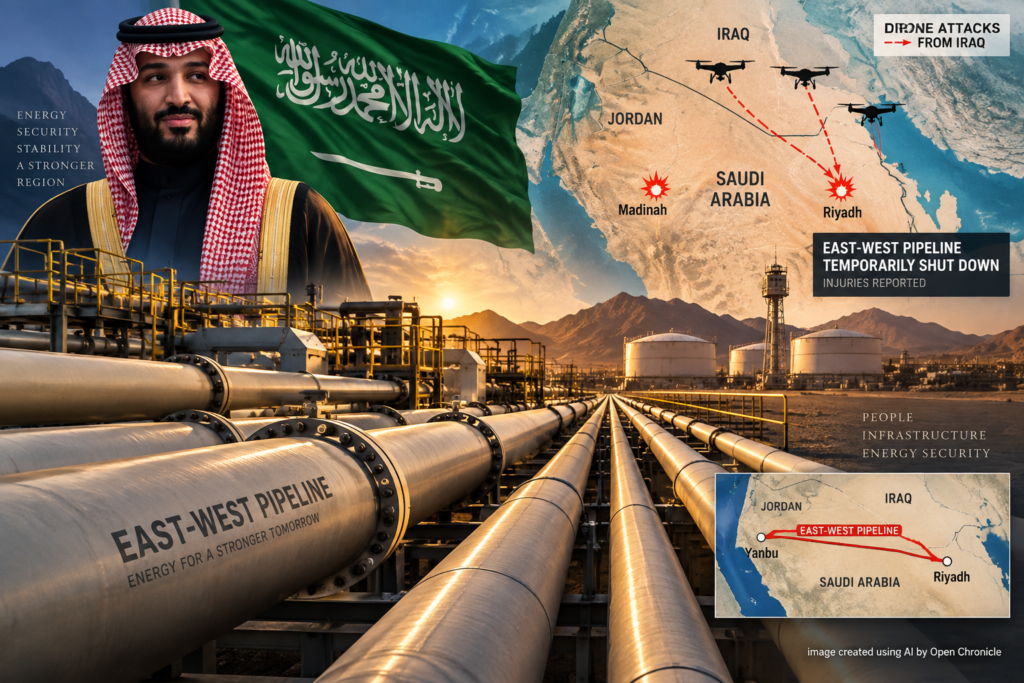
Saudi Arabia has temporarily shut its strategically important East West Pipeline after multiple drones launched from Iraq struck sections of the network in the Riyadh and Madinah regions, injuring several people and causing damage to infrastructure.
The Saudi Energy Ministry said the attacks took place on Thursday morning and that the pipeline was closed as a precaution while emergency and technical teams assessed its condition.
Riyadh strongly condemned the strikes but said it would not retaliate “at this stage” after the Iraqi government asked for time to investigate and prevent further attacks from being launched from its territory.
The incident represents another serious threat to Saudi energy infrastructure at a time when regional conflict has placed growing pressure on oil transportation routes across the Gulf and Red Sea.
Multiple drones target Saudi pipeline
An official source at the Saudi Energy Ministry said several drones struck the East West Pipeline in the Riyadh and Madinah regions.
A number of people were injured and received medical treatment, although authorities did not disclose how many were hurt or provide details about their condition.
The attacks also caused damage to the pipeline.
Emergency and specialized technical teams were immediately deployed to secure the affected infrastructure and determine whether it could safely resume operations.
The ministry said additional information would be released as assessments continued.
A critical alternative to the Strait of Hormuz
The East West Pipeline is one of the most strategically important components of Saudi Arabia’s energy infrastructure.
It transports crude oil from the kingdom’s main producing areas in the east across the Arabian Peninsula to facilities on the Red Sea coast, allowing Saudi Arabia to export substantial volumes without relying entirely on the Strait of Hormuz.
That alternative has become particularly important during the current regional conflict as instability around Hormuz has disrupted maritime traffic and increased risks for tankers.
Any sustained interruption to the East West Pipeline could therefore have implications well beyond Saudi Arabia, particularly if other export routes remain under pressure.
The Saudi government has not indicated how long the precautionary shutdown will last.
Riyadh says drones originated in Iraq
Saudi Arabia’s Foreign Ministry said the drones responsible for the attacks came from Iraqi territory.
The kingdom condemned the operation and warned that attacks against its energy infrastructure threaten not only Saudi security but potentially the stability of regional energy supplies.
Despite the seriousness of the incident, Riyadh said it had decided against immediate retaliation.
The decision followed a request from Iraqi Prime Minister Ali al-Zaidi, who asked Saudi Arabia to allow Baghdad to take measures against those responsible and prevent Iraqi territory from being used for further attacks against the kingdom or other neighboring countries.
Saudi Arabia said it supported the Iraqi government’s efforts.
However, Riyadh made clear that its restraint was conditional, stressing that it reserves the right to take whatever measures it considers necessary to protect its sovereignty, population and critical infrastructure.
Baghdad orders investigation
Iraq quickly condemned the drone attacks and rejected any operation threatening Saudi Arabia’s security or damaging relations between the two countries.
Al-Zaidi, who is also commander in chief of Iraq’s armed forces, ordered an investigation into how the attacks were launched and which individuals or organizations were responsible.
Authorities were also instructed to pursue legal action against anyone found to have participated.
The Iraqi government said it would not tolerate activities that endanger the country or undermine relations with neighboring states.
Baghdad also reiterated that Iraqi territory and airspace must not become launching points for attacks against other countries.
Its stated policy, the government said, is based on respect for national sovereignty and preventing Iraq from becoming an arena for wider regional confrontation.
Saudi restraint prevents immediate escalation
Saudi Arabia’s decision not to retaliate has, for now, reduced the danger of another round of military escalation involving Iraqi territory.
Baghdad welcomed the move, describing it as evidence of Riyadh’s commitment to Iraq’s stability and bilateral relations.
But the incident puts significant pressure on the Iraqi government to demonstrate that it can identify those responsible and prevent another attack.
The identity of the group behind Thursday’s operation was not established in the information provided.
The fact that Saudi Arabia says the drones originated in Iraq should therefore not be interpreted as evidence that the Iraqi government authorized the attack.
Tensions have been building since July
The latest incident follows an earlier confrontation involving drones launched from Iraq.
In late July, Saudi Arabia said it intercepted several drones attempting to strike oil installations in the Eastern Province and Riyadh region.
Riyadh blamed Iranian backed militias and called on Baghdad to prevent its territory from being used for attacks against Saudi Arabia.
Iraqi authorities subsequently pledged to stop unauthorized cross border operations and created a joint security committee to develop measures aimed at preventing further violations.
The crisis intensified on July 29 when US and Saudi forces carried out strikes against sites belonging to the Iranian aligned Popular Mobilization Forces in Iraq.
According to the PMF, 20 of its members were killed and another 32 were wounded.
Saudi Arabia said those strikes were conducted in self defense following attacks on its petroleum infrastructure.
Iraq faces growing pressure to control armed groups
The renewed drone attacks highlight a broader challenge for Baghdad.
Iraq occupies an increasingly difficult position amid the widening regional confrontation. The government maintains relations with Saudi Arabia and other Gulf states while powerful Iranian aligned political and armed organizations continue to operate inside the country.
Baghdad must therefore prevent unauthorized groups from conducting operations capable of dragging Iraq into conflicts with its neighbors.
The latest Saudi response gives the Iraqi government an opportunity to address the incident without immediately facing military retaliation.
Failure to prevent further attacks, however, could make continued Saudi restraint increasingly difficult.
Energy security under pressure across the region
The pipeline attack also fits into a larger pattern of mounting pressure on Middle Eastern energy infrastructure.
Saudi Arabia has traditionally regarded its East West Pipeline as a strategic safeguard against disruption in the Strait of Hormuz.
But instability is simultaneously increasing around the Red Sea, where Houthi advances in Yemen and threats to shipping around the Bab el Mandeb Strait have complicated Saudi Arabia’s alternative export routes.
This creates an increasingly difficult strategic environment.
The Strait of Hormuz faces conflict related disruption. Bab el Mandeb has become more dangerous. Now the land based pipeline designed to reduce Saudi dependence on those maritime chokepoints has itself been attacked.
For Riyadh, restoring the East West Pipeline is therefore about more than repairing damaged infrastructure. It is part of a wider effort to preserve the resilience of Saudi Arabia’s oil export network during one of the most unstable periods for regional energy security in years.
Saudi Arabia has chosen restraint for now. Whether that continues may depend on Baghdad’s ability to establish who launched the drones and ensure that Thursday’s attack is not repeated.