
By Open Chronicle with agencies
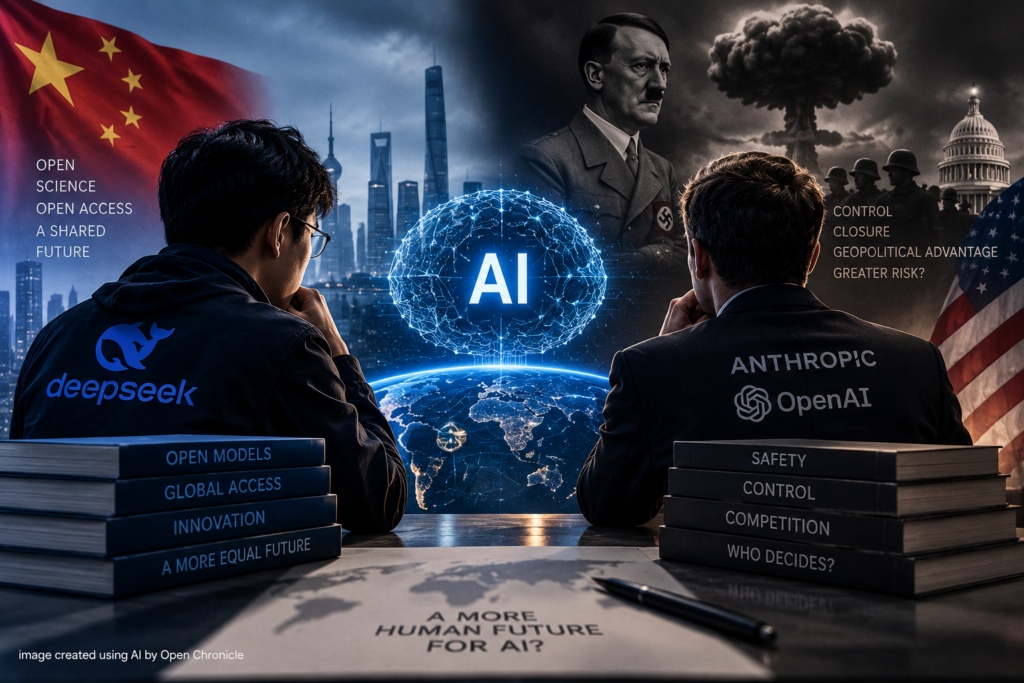
A Chinese engineer at DeepSeek has launched an unusually sharp attack on the prospect of a small group of American technology companies controlling the world’s most powerful artificial intelligence, comparing such a concentration of technological power to Nazi Germany obtaining an atomic weapon before the Allies.
Liu Shengyu, a machine learning systems engineer working on DeepSeek’s V4.1 model, argued in a Chinese language blog post that cutting edge artificial intelligence should remain broadly accessible, affordable and open.
His comments come as the global debate over AI safety increasingly overlaps with strategic competition between the United States and China, with some American researchers calling for slower development while Chinese voices warn that such restrictions could reinforce US technological dominance.
DeepSeek engineer warns against concentrated AI power
“I believe cutting edge intelligence should be made available to everyone in an open and affordable manner,” Liu wrote.
He said he did not trust Anthropic or OpenAI to guarantee that outcome, specifically expressing concern about the possibility of Anthropic eventually controlling the world’s most capable artificial intelligence or artificial general intelligence.
Liu then used an extreme historical analogy to describe the danger he believes that could create, comparing it to Adolf Hitler obtaining atomic bomb technology before the Allied powers.
The comparison reflects Liu’s personal argument rather than an official DeepSeek or Chinese government position.
Artificial general intelligence, commonly known as AGI, generally refers to hypothetical AI systems capable of performing a broad range of intellectual tasks at or beyond human levels.
No consensus exists over when, or whether, such systems will be developed.
Open source versus closed AI
At the heart of Liu’s argument is a growing divide over how the most powerful AI systems should be developed and distributed.
DeepSeek has built much of its international profile around models released with comparatively open access, challenging the more controlled approach used by several leading American AI laboratories.
Liu argued that access to increasingly powerful intelligence could eventually become important not only for businesses and governments, but also for individuals seeking economic and social opportunities.
As AI becomes more capable, he suggested, access to the strongest systems could influence people’s ability to overcome economic disadvantages.
That raises a broader question now confronting the technology industry: whether frontier AI should be treated as a widely available technological resource or as a potentially dangerous capability requiring strict controls.
Anthropic chief calls for slower development
Liu’s intervention follows renewed warnings from Anthropic CEO Dario Amodei about the risks associated with increasingly capable artificial intelligence.
Amodei called over the weekend for AI development to slow and for frontier systems to face closer monitoring. He also proposed allowing independent third party evaluators inside leading AI companies to assess their systems.
At the same time, Amodei argued that any regulatory framework should avoid unnecessarily sacrificing the commercial competitiveness of companies developing advanced AI.
Concerns within the industry have become increasingly public.
Former Anthropic researcher Jacob Coxon recently resigned after accusing leading AI companies of failing to behave responsibly as the technology advances.
Evan Hubinger, who leads alignment science work at Anthropic, has separately said that his personal estimate of the probability that AI could cause human extinction within the next decade exceeds 10 percent.
Such estimates remain deeply contested among researchers, and there is no scientific consensus about the probability of catastrophic outcomes from future AI.
China pushes back against AI slowdown proposals
The debate has also become increasingly geopolitical.
The Dongbuyaqiao Research Institute, an independent Chinese research platform, suggested on Tuesday that Amodei’s proposals could represent an effort to secure greater influence over AI industry rules before international standards are firmly established.
China’s Foreign Ministry has also criticized approaches to AI governance based on geopolitical confrontation.
Foreign Ministry spokesperson Guo Jiakun said on Monday that “fearmongering, confrontation and vicious competition” would undermine efforts to establish effective global governance for artificial intelligence.
A commentary published by the state run Global Times went further, characterizing Amodei’s proposals as part of what it called a “silent AI Cold War.” It argued that restrictions promoted in the name of safety could ultimately preserve America’s technological advantage while limiting China’s influence over international AI governance.
These arguments reflect a wider concern in Beijing that Western restrictions on advanced semiconductors, computing infrastructure and AI technologies could increasingly shape the international development of the sector.
Safety debate collides with US China competition
The disagreement exposes one of the central dilemmas facing the AI industry.
If the most advanced systems become substantially more capable, governments may have legitimate reasons to restrict access to technologies that could potentially be misused. Yet concentrating those systems in the hands of a small number of corporations or countries could itself create economic and political risks.
The United States and China are therefore confronting two competing concerns at the same time: preventing potentially dangerous AI capabilities from spreading without adequate safeguards while avoiding a world in which access to advanced intelligence becomes controlled by only a handful of institutions.
US President Donald Trump has rejected proposals that would significantly slow American AI development, arguing that restrictions could allow China to gain the technological advantage.
That position places Washington’s strategic competition with Beijing directly alongside the debate over AI safety.
A battle over who controls the AI frontier
The disagreement between Liu and prominent American AI executives ultimately extends beyond DeepSeek and Anthropic.
It concerns who will control the next generation of artificial intelligence, who will have access to it, and who will establish the rules governing its development.
One camp argues that increasingly powerful systems require stronger safeguards, controlled access and independent oversight. Another warns that excessive restrictions could concentrate unprecedented technological power inside a small number of corporations and governments.
As American and Chinese laboratories push toward increasingly capable systems, those competing visions are likely to become an important part of the wider geopolitical contest over artificial intelligence.
The race is no longer simply about which country or company builds the most capable model. Increasingly, it is also about who gets to use that intelligence, who decides what is considered too dangerous to release, and who ultimately writes the rules for the AI era.