
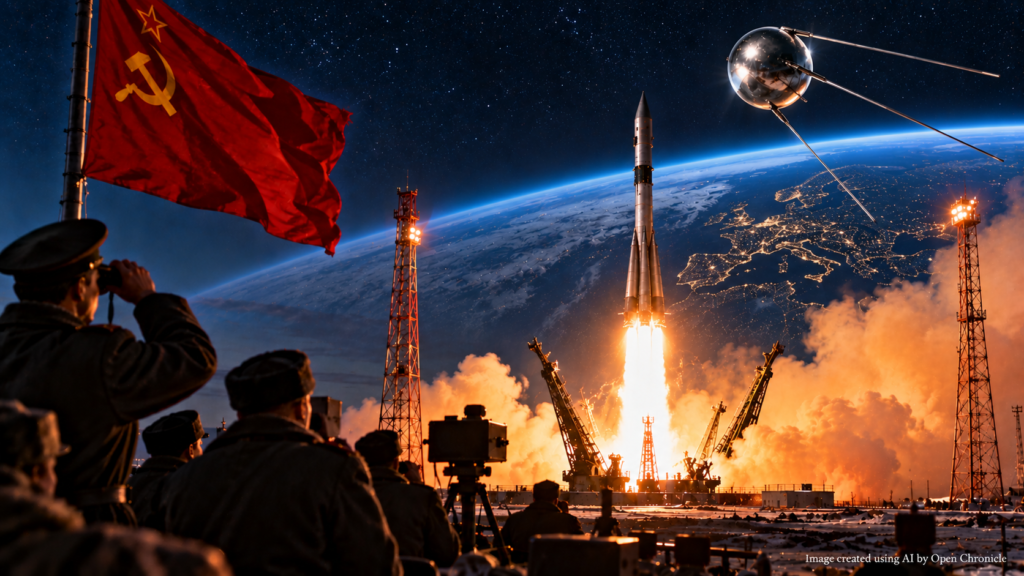
How a polished metal sphere transmitting a simple radio signal opened the Space Age, transformed the Cold War and began humanity’s journey beyond Earth
By Open Chronicle History Desk
On the evening of October 4, 1957, a rocket rose from the steppes of Soviet Kazakhstan.
At its summit was a remarkably simple machine.
A polished metal sphere.
Four long antennas.
A radio transmitter.
No cameras.
No crew.
No sophisticated scientific laboratory.
Its name was Sputnik 1.
Within minutes, it had achieved something no human civilization had accomplished before.
It was orbiting Earth.
For the first time in history, humanity had placed an artificial object into orbit around its own planet.
Sputnik measured only about 58 centimetres in diameter and weighed approximately 83.6 kilograms. Its elliptical orbit carried it around Earth roughly every hour and a half.
Yet the significance of the satellite could not be measured by its size.
Sputnik demonstrated that rockets could reach orbital velocity.
It shocked the United States.
It transformed scientific education.
It accelerated missile and satellite development.
It contributed directly to the creation of NASA.
It began the Space Race.
And within twelve years, that competition would carry human beings to the surface of the Moon.
The Space Age had begun.
1. Humanity Dreams of Space
Long before rockets could reach orbit, humans imagined travelling beyond Earth.
Ancient civilizations observed the movements of planets and stars.
Astronomers gradually transformed those observations into increasingly sophisticated models of the cosmos.
The scientific revolution changed humanity’s understanding of the heavens.
Copernicus placed the Sun rather than Earth at the center of the planetary system.
Kepler described planetary motion mathematically.
Galileo used the telescope to reveal mountains on the Moon and moons orbiting Jupiter.
Newton explained how gravity governed both falling objects and celestial bodies.
But understanding space was one thing.
Reaching it was another.
For centuries, the technology simply did not exist.
2. Konstantin Tsiolkovsky
One of the intellectual foundations of modern astronautics emerged in Imperial Russia.
Konstantin Tsiolkovsky, a largely self-taught Russian schoolteacher and theorist, explored mathematically how rockets might travel beyond Earth’s atmosphere.
In 1903, he published work describing rocket propulsion and the principles underlying spaceflight.
He understood a fundamental problem.
A spacecraft had to accelerate to enormous speed to remain in orbit.
Ordinary aircraft could never accomplish this.
Rockets could.
Tsiolkovsky also explored concepts including multistage rockets, space stations and journeys through the Solar System.
Much of it seemed fantastical.
Half a century later, engineers would begin turning those ideas into machines.
3. Rockets Become Weapons
Rocket technology developed rapidly during the Second World War.
Nazi Germany produced the V-2, the world’s first long-range guided ballistic missile.
Designed by a team that included Wernher von Braun, the V-2 reached altitudes beyond the conventional atmosphere during some flights.
But it was not built for peaceful exploration.
It was a weapon.
Thousands were launched against cities including London and Antwerp.
Its production also depended on brutal forced labor in the Mittelwerk underground factory complex, where thousands of prisoners died.
The history of spaceflight therefore contains a dark paradox.
Some of the technologies that eventually carried humans into space were accelerated by military programs developed during one of history’s most destructive wars.
4. The Scientists of the V-2
When Nazi Germany collapsed in 1945, the United States and Soviet Union both sought German rocket technology, documents and specialists.
The United States brought von Braun and other German engineers to America through Operation Paperclip.
The Soviet Union also captured equipment and recruited or transferred German specialists.
Both superpowers studied the V-2.
Both began developing more powerful rockets.
And both quickly recognized that the same fundamental technology had two very different possibilities.
A rocket could carry a warhead across continents.
Or it could carry something into space.
5. Sergei Korolev
At the center of the Soviet effort stood one of the most important figures in the history of spaceflight.
Sergei Pavlovich Korolev.
His identity was kept secret from the wider public for much of his career.
Official Soviet reports usually referred to him simply as the Chief Designer.
Korolev had survived imprisonment during Stalin’s purges before returning to rocket development.
After the war, he became a central architect of the Soviet missile and space programs.
His greatest early engineering achievement would be the R-7.
6. The R-7
The R-7 was designed primarily as an intercontinental ballistic missile.
Its military purpose was unmistakable.
The Soviet Union wanted a rocket capable of delivering a nuclear weapon over intercontinental distances.
But its enormous lifting capability made something else possible.
The R-7 could place an object into Earth orbit.
That meant the Soviet Union possessed not merely a missile.
It possessed the foundation of a space launch vehicle.
Korolev understood the opportunity.
7. The International Geophysical Year
The immediate scientific context for Sputnik was the International Geophysical Year, or IGY.
Running from July 1957 through December 1958, the IGY brought scientists from many countries together to study Earth and its environment.
Research included the atmosphere, oceans, polar regions, geomagnetism and cosmic phenomena.
Scientists also proposed launching artificial satellites.
The United States announced plans for an orbital satellite.
The Soviet Union planned one as well.
The race was underway, even if the wider public did not yet fully understand it.
NASA’s historical account notes that the international scientific community had called for artificial satellite launches during the IGY, while the United States selected Project Vanguard for its contribution.
8. Object D
Korolev originally intended to launch a sophisticated Soviet scientific satellite.
The project was known as Object D.
It would carry numerous instruments.
But development was taking too long.
Korolev knew the Americans were also preparing a satellite.
Being first mattered.
So the Soviet team changed strategy.
Instead of waiting for the complex scientific spacecraft, engineers would build something far simpler.
A small satellite.
A transmitter.
Batteries.
Antennas.
Enough to prove that the Soviet Union could place an object into orbit.
NASA’s history records that delays to Object D led Soviet authorities to authorize the simpler satellite that became Sputnik. NASA
9. A Metal Sphere
Sputnik’s design became iconic.
The satellite was approximately spherical and made from polished aluminium alloy.
Four long antennas extended behind it.
Inside were radio transmitters, batteries, temperature and pressure monitoring equipment and other basic systems.
Its radio transmitters operated on frequencies that could be received by observers on Earth.
The satellite itself was extraordinarily simple compared with later spacecraft.
But simplicity was part of its strength.
The Soviet engineers did not need Sputnik to conduct an elaborate scientific mission.
They needed it to reach orbit.
And to prove that it was there.
10. Baikonur
The launch took place from a remote Soviet rocket facility in Kazakhstan.
The site would later become famous as the Baikonur Cosmodrome.
At the time, secrecy surrounded Soviet missile development.
The R-7 stood on the launch pad carrying Sputnik at its summit.
Years of theoretical work, military research, engineering experiments and failed tests had led to this moment.
On October 4, 1957, the countdown proceeded.
Then the engines ignited.
11. October 4, 1957
The R-7 rose from the launch complex in a column of flame.
Its boosters burned.
Stages separated.
The vehicle accelerated.
Finally Sputnik reached the speed necessary to remain in orbit.
The satellite separated from the rocket.
NASA’s historical monograph places liftoff at approximately 10:26 p.m. Moscow time.
Earth had acquired something entirely new.
An artificial satellite.
12. Beep. Beep. Beep.
Sputnik’s most famous feature was not something people could see.
It was something they could hear.
Its radio transmitter broadcast repeated pulses.
Beep.
Beep.
Beep.
Radio operators around the world could tune their equipment and receive the signal.
The sound was technologically simple.
Psychologically, it was extraordinary.
Every pulse demonstrated that the satellite was still above them.
Every pulse demonstrated that Soviet engineering had reached space.
NASA notes that Sputnik’s signal could be monitored by amateur radio operators around the world.
The sound became the soundtrack of the beginning of the Space Age.
13. The First Orbit
Sputnik travelled around Earth repeatedly.
NASA gives its orbital period as approximately 98 minutes for the elliptical path, although contemporary and historical summaries sometimes round the figure differently as the orbit evolved.
That meant the satellite could cross enormous portions of the planet in little more than an hour and a half.
Borders meant nothing to it.
The Soviet satellite passed above countries that had no control over its movement.
This introduced another important concept.
Spacecraft could orbit over national territory.
That principle would become essential for communications satellites, weather satellites, Earth observation and reconnaissance.
14. A New Moon
News spread quickly.
The Soviet Union announced that it had successfully launched the world’s first artificial Earth satellite.
NASA’s account of the night records Radio Moscow announcing in the early hours that Earth effectively had a new Soviet-made moon.
Newspapers around the world rushed the story onto their front pages.
Scientists celebrated the technical achievement.
But the reaction was not purely scientific.
Sputnik had been launched during the Cold War.
And the rocket that carried it into orbit had military implications.
15. The Shock in America
For many Americans, Sputnik was deeply unsettling.
The United States had widely been perceived as the world’s leading technological power.
Yet the Soviet Union had reached orbit first.
The psychological impact was enormous.
The Eisenhower Presidential Library describes how the launch generated fear that a Soviet Union capable of placing a satellite in orbit might also possess rockets capable of delivering nuclear weapons to the United States.
The logic was frighteningly simple.
If a rocket could place Sputnik above America, what else could a rocket carry?
16. The Missile Question
Sputnik itself was harmless.
It carried no weapon.
But its launch vehicle demonstrated powerful rocket technology.
This was why the satellite’s significance extended far beyond astronomy.
Orbital launch vehicles and long-range ballistic missiles shared many fundamental engineering challenges.
Propulsion.
Guidance.
Staging.
High-speed flight.
Reliable engines.
The Space Race and the nuclear arms race were therefore technologically intertwined.
Sputnik was both a scientific achievement and a demonstration of strategic capability.
17. The Sputnik Crisis
American newspapers, politicians and commentators began asking uncomfortable questions.
Had the Soviet Union overtaken the United States technologically?
Was American science falling behind?
Were schools producing enough scientists and engineers?
Was national defense vulnerable?
Was there a “missile gap”?
Some fears were exaggerated.
The United States possessed enormous scientific and technological capabilities.
President Dwight D. Eisenhower initially sought to prevent panic.
But the political consequences were impossible to ignore.
A new national debate had begun.
18. Project Vanguard
The United States had already been developing its own satellite under Project Vanguard.
But after Sputnik, the programme was suddenly operating under intense public scrutiny.
On December 6, 1957, Vanguard attempted to launch a small satellite from Cape Canaveral.
Television cameras were watching.
The rocket rose only slightly from the launch pad.
Then it lost thrust.
It fell back.
And exploded.
The failure became an international embarrassment.
Meanwhile, Sputnik had already been circling Earth.
19. Sputnik 2
The Soviet Union moved even faster than many observers expected.
Less than a month after Sputnik 1, on November 3, 1957, the Soviet Union launched Sputnik 2.
This spacecraft carried a living passenger.
A dog named Laika.
For the first time, a living creature from Earth had been placed into orbit.
Laika did not survive the mission.
The spacecraft had not been designed for recovery.
The mission nevertheless demonstrated another possibility.
If an animal could survive launch and at least temporarily function in orbit, perhaps a human eventually could as well.
20. Explorer 1
The United States responded.
On January 31, 1958, Explorer 1 became the first successful American satellite.
The launch team included the Army Ballistic Missile Agency, the Jet Propulsion Laboratory and scientists led by James Van Allen.
Unlike Sputnik 1, Explorer 1 carried scientific instruments.
Its measurements helped reveal the radiation regions around Earth now known as the Van Allen belts.
The United States had entered the Space Age.
Now the competition accelerated.
21. America Reorganizes Science
Sputnik produced consequences far beyond rockets.
American policymakers became increasingly concerned about science and mathematics education.
Investment expanded.
Research programs grew.
Technical education received greater political attention.
In 1958, Eisenhower signed the National Defense Education Act, providing federal support for education in areas considered strategically important.
The Eisenhower Presidential Library describes Sputnik as a catalyst for a major national focus on scientific and technical talent.
The satellite was changing classrooms as well as laboratories.
22. NASA
One institutional consequence was especially important.
The United States needed a coordinated civilian space agency.
On July 29, 1958, President Eisenhower signed the National Aeronautics and Space Act.
It created the National Aeronautics and Space Administration.
NASA formally began operations on October 1, 1958.
Less than one year after Sputnik, the organization that would eventually send astronauts to the Moon existed.
The Soviet satellite had helped transform the structure of American science and space policy.
23. The Race for Firsts
What followed was an extraordinary technological competition.
The Soviet Union achieved a remarkable sequence of early milestones.
First artificial satellite.
First animal in orbit.
First spacecraft to reach the vicinity of the Moon.
First images of the Moon’s far side.
Then came the most dramatic achievement yet.
A human being would leave Earth.
24. Yuri Gagarin
On April 12, 1961, Soviet cosmonaut Yuri Gagarin launched aboard Vostok 1.
He completed one orbit of Earth.
Gagarin became the first human in space.
The symbolic effect was immense.
Only three and a half years had passed since Sputnik.
The Soviet Union had now achieved another historic first.
American pressure intensified.
President John F. Kennedy soon chose an objective so difficult that accomplishing it would require a technological mobilization on an unprecedented scale.
The Moon.
25. The Moon Race
On May 25, 1961, Kennedy called for the United States to land a man on the Moon and return him safely to Earth before the decade ended.
The Apollo programme transformed that goal into engineering reality.
New rockets.
New spacecraft.
New computers.
New navigation systems.
New spacesuits.
New tracking networks.
And the most powerful operational launch vehicle ever built at the time:
Saturn V.
The journey from Sputnik to Apollo had taken barely more than a decade.
26. July 20, 1969
On July 20, 1969, Apollo 11 landed on the Moon.
Neil Armstrong and Buzz Aldrin walked across the lunar surface while Michael Collins remained in lunar orbit.
NASA notes the remarkable chronology.
Less than twelve years separated Sputnik’s launch from the first human landing on the Moon.
The transformation was astonishing.
In 1957, humanity had never placed even a small artificial satellite in orbit.
By 1969, human beings were walking on another world.
27. Satellites Transform Civilization
The importance of Sputnik extends beyond the Space Race.
Sputnik demonstrated the practical reality of artificial satellites.
Today, modern civilization depends upon them.
Satellites provide weather observations.
Global communications.
Television broadcasting.
Navigation.
Scientific research.
Disaster monitoring.
Environmental observation.
Military reconnaissance.
Climate measurements.
Internet connectivity.
Agricultural monitoring.
Search and rescue.
The invisible infrastructure above Earth has become deeply integrated into life below it.
28. From Sputnik to GPS
Consider navigation.
For most of human history, travellers determined their position using landmarks, maps, compasses, stars and increasingly sophisticated instruments.
Today, satellite navigation systems can calculate location with extraordinary precision.
Cars.
Aircraft.
Ships.
Smartphones.
Surveyors.
Farm machinery.
Emergency services.
Financial networks.
All rely in various ways on timing and positioning signals transmitted from orbit.
The technological world created after Sputnik now surrounds everyday life.
29. Weather From Space
Before the satellite age, meteorologists had only limited information about large weather systems over oceans and remote regions.
Spacecraft changed that.
Weather satellites could observe cloud formations across entire continents and oceans.
Storms could be tracked.
Hurricanes could be monitored.
Atmospheric patterns could be studied globally.
A technological concept demonstrated by Sputnik ultimately helped give humanity something unprecedented:
the ability to observe its own planet as a planetary system.
30. Earth Becomes Visible
Perhaps one of the most profound consequences of spaceflight was philosophical rather than technological.
Before the Space Age, no human being had seen Earth from space.
Then satellites and spacecraft began sending images home.
Astronauts later photographed the planet from orbit and from the Moon.
Earth appeared as a sphere suspended in darkness.
Borders were invisible.
The atmosphere looked thin.
The planet appeared finite.
Space exploration changed not only what humanity could reach.
It changed how humanity could see itself.
31. Sputnik’s Short Life
Sputnik’s operational life was brief.
Its batteries eventually failed on October 26, 1957, ending the famous radio transmissions.
But the satellite remained in orbit.
Gradually, atmospheric drag lowered its trajectory.
On January 4, 1958, Sputnik re-entered Earth’s atmosphere and burned up.
It had existed in orbit for only a few months.
Its historical influence would last far longer.
32. The Man Behind Sputnik
Sergei Korolev did not become internationally famous during Sputnik’s triumph.
The Soviet government kept his identity secret.
To the outside world, the achievements of the Soviet space programme appeared almost anonymous.
Korolev continued directing ambitious projects.
Sputnik.
Lunar probes.
Vostok.
Gagarin.
Voskhod.
Early work toward more ambitious lunar missions.
He died in 1966.
Only afterward did his role become widely known.
Today he is recognized as one of the principal architects of the Space Age.
33. The Cold War Paradox
Sputnik illustrates one of the great paradoxes of the twentieth century.
The Space Age produced extraordinary scientific discoveries.
But much of its technological acceleration came from military rivalry.
Rockets designed in the shadow of nuclear war became vehicles for scientific exploration.
Competition between hostile superpowers produced satellites that eventually transformed peaceful communication and research.
The same technological family produced both intercontinental missiles and lunar spacecraft.
Human ingenuity and geopolitical fear developed side by side.
34. Cooperation Eventually Replaces Competition
The Space Race did not remain purely competitive forever.
In 1975, an American Apollo spacecraft docked with a Soviet Soyuz spacecraft during the Apollo-Soyuz Test Project.
American astronauts and Soviet cosmonauts met in orbit.
The symbolic contrast with Sputnik was striking.
In 1957, space had become a new arena of superpower rivalry.
By the 1970s, it could also become a place of cooperation.
After the Cold War, that cooperation expanded dramatically.
35. The International Space Station
The International Space Station eventually brought together the United States, Russia, Europe, Japan, Canada and other partners in one of the largest cooperative scientific projects ever attempted.
Humans began living continuously in orbit.
Experiments were conducted in microgravity.
Spacecraft from different countries routinely travelled to the same orbital laboratory.
The technology had evolved enormously.
But the basic principle remained the one demonstrated in October 1957.
Accelerate an object sufficiently fast around Earth, and gravity becomes the force that keeps it in orbit.
36. Thousands of Satellites
Sputnik entered an almost empty orbital environment.
Today, thousands of active satellites orbit Earth, alongside inactive spacecraft, spent rocket stages and fragments of orbital debris.
This creates a new problem that Korolev’s engineers could scarcely have imagined at the beginning of the Space Age.
Space traffic.
Collision risk.
Orbital debris.
Satellite regulation.
Military competition.
Commercial constellations.
Humanity has not merely reached space.
It has begun building infrastructure there.
37. From One Satellite to Other Worlds
The technological lineage that followed Sputnik now extends far beyond Earth orbit.
Spacecraft have visited every planet in the Solar System.
Robotic probes have landed on Mars.
Spacecraft have descended through the atmosphere of Venus.
Others have explored Jupiter and Saturn.
Probes have encountered asteroids and comets.
Voyager spacecraft have travelled into interstellar space.
Telescopes orbiting above Earth’s atmosphere observe galaxies billions of light-years away.
All of this belongs to the era that began when Sputnik crossed the sky.
38. Why October 4 Matters
October 4, 1957 represents one of those rare moments when human history clearly divides into a before and an after.
Before Sputnik, spaceflight remained largely experimental, theoretical or fictional.
After Sputnik, orbital space became a domain of human activity.
The satellite itself was primitive by modern standards.
A metal sphere.
Batteries.
Antennas.
A radio transmitter.
But historical importance does not always belong to the most complicated machine.
Sometimes it belongs to the first machine that proves something previously impossible can actually be done.
Sputnik did exactly that.
October 4, 1957: The Night Earth Acquired a Second Moon
Imagine standing outside on an autumn night in 1957.
There are no communications satellites overhead.
No GPS constellation.
No weather satellites.
No International Space Station.
No astronauts.
No footprints on the Moon.
No robotic spacecraft on Mars.
Human civilization exists entirely below the boundary of space.
Then somewhere above you, invisible against the darkness, a small polished sphere crosses the sky.
A radio receiver begins to pulse.
Beep.
A pause.
Beep.
Another pause.
Beep.
The signal contains no speech.
It carries no great scientific message.
It does not need one.
The message is the existence of the signal itself.
Something made by human hands is circling the Earth.
For thousands of years, humanity had looked upward at the Moon, planets and stars.
On October 4, 1957, humanity finally placed something among them.
The object would burn up only three months later.
But there would be no return to the world that existed before it.
The Space Age had begun.