
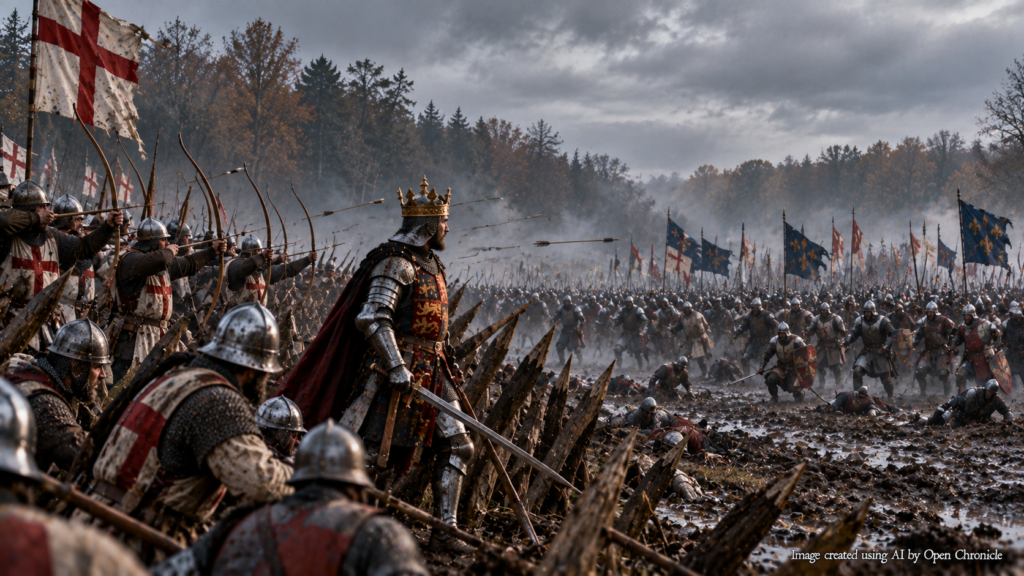
How Henry V’s exhausted army defeated a larger French force in the mud of northern France, and why one of the most famous battles of the Hundred Years’ War remains a subject of historical debate.
By Open Chronicle History Desk
On the morning of October 25, 1415, an exhausted English army prepared for battle in the countryside of northern France.
Its soldiers were hungry.
Many were ill.
They had marched for days through hostile territory.
Their king, Henry V of England, had brought them across the English Channel in pursuit of a dynastic claim to the French throne.
But the campaign had gone badly.
A lengthy siege had weakened the army.
Disease had taken its toll.
The English were attempting to reach the safety of Calais when a French force blocked their route.
Near the village of Azincourt, known in English as Agincourt, the two armies faced one another across muddy fields.
The French possessed more men, particularly heavily armored men-at-arms.
They expected to defeat the English and end Henry’s campaign.
Instead, the battle became one of the most famous English victories of the Middle Ages.
French attacks lost momentum in difficult terrain.
The crowded battlefield made movement increasingly difficult.
English archers helped disrupt the advancing enemy, while dismounted men-at-arms fought at close quarters.
By the end of the engagement, the French army had suffered a devastating defeat.
Many members of the French nobility were dead or captured.
Henry V had secured a victory that would transform his political reputation and strengthen England’s position in the Hundred Years’ War.
Yet Agincourt was not simply a triumph of heroic archers over arrogant knights.
The battle involved tactical decisions, logistical problems, environmental conditions and the political divisions of medieval France.
Even the numbers of men who fought and died remain disputed.
And one of the most controversial episodes came after the English victory appeared secure, when Henry ordered the killing of many French prisoners.
To understand Agincourt, it is necessary to look beyond the legend.
It was a military victory of extraordinary significance.
It was also a brutal encounter in a prolonged conflict that devastated communities on both sides of the Channel.
1. The Hundred Years’ War
The Hundred Years’ War was a series of conflicts between the English and French crowns.
It began in 1337 and continued, with interruptions, until 1453.
The struggle concerned dynastic claims, territorial possessions, political authority and economic interests.
English kings claimed rights to the French throne through their ancestry.
French rulers rejected those claims.
The conflict became one of the defining struggles of late medieval Western Europe.
It was not a single continuous war.
Instead, it consisted of campaigns, truces, alliances and renewed fighting over more than a century.
2. England’s Claims in France
English monarchs possessed a long history of territorial interests in France.
Following the Norman Conquest of England in 1066, the ruling dynasties maintained connections across the Channel.
Over time, disputes developed over lands, feudal obligations and royal authority.
By the fourteenth century, the English crown had advanced a claim to the French throne.
The claim became central to the Hundred Years’ War.
Henry V inherited this political and dynastic ambition.
His invasion of France in 1415 was intended to strengthen his position through military success.
3. Henry V Becomes King
Henry V became King of England in 1413.
He was a member of the House of Lancaster.
His father, Henry IV, had taken the throne from Richard II in 1399.
The Lancastrian dynasty therefore faced questions of legitimacy.
Henry V sought to consolidate royal authority.
A successful military campaign in France could strengthen his domestic position and reinforce his claim to kingship.
The war also offered opportunities for prestige, territory and political influence.
4. France in Political Crisis
France was experiencing serious internal divisions.
King Charles VI suffered recurring episodes of mental illness.
His condition contributed to struggles over royal authority.
Powerful noble factions competed for influence.
The Armagnacs and Burgundians became central rivals.
Their conflict weakened the French monarchy.
The divisions made coordinated resistance to English military ambitions more difficult.
Henry V recognized that France’s political instability created opportunities.
5. The Armagnac-Burgundian Conflict
The rivalry between the Armagnacs and Burgundians became increasingly violent.
The conflict involved competing aristocratic networks, regional interests and control of royal government.
The assassination of Louis, Duke of Orléans, in 1407 intensified the crisis.
France moved toward civil conflict.
The rivalry affected military planning and political cooperation.
Although French nobles could unite against an English invasion, internal distrust remained a major problem.
Agincourt took place against this background of political fragmentation.
6. Henry’s Invasion of 1415
In August 1415, Henry V crossed the English Channel with an expeditionary army.
His forces landed near Harfleur, a strategically important port at the mouth of the Seine.
The campaign aimed to establish a stronger English position in Normandy.
Henry hoped to capture territory and demonstrate military strength.
The operation was ambitious.
But it quickly encountered serious difficulties.
7. The Siege of Harfleur
Harfleur resisted the English attack.
The siege lasted several weeks.
English forces used artillery and other siege techniques.
The defenders eventually surrendered in September 1415.
But the victory came at a heavy cost.
Disease spread through the English camp.
Dysentery was particularly destructive.
Many soldiers became too ill to continue the campaign.
Others were left behind to garrison the captured town.
Henry’s army was significantly weakened.
8. The March Toward Calais
After taking Harfleur, Henry decided to march toward Calais.
Calais was an English-held port.
Reaching it would provide access to supplies and transportation back to England.
The march was dangerous.
French forces attempted to block the English route.
The army had to cross rivers and navigate hostile territory.
Its soldiers were exhausted.
Food supplies were limited.
The campaign had become a test of endurance.
9. The French Response
French commanders assembled a substantial army to confront Henry.
The force included nobles, knights, men-at-arms and other soldiers.
Its commanders intended to prevent the English from reaching Calais.
The French believed they possessed the strength to defeat Henry’s weakened army.
Their preparations reflected the importance of stopping the English invasion.
A decisive victory could destroy Henry’s military credibility and restore French confidence.
10. The Road to Agincourt
The English marched northward while French forces attempted to intercept them.
The armies maneuvered through the countryside of northern France.
Eventually, the French blocked the route toward Calais.
Henry faced a difficult choice.
He could attempt to avoid battle.
But his exhausted army had limited freedom of movement.
The confrontation became increasingly likely.
On October 25, the armies met near Agincourt.
11. Saint Crispin’s Day
The battle took place on the feast day of Saints Crispin and Crispinian.
The date later became closely associated with Henry V.
William Shakespeare would immortalize it in his play Henry V.
His famous Saint Crispin’s Day speech became one of the most celebrated dramatic representations of military leadership.
But the speech is a literary creation.
There is no reliable evidence that Henry delivered Shakespeare’s words before the battle.
The distinction between historical event and dramatic memory is essential.
12. The Size of the Armies
The exact number of soldiers at Agincourt remains disputed.
Medieval chroniclers frequently gave exaggerated or inconsistent figures.
Modern historians have offered different estimates.
The English army probably numbered several thousand men.
The French force was larger, perhaps substantially so.
But claims that the French outnumbered the English by five or six to one should be treated cautiously.
The numerical imbalance was important.
Its precise scale remains uncertain.
13. English Men-at-Arms
The English army included heavily armored men-at-arms.
They fought on foot during the battle.
Their armor provided protection against many weapons.
They carried swords, polearms and other arms suitable for close combat.
These soldiers formed an essential part of Henry’s fighting force.
Although English archers receive much of the attention in popular accounts, the men-at-arms played a decisive role in the close-quarter fighting.
14. The English Longbowmen
The English army also included a large proportion of archers.
Many used the powerful longbow.
The weapon required considerable strength and training.
Experienced archers could release arrows rapidly.
Massed archery could disrupt enemy formations and threaten men and horses.
But the longbow was not a magical weapon capable of penetrating every type of armor.
Its effectiveness depended on distance, angle, armor quality and battlefield conditions.
At Agincourt, archery worked in combination with terrain and close combat.
15. French Men-at-Arms
The French army included heavily armored men-at-arms.
Many belonged to the nobility or served in aristocratic military households.
They were experienced in mounted and dismounted warfare.
Their equipment was sophisticated.
Late medieval plate armor could provide considerable protection.
The French were not technologically backward.
Their defeat reflected the difficulties of attacking through constrained, muddy terrain against a prepared enemy.
16. The Battlefield
The battle was fought in an area bordered by woodland.
The terrain restricted the width available for the French advance.
This was important because the French army needed space to deploy effectively.
A large force could become a disadvantage when compressed into a narrow area.
The battlefield’s precise medieval appearance remains a subject of historical and archaeological investigation.
Nevertheless, the relationship between terrain and formation is central to understanding the battle.
17. Rain and Mud
Rain before the battle had left the ground wet.
The movement of soldiers and horses worsened conditions.
Mud made advancing difficult.
Heavily armored men could become exhausted as they struggled through soft ground.
Crowded formations intensified the problem.
Fallen soldiers could obstruct those behind them.
The terrain did not defeat the French by itself.
But it magnified the disadvantages of their attack.
18. Henry’s Defensive Position
Henry deployed his forces in a relatively compact formation.
English men-at-arms occupied the central position.
Archers were placed along the formation and its flanks.
The archers used sharpened wooden stakes to help protect themselves against cavalry.
The defensive arrangement was designed to make French attacks difficult.
Henry needed to compensate for his smaller army.
He sought to force the enemy into unfavorable conditions.
19. The French Battle Plan
The French intended to overwhelm the English through superior numbers and heavily armored troops.
Their force included mounted elements and large bodies of dismounted men-at-arms.
But coordinating the attack was difficult.
The battlefield restricted movement.
The French command structure involved multiple powerful nobles.
The resulting assault lacked the flexibility needed to respond effectively to changing conditions.
20. The Battle Begins
The English eventually advanced to bring the French within effective range.
The movement was risky.
It required the English to reposition their defensive line and archers’ stakes.
Once the English were in position, their archers began shooting.
The French responded.
Mounted troops attempted to attack the English archers.
The battle rapidly became chaotic.
21. The French Cavalry Attack
French mounted forces attempted to disrupt the English archers.
But the attack encountered serious difficulties.
The ground was wet.
The English had defensive stakes.
Arrows threatened horses and riders.
The cavalry failed to break the English formation.
Retreating horses and men contributed to confusion among the French troops advancing behind them.
The attack did not achieve its intended result.
22. The Advance of the French Men-at-Arms
French men-at-arms advanced toward the English line.
Many fought on foot.
Their movement was slow and difficult.
The muddy ground increased fatigue.
The narrow battlefield compressed their formation.
The French front ranks encountered English resistance.
Those behind continued pressing forward.
The result was dangerous overcrowding.
23. The Crush of the Battlefield
The French formation became increasingly congested.
Soldiers struggled to maneuver.
Men who fell could find it difficult to rise.
Armor, weapons and bodies restricted movement.
The pressure from advancing troops intensified the problem.
Some soldiers were crushed or suffocated amid the crowding.
Others were killed in close combat.
The battlefield became a scene of extraordinary violence.
24. English Archers Enter Close Combat
As the French attack lost momentum, English archers joined the close fighting.
Many were more lightly equipped than men-at-arms.
They could move more freely through the muddy terrain.
Archers used swords, axes, mallets and other weapons.
They attacked French soldiers who were exhausted, trapped or unable to defend themselves effectively.
This phase of the battle was crucial.
The victory was not achieved by arrows alone.
25. The Role of Armor
Popular representations often suggest that French knights were helpless because their armor was too heavy.
This is misleading.
Well-made plate armor allowed considerable mobility.
Trained soldiers could run, fight and rise from the ground while wearing it.
At Agincourt, the problem was the combination of fatigue, mud, crowding and combat.
Armor provided protection.
But it could not eliminate the dangers created by the battlefield conditions.
26. French Commanders Fall
The French suffered severe losses among their leading nobles and commanders.
Several important aristocrats were killed.
Among them was Charles d’Albret, Constable of France.
The loss of senior commanders weakened the army’s ability to maintain coordination.
Many other nobles were captured.
The defeat damaged the French political and military elite.
Its consequences extended beyond the battlefield.
27. The Duke of Orléans
Charles, Duke of Orléans, was among the prominent French nobles captured at Agincourt.
He would remain a prisoner in England for approximately twenty-five years.
During his captivity, he became known for his poetry.
His experience illustrates how medieval warfare affected aristocratic politics.
Capturing wealthy nobles could provide opportunities for ransom.
But prolonged imprisonment could also influence dynastic relationships and political power.
28. The Killing of Prisoners
One of the most controversial episodes occurred after many French soldiers had been captured.
Henry ordered the killing of numerous prisoners.
The precise number remains uncertain.
Contemporary accounts suggest that the English feared renewed attacks and lacked sufficient manpower to guard their captives.
The order has been interpreted in different ways.
Some historians emphasize the perceived military danger.
Others stress its brutality and the violation of expectations surrounding aristocratic ransom.
The episode complicates the heroic image of Henry V.
29. Medieval Rules of War
Medieval warfare operated under customs and expectations concerning prisoners.
High-ranking captives could be held for ransom.
But these practices were not consistently applied.
The treatment of prisoners depended on circumstances, status and military necessity.
The killing at Agincourt shocked some contemporary observers.
It remains a reminder that medieval battles were governed by a mixture of custom, calculation and violence.
30. The French Defeat
By the end of the battle, the French army had suffered catastrophic losses.
Thousands of French soldiers were killed, although exact casualty figures remain disputed.
Many nobles were among the dead.
Others were captured.
The English losses were much smaller.
The scale of the victory was remarkable.
Henry’s weakened army had defeated a larger force under extremely difficult conditions.
31. English Casualties
The English suffered casualties, including prominent members of the nobility.
Edward, Duke of York, was killed.
Michael de la Pole, Earl of Suffolk, also died.
The exact number of English dead remains uncertain.
Medieval accounts differ.
Nevertheless, the English losses were far below those of the French.
The disparity contributed to the battle’s extraordinary reputation.
32. Henry V’s Leadership
Henry’s conduct at Agincourt strengthened his reputation as a military commander.
He maintained discipline during a difficult campaign.
He chose a defensive position that reduced the enemy’s numerical advantage.
His army fought with determination.
But leadership alone does not explain the outcome.
French tactical problems, terrain, weather and the effectiveness of English troops all contributed.
Agincourt was a victory of military organization as well as royal command.
33. The English Return to Calais
After the battle, Henry continued toward Calais.
His army was exhausted.
The campaign had achieved a spectacular victory but remained logistically difficult.
The English eventually returned home.
Henry was celebrated as a victorious king.
The triumph enhanced his political authority.
It also strengthened support for further campaigns in France.
34. Agincourt’s Immediate Consequences
The battle weakened the French aristocratic leadership.
It damaged French military prestige.
It reinforced England’s ability to conduct successful operations on the continent.
But Agincourt did not immediately end the Hundred Years’ War.
Nor did it place all of France under English control.
The conflict continued.
Henry would need further campaigns to translate victory into political gains.
35. Henry Returns to France
In 1417, Henry launched another major invasion.
This campaign focused on the conquest of Normandy.
English forces captured important towns and fortresses.
The campaign was systematic.
Henry sought to establish lasting territorial control.
Agincourt had helped create the political and military conditions for this renewed offensive.
36. The Fall of Rouen
Rouen, one of Normandy’s most important cities, surrendered to Henry in January 1419 after a prolonged siege.
The conquest represented a major achievement.
It strengthened English control over Normandy.
The siege also caused severe suffering among civilians.
The fall of Rouen demonstrated that the war was not limited to spectacular battles.
Sieges, hunger and the destruction of local economies were central features of medieval warfare.
37. The Treaty of Troyes
In 1420, Henry V secured the Treaty of Troyes.
The agreement recognized him as heir to the French throne and regent of France.
He married Catherine of Valois, daughter of Charles VI.
The treaty appeared to bring Henry close to achieving his dynastic ambitions.
But the settlement was contested.
The Dauphin Charles and his supporters rejected it.
France remained politically divided.
38. Henry V Dies
Henry V died in August 1422.
He was only thirty-five years old.
His death prevented him from personally completing his dynastic ambitions.
His infant son became Henry VI of England.
The succession created new political and military challenges.
Charles VI of France died later that year.
The conflict over the French crown continued.
Agincourt’s victory had not produced a permanent settlement.
39. Joan of Arc and the French Recovery
During the following decades, French resistance strengthened.
Joan of Arc emerged as a major figure in 1429.
Her role in the relief of Orléans and the coronation of Charles VII helped transform French morale.
The French monarchy gradually recovered territory.
Military organization improved.
The political balance shifted.
By 1453, the English had lost nearly all their continental possessions in France, apart from Calais.
The long-term outcome of the war was therefore very different from what Agincourt seemed to promise.
40. The Longbow Legend
Agincourt became closely associated with the English longbow.
Popular accounts often portray archers as the decisive factor.
The longbow was certainly important.
But modern historians emphasize the interaction of multiple factors.
The battlefield was narrow.
The ground was muddy.
French formations became overcrowded.
English men-at-arms and archers fought together.
The battle cannot be explained by a single weapon.
41. The Myth of the Two Fingers
A popular story claims that English archers displayed two fingers to the French after the battle.
According to the legend, the gesture originated because French soldiers threatened to cut off the fingers used to draw a bow.
There is no reliable contemporary evidence supporting this explanation.
The story is generally regarded as a later myth.
It illustrates how famous battles accumulate traditions that are not supported by historical sources.
42. Shakespeare’s Henry V
William Shakespeare’s play Henry V, written around 1599, transformed Agincourt into a dramatic story of kingship and national identity.
The Saint Crispin’s Day speech became one of the most famous passages in English literature.
Its language of brotherhood and shared sacrifice shaped popular memory.
But Shakespeare was writing drama, not a modern historical reconstruction.
His interpretation reflected the concerns of Elizabethan England.
The play remains culturally important.
It should not be treated as a literal account of the battle.
43. Agincourt in Modern Cinema
The battle has appeared in numerous films and television productions.
Laurence Olivier’s Henry V in 1944 presented the story during the Second World War.
Kenneth Branagh’s 1989 adaptation offered a darker and more physically intense interpretation.
More recent productions have also revisited Henry’s reign.
These portrayals reflect changing attitudes toward war, leadership and nationalism.
They contribute to the continuing cultural life of Agincourt.
44. Historical Debate
Historians continue to debate several aspects of the battle.
The size of the armies remains uncertain.
Casualty estimates vary.
The exact arrangement of French formations is disputed.
The role of archery and the sequence of events are subjects of continuing research.
Medieval sources often reflect political loyalties and literary conventions.
Reconstructing Agincourt requires careful comparison of chronicles, documents and battlefield evidence.
45. The Battle’s Place in English Memory
Agincourt became one of the most celebrated victories in English history.
It was associated with courage, discipline and the ability to overcome overwhelming odds.
Henry V became an idealized warrior king.
The battle entered literature, national ceremonies and popular culture.
But historical memory is selective.
It often emphasizes triumph while minimizing suffering, political ambition and controversial decisions.
A fuller understanding must include both victory and violence.
46. The French Memory of Agincourt
For France, Agincourt represented a devastating defeat.
The loss of noble leaders weakened military and political networks.
The battle exposed problems in French coordination.
But it did not end French resistance.
Over time, France recovered.
The eventual French victory in the Hundred Years’ War transformed the longer historical narrative.
Agincourt became one episode in a conflict whose final outcome favored the French monarchy.
47. Warfare and Social Change
Agincourt is sometimes presented as proof that medieval knighthood had become obsolete.
That interpretation is too simple.
Heavily armored soldiers remained important for generations.
The battle did, however, demonstrate the importance of disciplined infantry, missile weapons and battlefield conditions.
Military change was gradual.
New tactics and technologies interacted with older traditions.
Agincourt became an important example of the changing character of late medieval warfare.
48. The Human Cost
The battle’s fame can obscure its human consequences.
Thousands of men died.
Families lost sons, fathers and husbands.
Prisoners faced uncertainty.
Wounded soldiers endured severe suffering.
The surrounding countryside had already experienced the disruption of military campaigns.
The Hundred Years’ War affected civilians through taxation, raids, sieges and economic destruction.
Agincourt was a dramatic event within a much larger history of violence.
49. Why October 25 Matters
October 25, 1415 marks one of the most famous military victories of the Middle Ages.
Henry V’s army defeated a larger French force in difficult conditions.
The battle strengthened England’s position in the Hundred Years’ War.
It enhanced Henry’s reputation.
It contributed to the political developments that culminated in the Treaty of Troyes.
But it did not determine the final outcome of the war.
Its historical importance lies both in its immediate military consequences and in the powerful legend it created.
October 25, 1415: The Victory That Became a Legend
Imagine the battlefield after the fighting.
The rain has stopped.
The ground is torn by thousands of footsteps.
Broken weapons lie scattered across the fields.
Exhausted English soldiers stand among the dead.
French nobles who expected victory have been killed or captured.
The army that appeared trapped on the road to Calais has survived.
Henry V has won.
The victory will be celebrated in England.
It will inspire chronicles, poetry and drama.
It will become a symbol of courage against overwhelming odds.
But the men who fought could not know how the wider war would end.
They could not know that Henry would die only seven years later.
They could not know that France would eventually recover its territory.
They could not know that Shakespeare would transform their experience into one of the most famous speeches in English literature.
Agincourt was a real battle fought by exhausted men in mud, fear and violence.
Its consequences were significant.
Its legend became even larger.
On October 25, 1415, Henry V won a remarkable victory at Agincourt. The battle changed the course of the Hundred Years’ War, but its enduring power lies equally in the history and mythology that followed.
Historical Sources and Further Reading
Historical studies and institutional resources examining the Battle of Agincourt, the Hundred Years’ War, medieval warfare and the development of Henry V’s reputation in historical memory.
Battle of Agincourt: History and Significance
A historical overview of the battle fought on October 25, 1415, including Henry V’s campaign, the opposing armies, the military outcome and the battle’s significance during the Hundred Years’ War.
Read the Historical Overview →
The Battle of Agincourt
Museum research on Henry V’s campaign and the military conditions of Agincourt, including the importance of terrain, battlefield formations and the English longbow.
Explore the Military History →
Juliet Barker, Agincourt: The King, the Campaign, the Battle
Juliet Barker’s detailed historical study of the 1415 campaign, drawing on documentary evidence to examine Henry V’s preparations, the siege of Harfleur, the march toward Calais and the battle itself.
Anne Curry, Agincourt: A New History
A major scholarly reassessment of Agincourt, examining the evidence for the size of the opposing armies, the organization of the campaign and the differences between contemporary records and later legends.
The Battle of Agincourt took place on October 25, 1415, during the Hundred Years’ War. Although the English victory under Henry V is firmly established, historians continue to debate the numerical strength of the opposing armies, casualty estimates and particular details of the fighting. This article distinguishes contemporary evidence from later literary traditions, especially Shakespeare’s representation of Henry V and the popular legends surrounding English archers. It also acknowledges the killing of French prisoners and the wider human consequences of the campaign. Historical interpretations of Agincourt remain subject to revision as documentary and archaeological research develops.