
By Open Chronicle
A fourth-generation fighter is a broad classification of jet combat aircraft whose design philosophy emerged primarily during the 1970s and whose operational introduction began during that decade and the early 1980s.
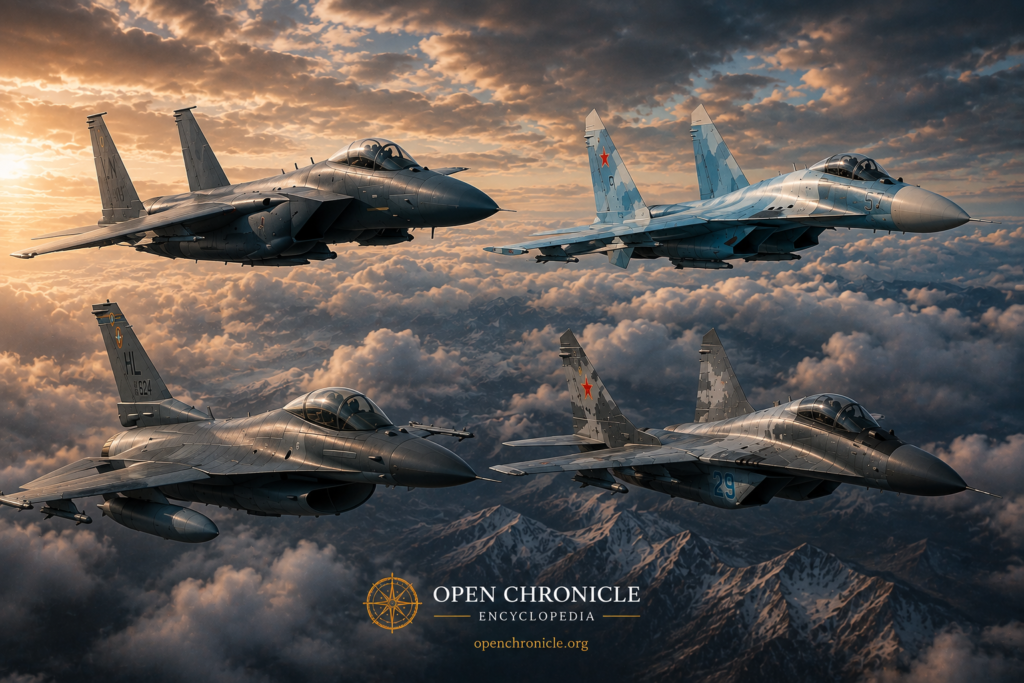
Aircraft associated with the generation include some of the most influential fighters ever developed: the Grumman F-14 Tomcat, McDonnell Douglas F-15 Eagle, General Dynamics F-16 Fighting Falcon, McDonnell Douglas F/A 18 Hornet, Dassault Mirage 2000, Mikoyan MiG-29 and Sukhoi Su-27.
Together they represented a major change in combat aircraft design.
Where many earlier fighters had emphasised speed, altitude and missile interception, the fourth generation restored manoeuvrability as a fundamental requirement while retaining increasingly capable radar-guided weapons and beyond visual range combat.
At the same time, advances in electronics transformed the fighter itself.
Fly-by-wire controls, digital computers, pulse Doppler radar, head-up displays, hands-on throttle and stick controls, multifunction displays, increasingly sophisticated electronic warfare systems and precision weapons gradually turned the fighter from an aircraft carrying weapons into an integrated combat system.
Many fourth-generation designs proved exceptionally adaptable.
Instead of disappearing when fifth generation aircraft arrived, they underwent successive modernisation programmes involving active electronically scanned array radar, modern data links, infrared search and track systems, digital electronic warfare, helmet-mounted displays, new mission computers and increasingly sophisticated weapons.
This evolutionary process produced aircraft frequently described as 4.5 generation, fourth generation plus, or advanced fourth generation fighters.
More than half a century after the first aircraft of the generation flew, descendants of these designs remain an important component of global combat aviation.
Quick Facts
Type: Jet fighter aircraft generation
Design era: Primarily 1970s onward
Operational emergence: 1970s and 1980s
Preceded by: Third-generation fighter
Followed by: Fifth-generation fighter
Principal design emphasis: Manoeuvrability, energy performance, advanced avionics and multirole capability
Typical radar: Pulse Doppler multimode radar, later increasingly AESA
Typical flight controls: Conventional augmented controls or fly-by-wire, depending upon aircraft and development period
Typical weapons: Radar-guided and infrared air-to-air missiles, cannon, precision-guided and conventional air-to-ground weapons
Later developments: Advanced fourth-generation and 4.5 generation fighters
Representative aircraft: F-14, F-15, F-16, F/A 18, Mirage 2000, MiG-29 and Su-27
Modern derivatives and related advanced designs: F-15EX, F-16V and Block 70/72, F/A 18E/F Super Hornet, Rafale, Eurofighter Typhoon, Gripen E, Su-30, Su-35, MiG-35, J-10C and others
Understanding Fighter Generations
The concept of fighter generations is useful, but it should not be interpreted as a rigid scientific classification.
There is no single international authority that determines precisely where one generation begins and another ends.
Instead, the terminology provides a convenient way of describing broad technological and doctrinal transitions.
Aircraft belonging to the same nominal generation can therefore differ considerably.
The F-14 Tomcat, for example, relied upon variable geometry wings and was originally optimised for fleet air defence.
The F-16 used a lightweight single-engine configuration, relaxed static stability and fly-by-wire controls.
The Su-27 was a large twin-engine fighter designed for long-range air superiority and exceptional manoeuvrability.
All are commonly placed within the fourth generation because they represent overlapping developments in fighter technology and doctrine rather than a single standardised specification.
Origins
The fourth generation emerged partly from the experience of earlier jet combat.
During the 1950s and 1960s, many designers and military planners believed that increasingly capable radar and guided missiles would fundamentally transform air combat.
Future engagements were expected to occur at high speed and considerable distance.
Close-range dogfighting appeared to some observers to be becoming obsolete.
Aircraft therefore increasingly emphasised speed, altitude, interception capability and missile armament.
Some designs were developed without internal guns.
Combat experience demonstrated that reality was more complicated.
Missiles were important and would become progressively more capable, but early systems had significant limitations.
Rules of engagement could require visual identification.
Radar performance could be affected by clutter and operational circumstances.
Missiles had engagement restrictions.
Air combat could rapidly collapse from a distant interception into a close-range manoeuvring fight.
The fourth generation was shaped by those lessons.
Lessons of Vietnam
The Vietnam War became particularly influential in American thinking about fighter design.
Aircraft such as the F 4 Phantom II possessed powerful radar, high speed, and substantial missile armament.
Yet combat frequently occurred under conditions very different from the long-range engagements anticipated by earlier doctrine.
Pilots sometimes found themselves fighting visually at relatively short range.
Training, situational awareness, missile reliability and manoeuvrability remained critically important.
The experience contributed to renewed interest in aircraft capable of combining advanced missile systems with excellent aerodynamic performance.
The result was not a return to the simple gun fighters of the 1950s.
Instead, the next generation attempted to combine both worlds.
The Return of Manoeuvrability
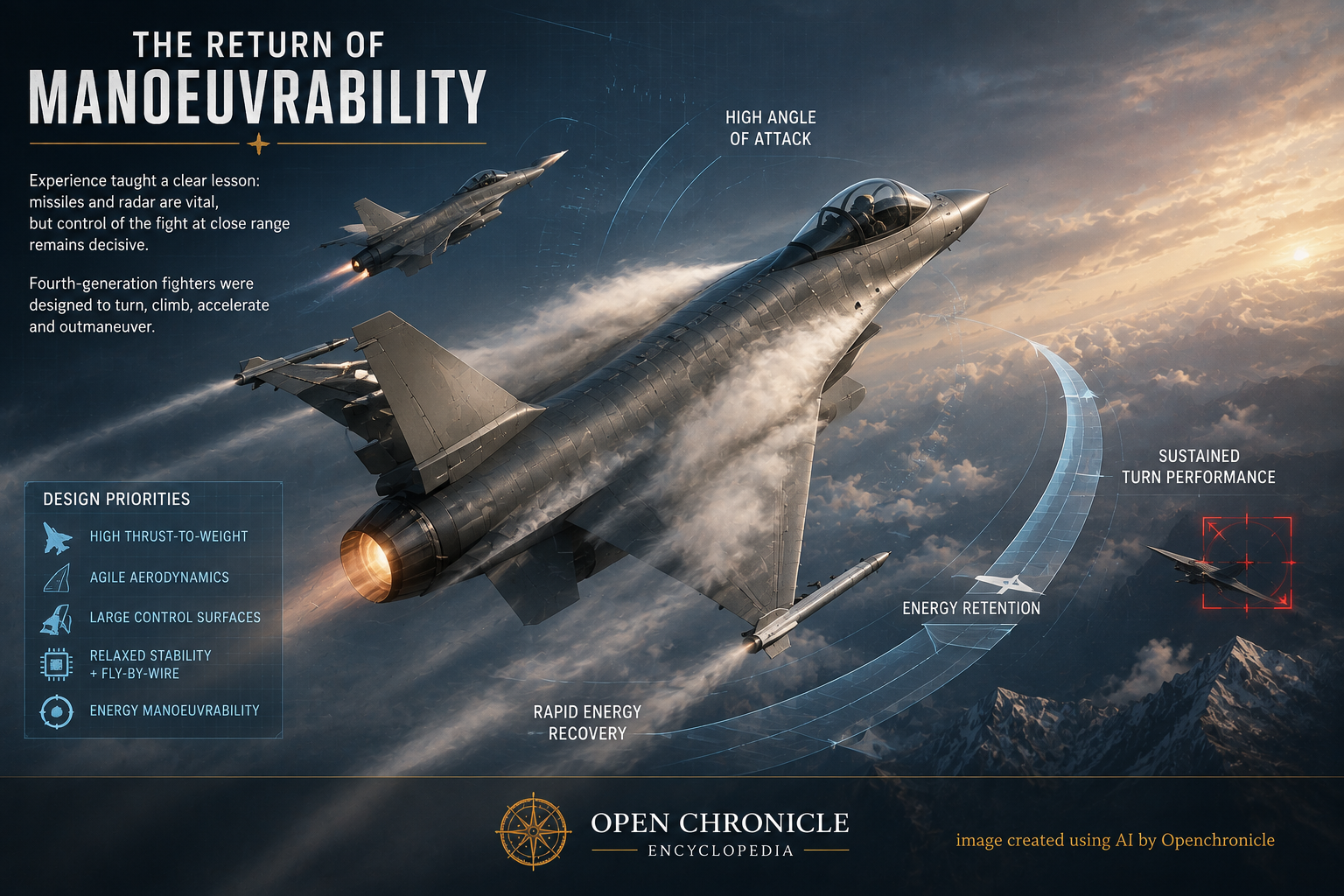
Fourth-generation fighter designers placed renewed emphasis on manoeuvrability.
High thrust engines provided rapid acceleration and strong climb performance.
Large and powerful control surfaces allowed rapid changes in attitude.
Aerodynamic configurations increasingly exploited vortex lift and high angle of attack performance.
Some aircraft were deliberately designed with reduced natural stability.
This represented a fundamental change.
A traditionally stable aircraft naturally resists disturbances and tends to return towards equilibrium.
That behaviour makes it easier to fly but can also oppose rapid manoeuvring.
Reducing stability allows an aircraft to respond more readily to control inputs.
Computers can then provide the artificial stability necessary to make such an aircraft practical.
This relationship between aerodynamics and computing became one of the defining characteristics of advanced fourth-generation design.
Energy Manoeuvrability
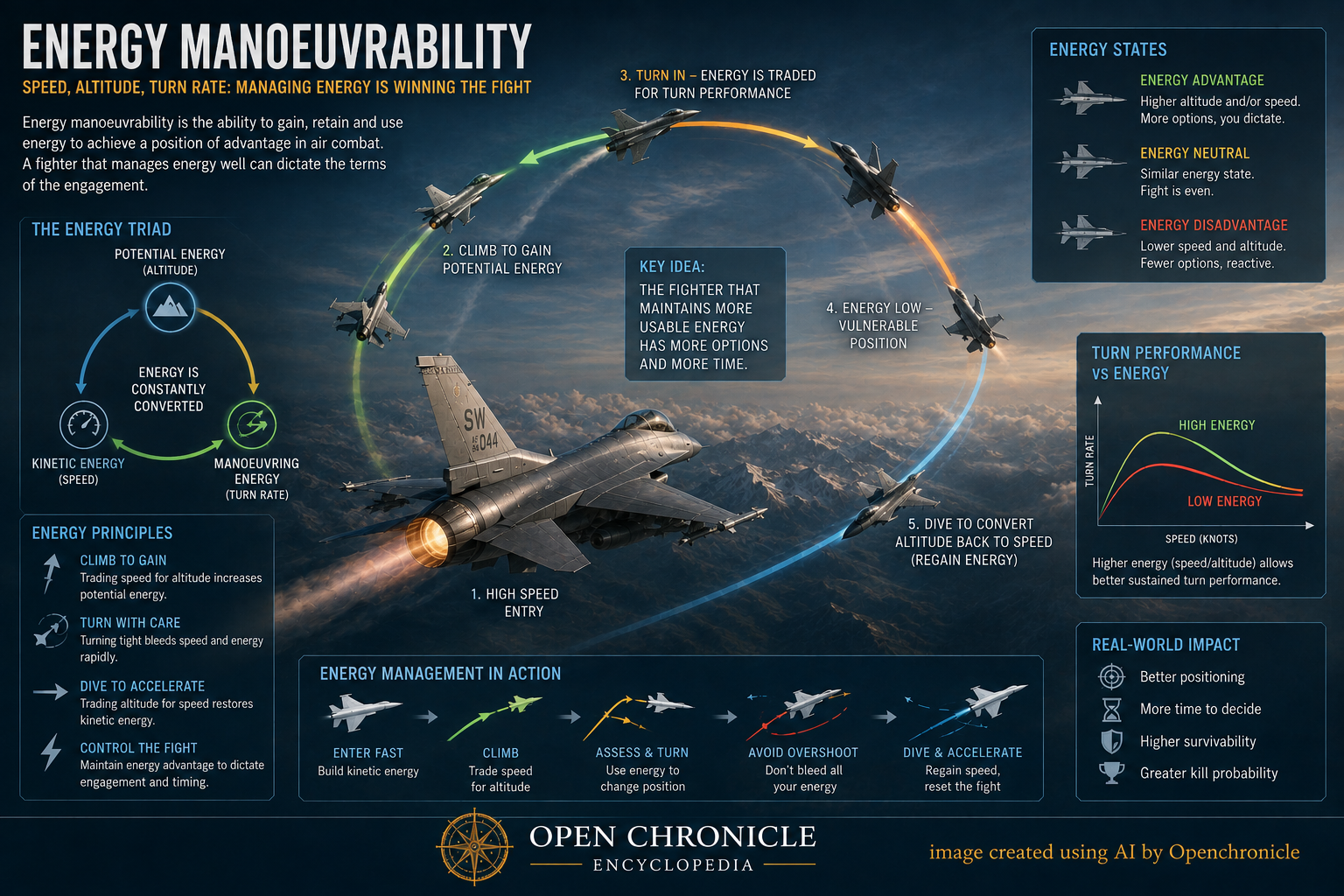
The intellectual development of the generation was also influenced by energy manoeuvrability theory, associated particularly with United States Air Force officer John Boyd and mathematician Thomas Christie.
A fighter does not simply turn.
Every manoeuvre involves exchanges between speed, altitude and energy.
An aircraft may execute a tight turn but lose substantial velocity while doing so.
Another may turn less rapidly initially but retain enough energy to continue manoeuvring effectively.
Energy manoeuvrability analysis provided engineers and tacticians with methods for comparing these relationships.
This thinking strongly influenced the environment in which aircraft such as the F-15 and F-16 were developed.
The objective became not merely maximum speed but the ability to gain, retain, and recover energy throughout combat.
High Thrust-to-Weight Ratio
Powerful turbofan engines became another characteristic of the generation.
The relationship between aircraft weight and engine thrust strongly influences acceleration and climb performance.
A fighter with a high thrust-to-weight ratio can recover speed rapidly after energy-intensive manoeuvres.
Some advanced fighters can produce thrust approaching or exceeding their combat weight under particular configurations.
This does not mean that they simply accelerate vertically without limitation.
Drag, altitude, fuel load and external stores remain important.
Nevertheless, powerful engines dramatically expanded the manoeuvring possibilities available to fighter pilots.
Fly-by-wire
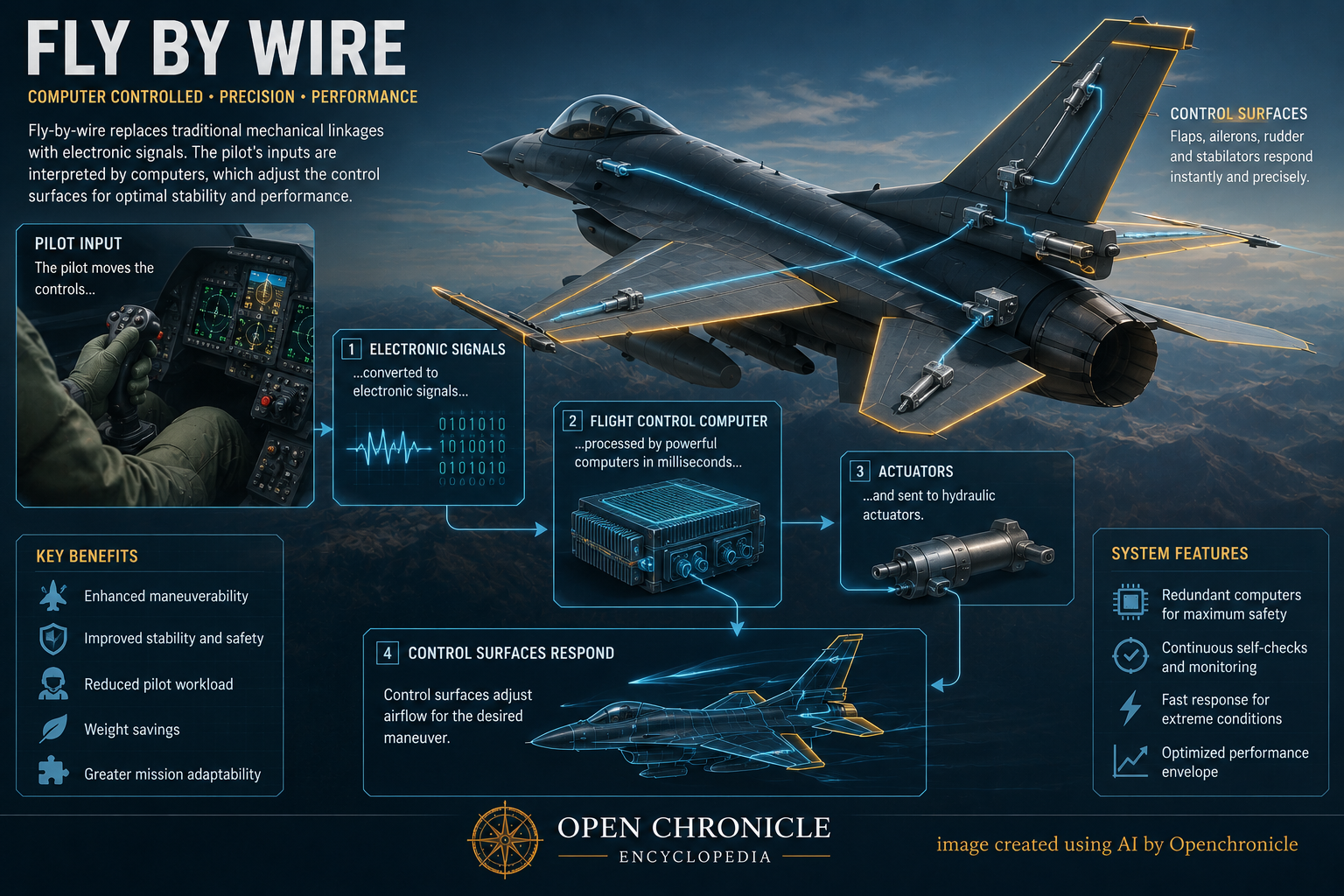
One of the most important technologies associated with fourth-generation fighters is fly-by-wire.
In a conventional mechanical flight control system, movement of the pilot’s controls is transmitted through cables, rods, hydraulic systems or combinations of these mechanisms.
A fly-by-wire aircraft instead uses electrical signals to transmit pilot commands to the flight control system.
Computers interpret those commands and determine the appropriate movement of the control surfaces.
The General Dynamics YF-16 became particularly important in demonstrating how this technology could be combined with relaxed static stability.
NASA documentation of the YF-16 flight control system identifies relaxed static longitudinal stability, fly-by-wire, and the side stick controller among its distinctive characteristics.
The computer was no longer merely assisting the pilot.
It had become an essential intermediary between pilot and aircraft.
Relaxed Static Stability
Relaxed static stability became one of the revolutionary aerodynamic ideas associated with the generation.
Most conventional aircraft are designed so that they naturally resist departures from stable flight.
The F-16 demonstrated another approach.
Its configuration deliberately reduced natural stability to improve responsiveness.
The aircraft therefore depended upon its flight control system to make continuous corrections.
Thousands of small control adjustments could occur without the pilot consciously commanding them.
The pilot indicated the desired manoeuvre.
The computers determined how the aircraft’s control surfaces should respond while maintaining controlled flight.
This concept subsequently became fundamental to modern high-performance aircraft.
Not Every Fourth Generation Fighter Used the Same Controls
It is important not to reduce the fourth generation simply to fly-by-wire.
Early aircraft such as the F-14 and F-15 initially retained more conventional flight control architectures.
Technology entered service progressively rather than simultaneously.
Aircraft designed only a few years apart could therefore possess substantially different systems.
Later upgrades also blurred distinctions.
An aircraft originally designed with one generation of electronics could receive digital flight controls, modern mission computers and entirely new sensors decades later.
This capacity for modernisation became one of the most important characteristics of the generation.
Pulse Doppler Radar
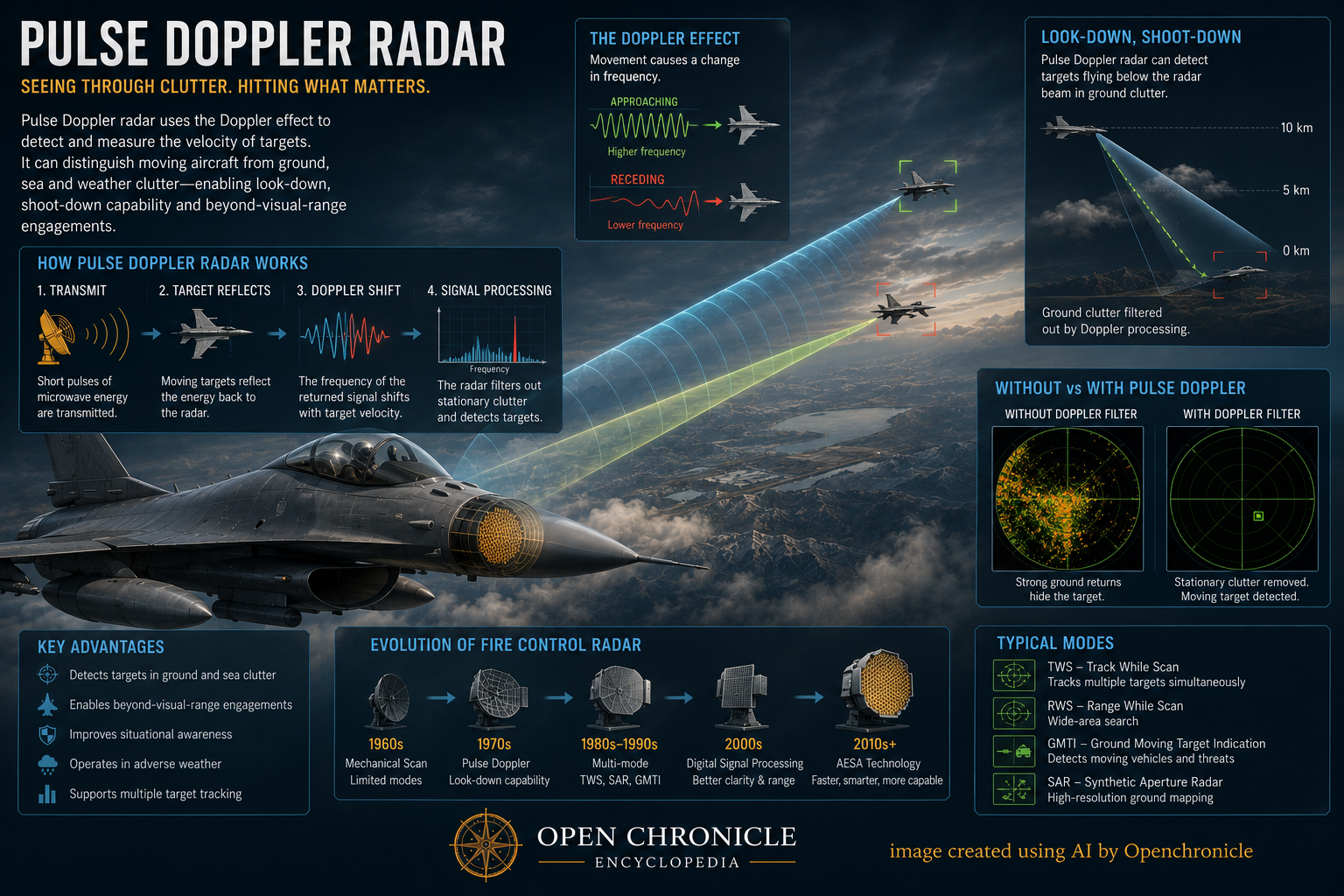
Radar technology advanced dramatically.
Pulse Doppler fire control radars gave fighters improved ability to detect and track targets against background clutter.
This was particularly important when looking downward.
Earlier radars could struggle to distinguish a low-flying aircraft from radar reflections generated by the ground.
Improved signal processing enabled look-down, shoot-down capability.
A fighter at high altitude could therefore detect and engage targets operating below it far more effectively.
This significantly changed both interception and air superiority tactics.
Beyond Visual Range Combat
The fourth generation did not abandon beyond visual range combat.
Instead, it attempted to combine BVR capability with close-range manoeuvrability.
Aircraft such as the F-14 and F-15 could conduct radar-guided interceptions at significant distances while retaining the aerodynamic performance required for close combat.
This balance became increasingly important as missile technology improved.
Later weapons such as the AIM-120 AMRAAM and comparable systems transformed BVR warfare.
The pilot increasingly needed to understand a battlespace extending far beyond visual range.
The F-14 Tomcat
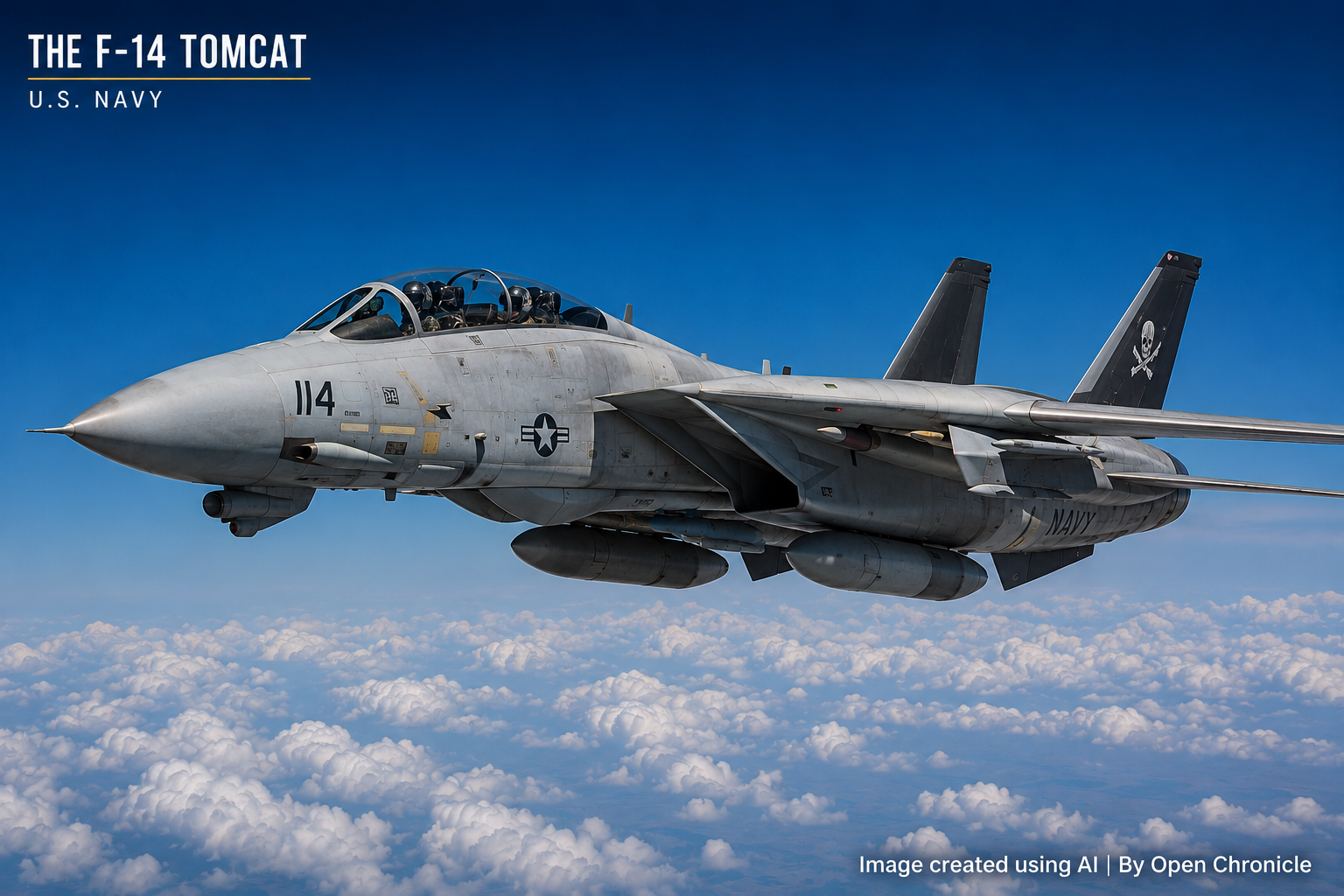
The Grumman F-14 Tomcat represented one of the earliest major fourth-generation designs.
Developed for the United States Navy, it combined variable-sweep wings with a powerful radar and long-range missile capability.
Its principal Cold War mission involved defending carrier battle groups against aircraft carrying anti-ship missiles.
The F-14’s AWG-9 radar and AIM-54 Phoenix missile combination allowed engagement of multiple targets at long distance.
At the same time, the aircraft retained substantial manoeuvrability.
The Tomcat therefore embodied the fourth generation attempt to combine sophisticated interception with visual combat capability.
The F-15 Eagle
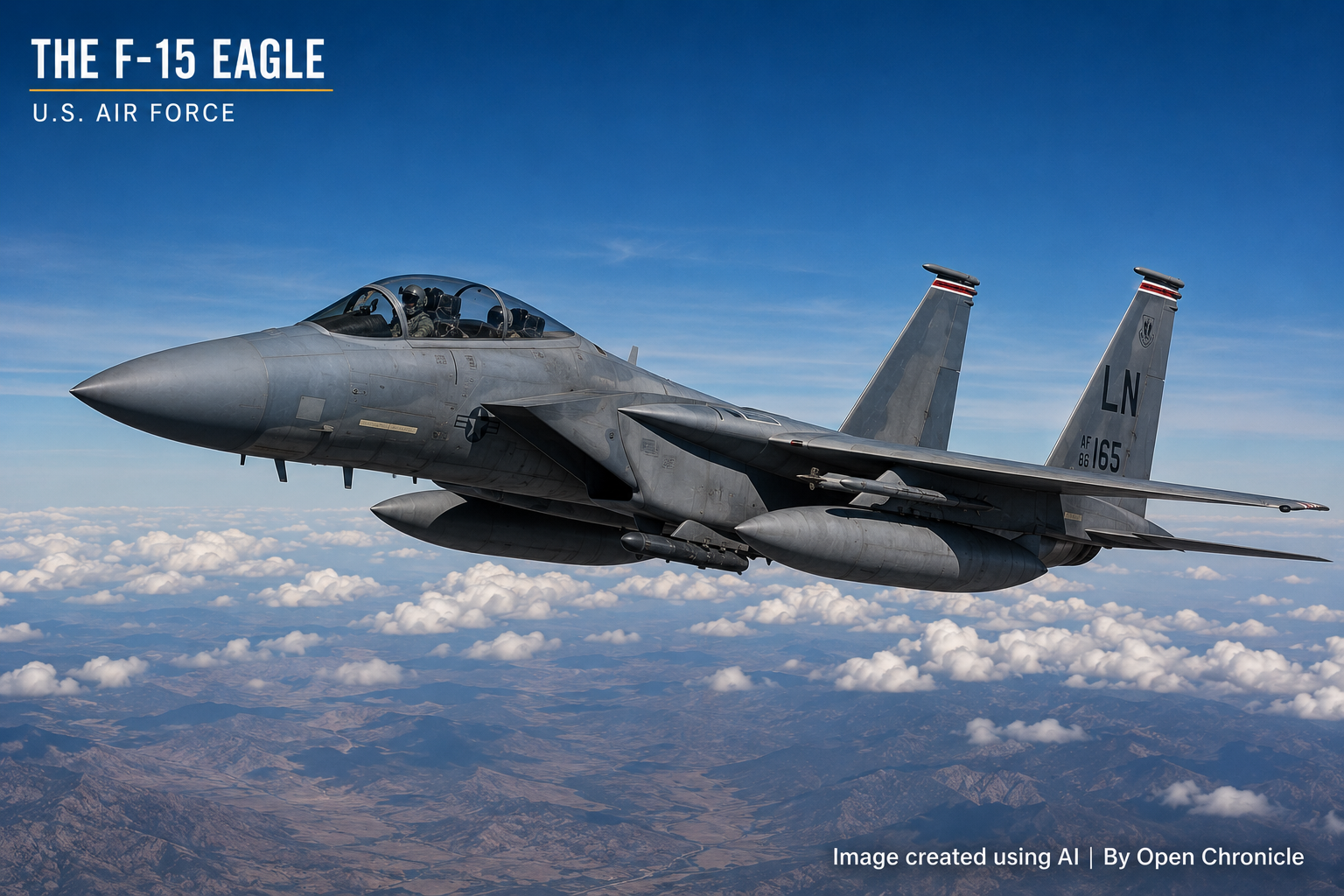
The McDonnell Douglas F-15 Eagle emerged from the United States Air Force requirement for a dedicated air superiority fighter.
Its development reflected lessons from Vietnam and concern about increasingly capable Soviet aircraft.
The F-15 combined twin engines, powerful radar, high thrust, substantial missile armament, and excellent manoeuvrability.
Unlike later lightweight fighters, the Eagle was designed as a comparatively large and expensive aircraft capable of achieving air superiority at considerable distance.
Its extraordinary development potential subsequently produced the F-15E Strike Eagle and, decades later, the F-15EX Eagle II.
Modern F-15EX aircraft incorporate digital fly-by-wire controls, AESA radar, advanced electronic warfare, digital cockpit systems, networking, and open mission systems architecture.
The evolution demonstrates how a fourth-generation aerodynamic design can remain relevant through extensive technological renewal.
The F-16 Fighting Falcon
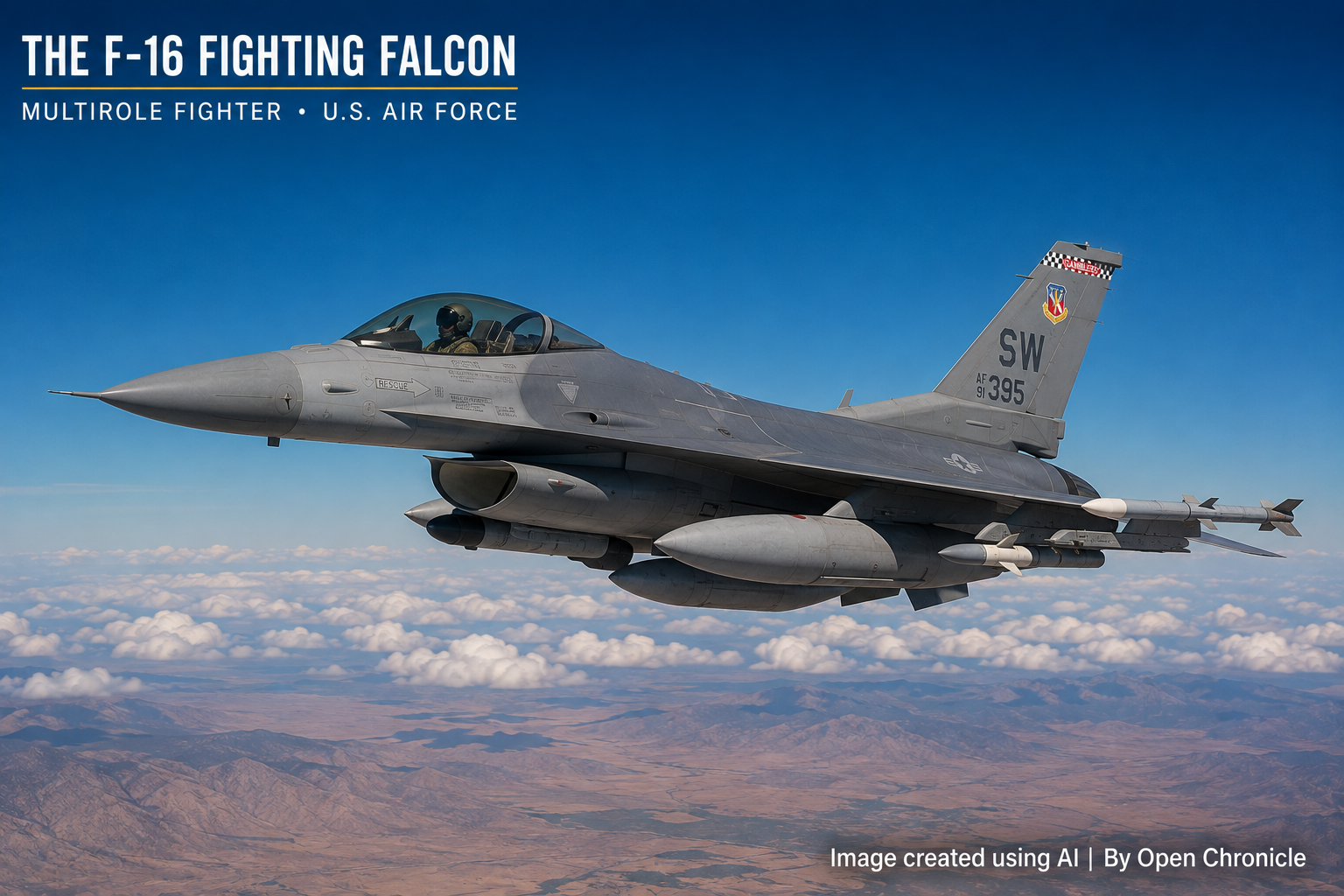
If the F-15 represented the high end of American fourth-generation air power, the General Dynamics F-16 Fighting Falcon represented the lightweight alternative.
The aircraft evolved from the YF-16 developed for the Lightweight Fighter programme.
Its design emphasised low weight, high thrust, exceptional visibility, energy manoeuvrability and advanced flight controls.
The F-16 introduced relaxed static stability and fly-by-wire controls on an operational fighter at an unprecedented level of integration.
Its bubble canopy provided exceptional visibility.
The side-mounted control stick reduced cockpit obstruction and assisted control under high gravitational forces.
Originally conceived with a strong emphasis on air combat, the F-16 evolved into an extraordinarily adaptable multirole platform.
Modern Block 70 and Block 72 aircraft bear the unmistakable aerodynamic shape of the original fighter while incorporating APG 83 AESA radar, modern displays, targeting systems, advanced weapons, and substantially improved computing.
The F/A 18 Hornet
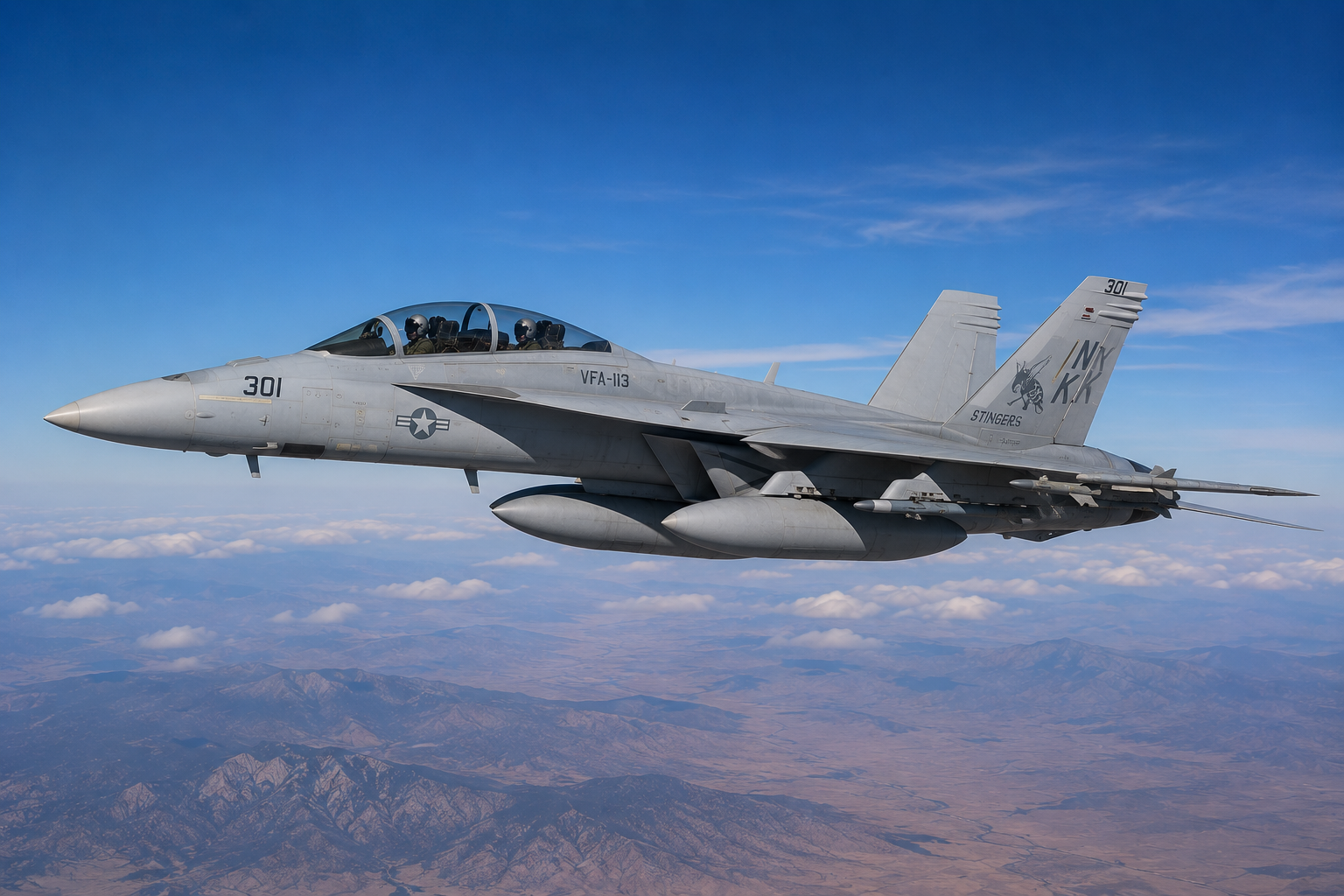
The McDonnell Douglas F/A 18 Hornet emerged partly from the Northrop YF 17, the competitor to the YF 16 during the Lightweight Fighter programme.
The aircraft was extensively redesigned for naval service.
It combined twin engines, strong low-speed handling, carrier compatibility and genuine multirole capability.
The designation itself reflected this philosophy.
The Hornet could conduct fighter and attack missions without requiring entirely separate aircraft types.
Later development produced the substantially enlarged F/A 18E/F Super Hornet.
Although sharing the Hornet name and general design lineage, the Super Hornet became a much larger and significantly redesigned aircraft incorporating increasingly advanced radar, electronic warfare, and networked capabilities.
The Soviet Response
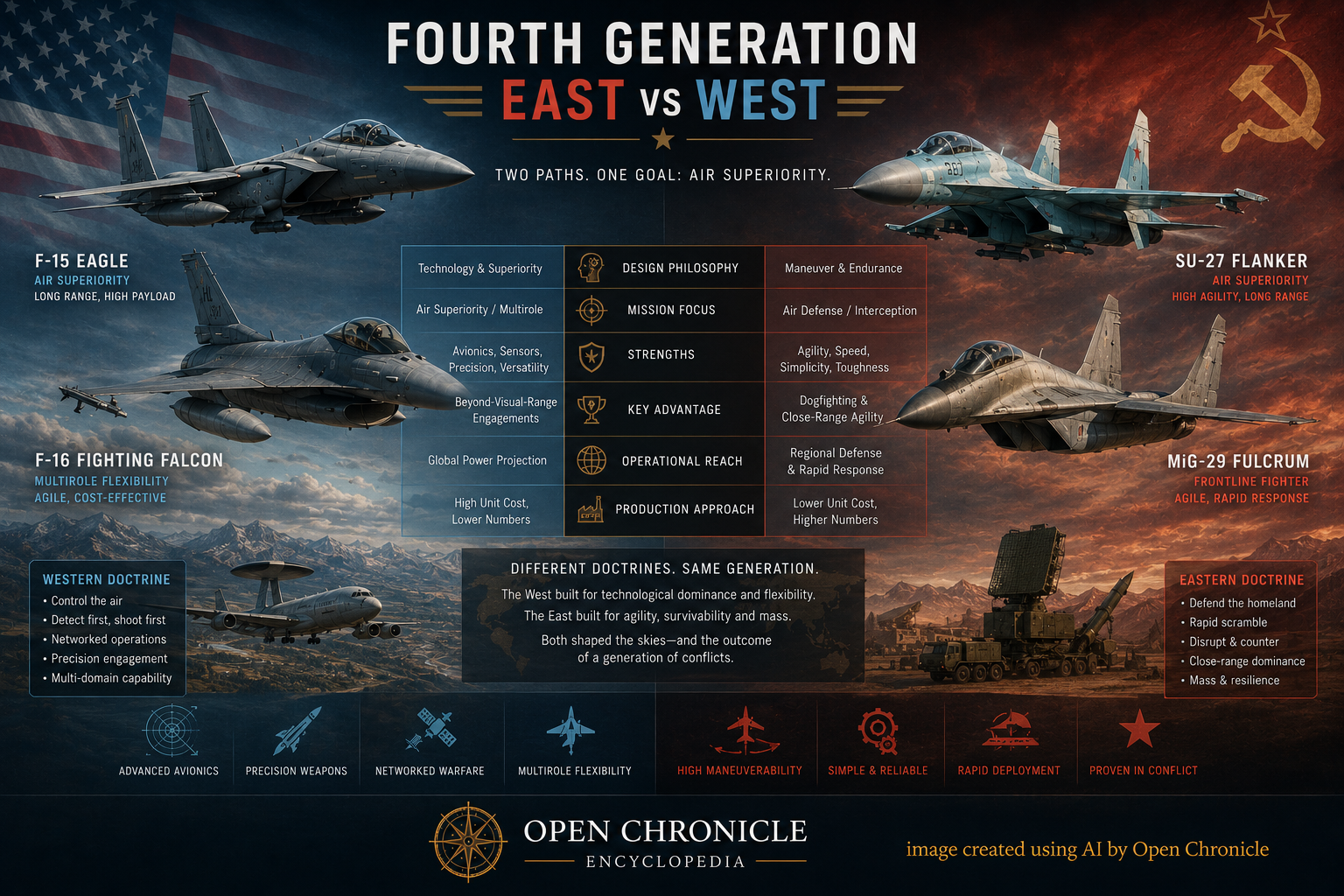
The Soviet Union developed its own major fourth-generation fighter families.
Two aircraft became particularly significant.
The Mikoyan MiG-29 was intended as a relatively compact tactical fighter.
The Sukhoi Su-27 was a larger, longer-range air superiority aircraft.
Their relationship is sometimes compared loosely with the American F-16 and F-15 pairing, although the design requirements, doctrine and operational systems were not identical.
Both Soviet aircraft placed substantial emphasis on manoeuvrability.
Their descendants became major components of Russian and international combat aviation.
MiG 29
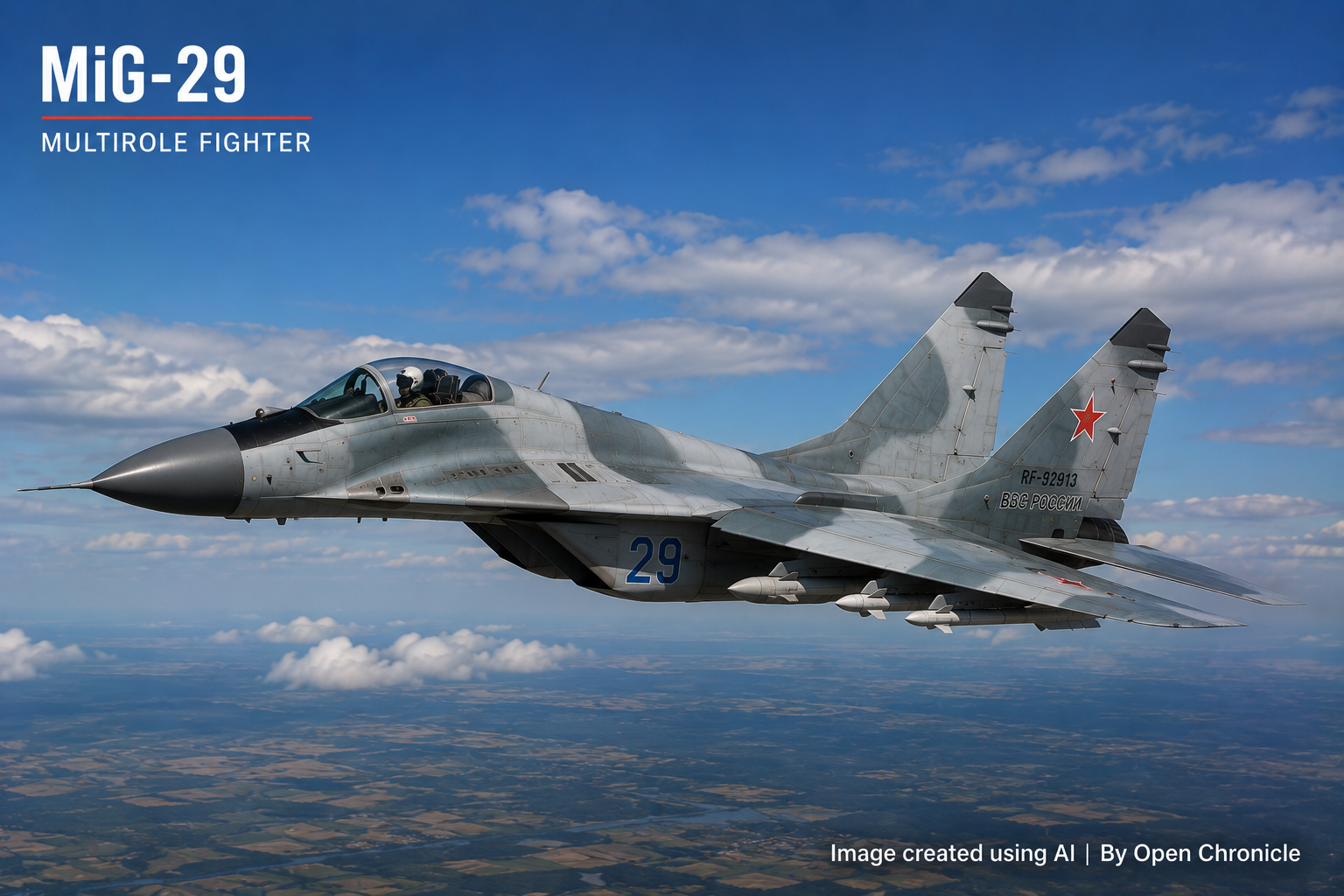
The MiG 29 combined twin engines, strong acceleration, and high angle of attack capability with radar and infrared sensors.
Its infrared search and track system provided a passive method of detecting aerial targets.
Helmet-mounted sighting combined with highly agile short-range missiles became a particularly important feature.
This allowed pilots to designate targets located away from the aircraft’s forward axis.
Western evaluations of former East German MiG-29 aircraft after German reunification helped demonstrate the tactical significance of this combination.
Later MiG-29 derivatives expanded range, avionics, and weapons capability, ultimately contributing to developments such as the MiG-35.
Sukhoi Su 27
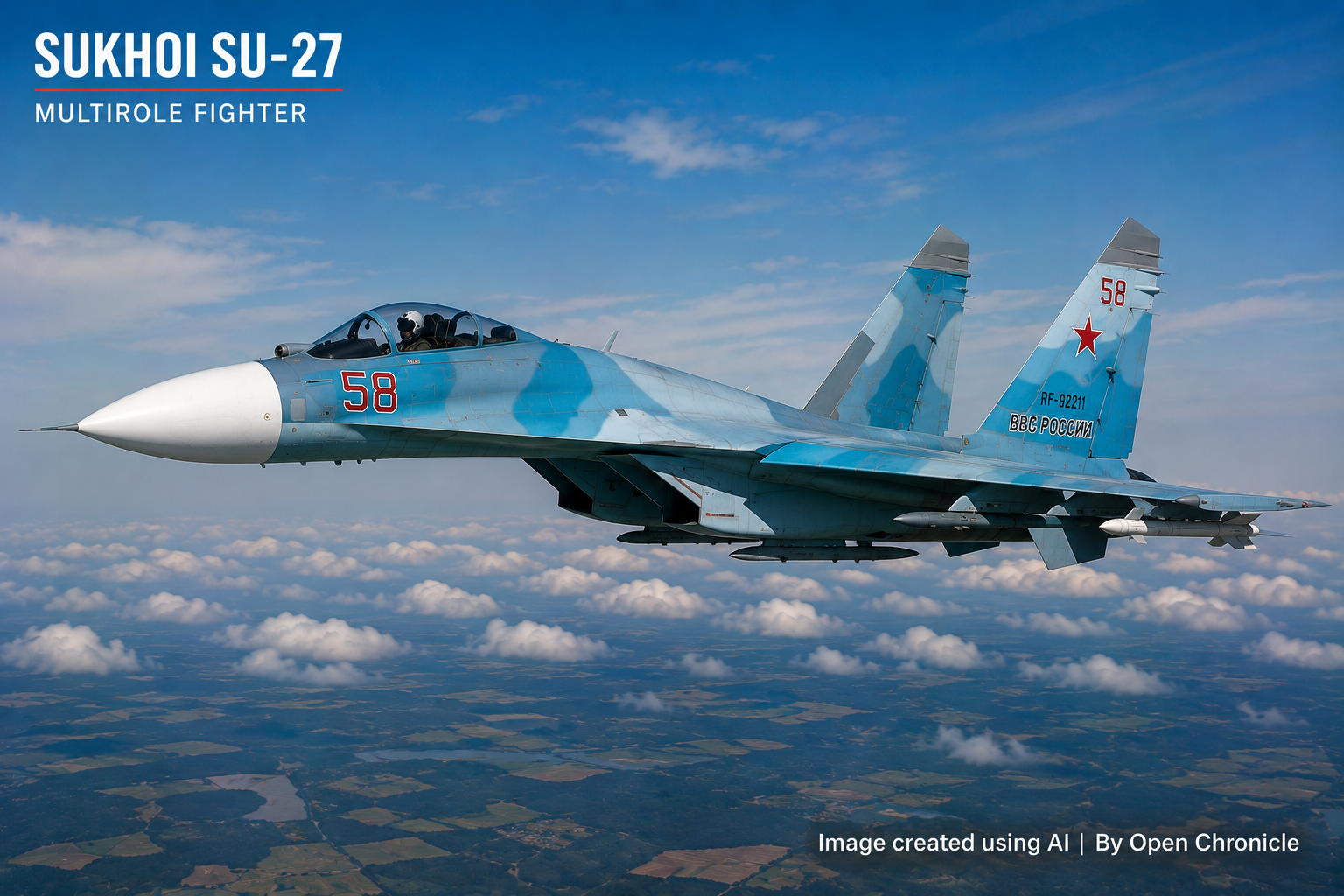
The Su-27 became one of the most aerodynamically influential fighters of its era.
It combined a large blended airframe, powerful twin engines, long range, and exceptional manoeuvrability.
The design supported controlled flight at unusually high angles of attack.
Air show demonstrations such as the manoeuvre popularly known as Pugachev’s Cobra became famous demonstrations of the aircraft’s aerodynamic capabilities.
The Su-27 subsequently became the foundation of an enormous family of aircraft.
These included the Su-30, Su-33, Su-34 and Su-35, among others.
Successive derivatives incorporated new radar, engines, electronic warfare, thrust vectoring and precision strike capability.
Mirage 2000
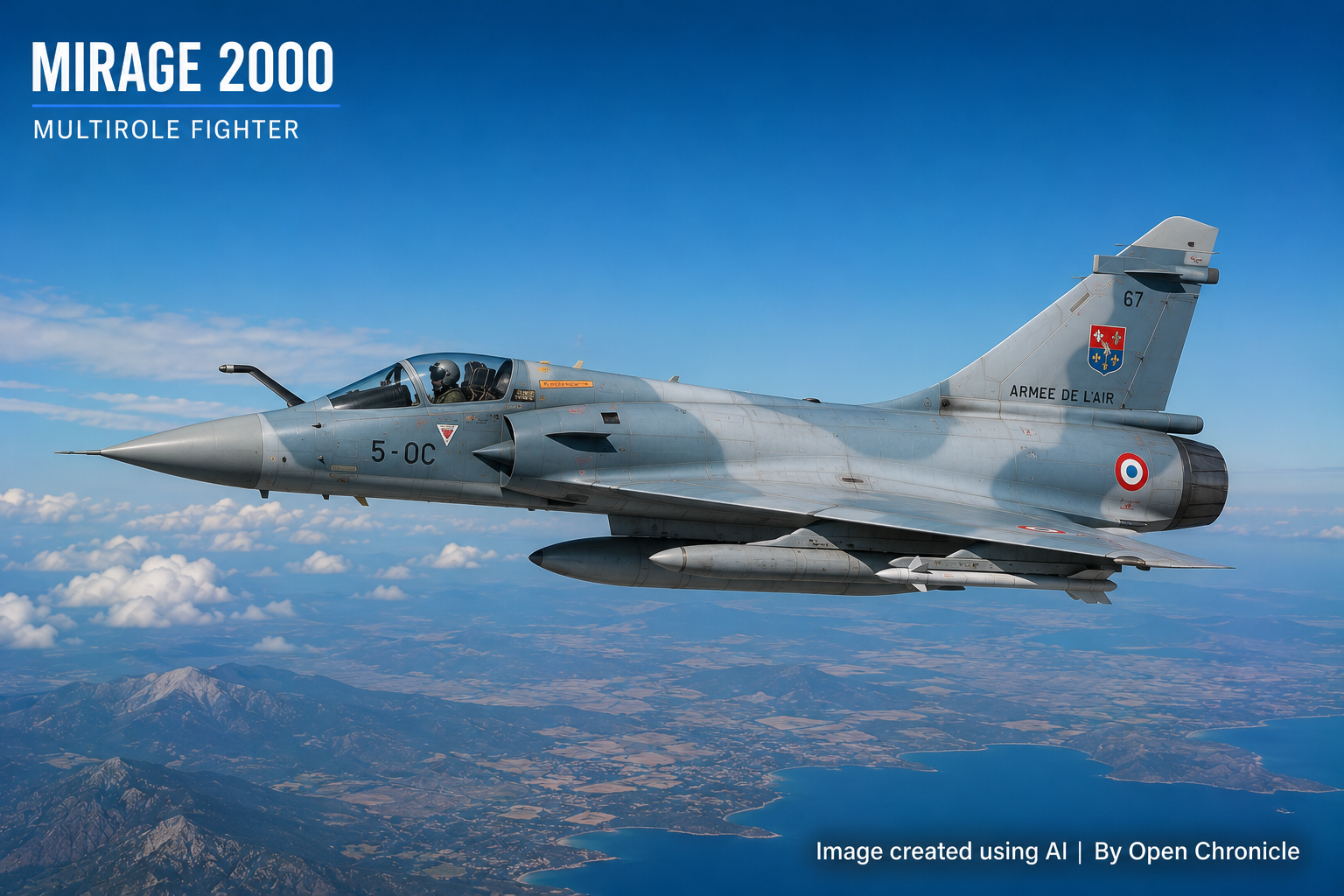
France developed the Dassault Mirage 2000 as another major fourth-generation fighter.
The aircraft retained the delta wing configuration associated with earlier Mirage designs while incorporating modern flight controls and avionics.
The Mirage 2000 served in air defence, conventional strike and nuclear roles depending upon the variant.
Later Mirage 2000 5 developments introduced major radar and cockpit improvements and significantly expanded multirole capability.
The aircraft demonstrated that advanced flight control systems could overcome many of the traditional handling disadvantages associated with tailless delta wing fighters.
Multirole Combat
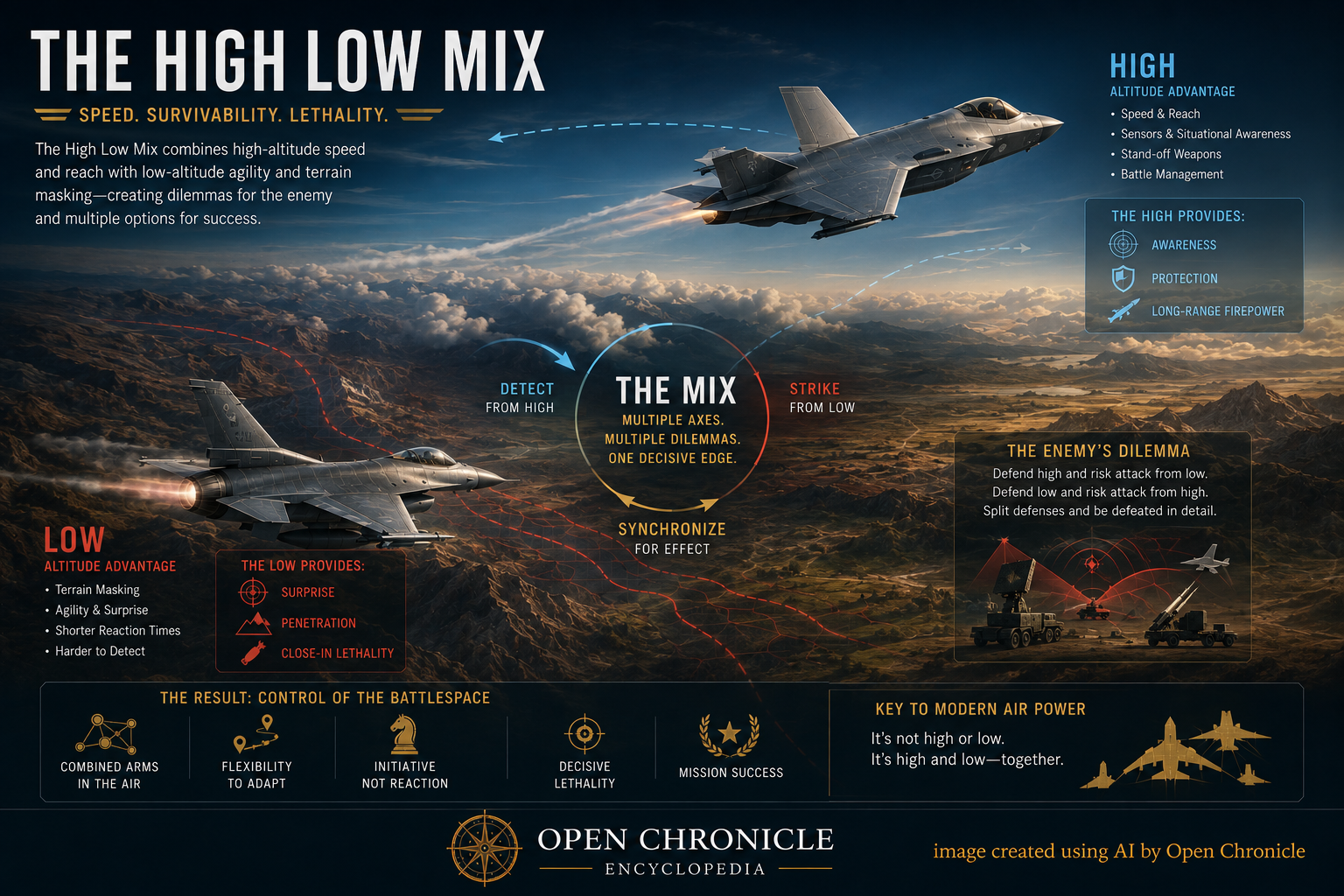
Multirole capability became increasingly important during the fourth generation.
Specialised aircraft could offer exceptional performance in a particular mission.
They could also be expensive to acquire and support.
An aircraft capable of conducting air defence, interception, strike, reconnaissance and maritime missions offered considerable operational flexibility.
Digital avionics made this increasingly practical.
Different radar modes could support different missions.
Mission computers could manage multiple weapon types.
External pods could provide targeting or reconnaissance capability.
Software increasingly determined what an aircraft could do.
This represented a profound shift in combat aviation.
Hands-on Throttle and Stick
Fourth-generation cockpits increasingly incorporated HOTAS, or hands on throttle and stick.
Important controls were positioned directly on the throttle and control stick.
The pilot could therefore select weapons, operate sensors or change radar modes without repeatedly looking down and moving hands across the cockpit.
This reduced workload during high-intensity combat.
Combined with head-up displays, multifunction displays and later helmet-mounted systems, HOTAS helped transform the cockpit from an array of individual instruments into an integrated human-machine interface.
Head-Up Displays
The head-up display became another characteristic feature.
Critical flight and combat information could be projected directly into the pilot’s forward field of view.
Speed, altitude, aiming information, navigation cues and weapon symbology could therefore be monitored while the pilot continued looking outside the cockpit.
This became particularly valuable during close combat and ground attack.
Later generations expanded the concept through helmet-mounted displays.
Glass Cockpits
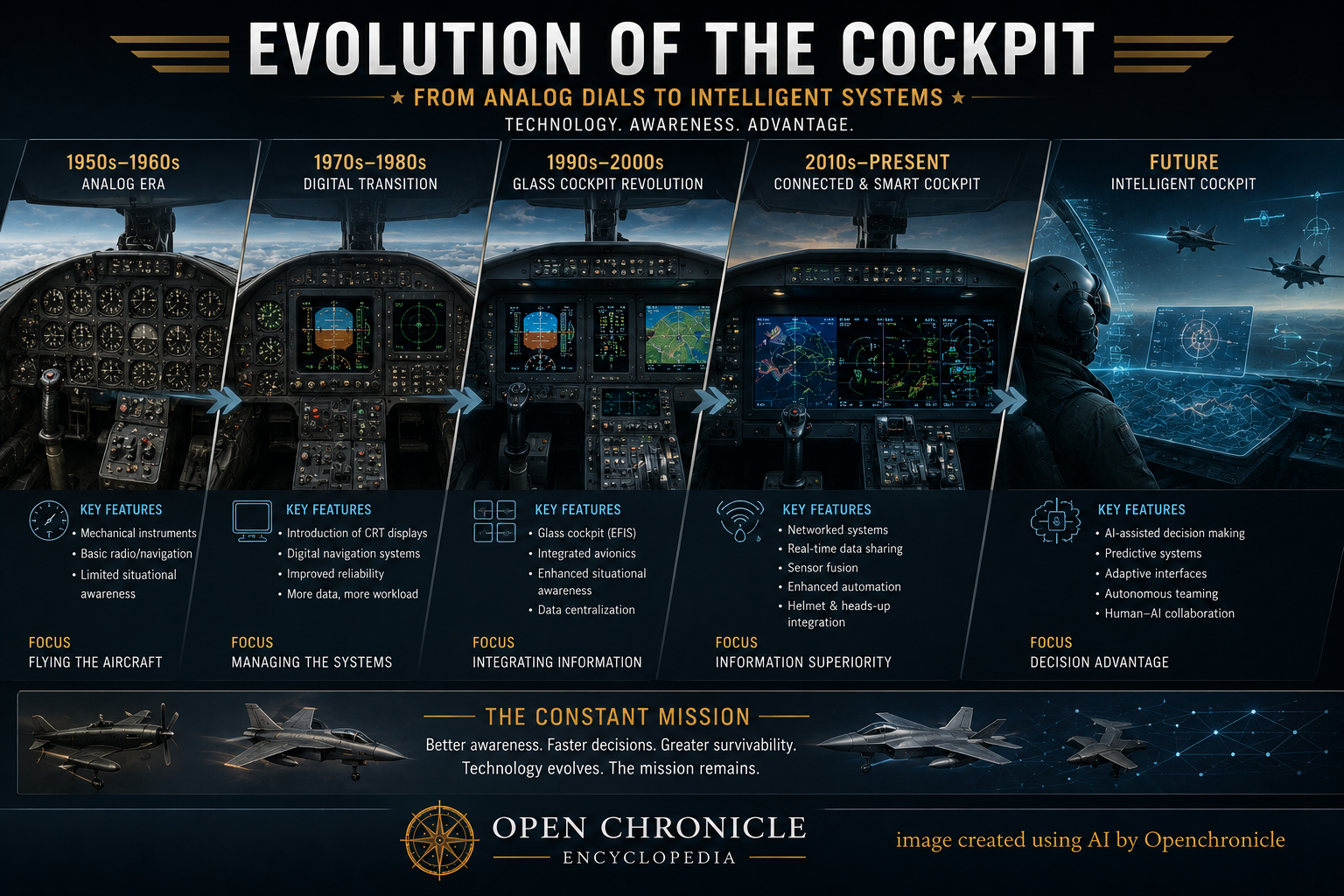
Early fourth generation fighters still contained numerous analogue instruments.
Successive modernisation programmes progressively replaced them with multifunction electronic displays.
A single display could present radar information, navigation maps, engine status or weapon data depending upon the pilot’s selection.
Modern variants increasingly use large colour displays.
The cockpit therefore evolved from a collection of dedicated instruments towards a software-defined information environment.
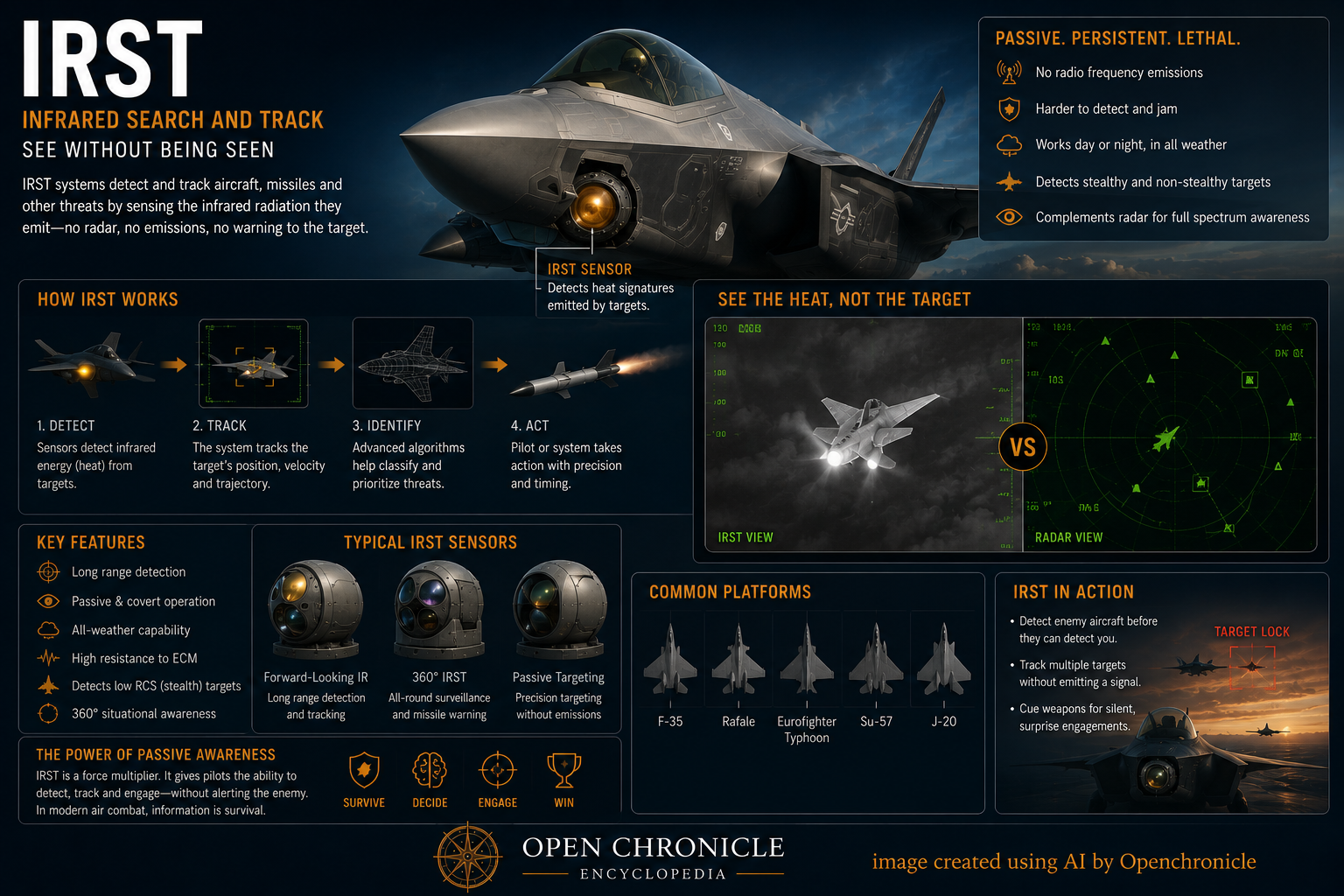
Infrared Search and Track
Radar is powerful but active.
When a fighter transmits radar energy, adversaries may detect those emissions.
Infrared search and track systems offer a passive alternative.
An IRST detects thermal radiation produced by aircraft and their engines.
Because it does not need to transmit radar energy, it can search without announcing itself in the same manner as an active radar.
Soviet fighters made extensive operational use of IRST systems.
Later Western aircraft increasingly incorporated similar capabilities.
Modern Gripen E, Rafale and Typhoon configurations illustrate the growing importance of combining active and passive sensors.
Data Links
The fourth generation also became increasingly networked.
A fighter no longer needed to rely exclusively upon information collected by its own sensors.
Data links allowed information to be exchanged between aircraft, airborne early warning platforms, ships and ground command systems.
This changed the meaning of situational awareness.
One aircraft could detect a target.
Another could receive its location.
A third could potentially engage based upon information supplied through the network.
The aircraft therefore became a node within a larger combat system.
Modern fourth-generation derivatives have taken this concept considerably further.
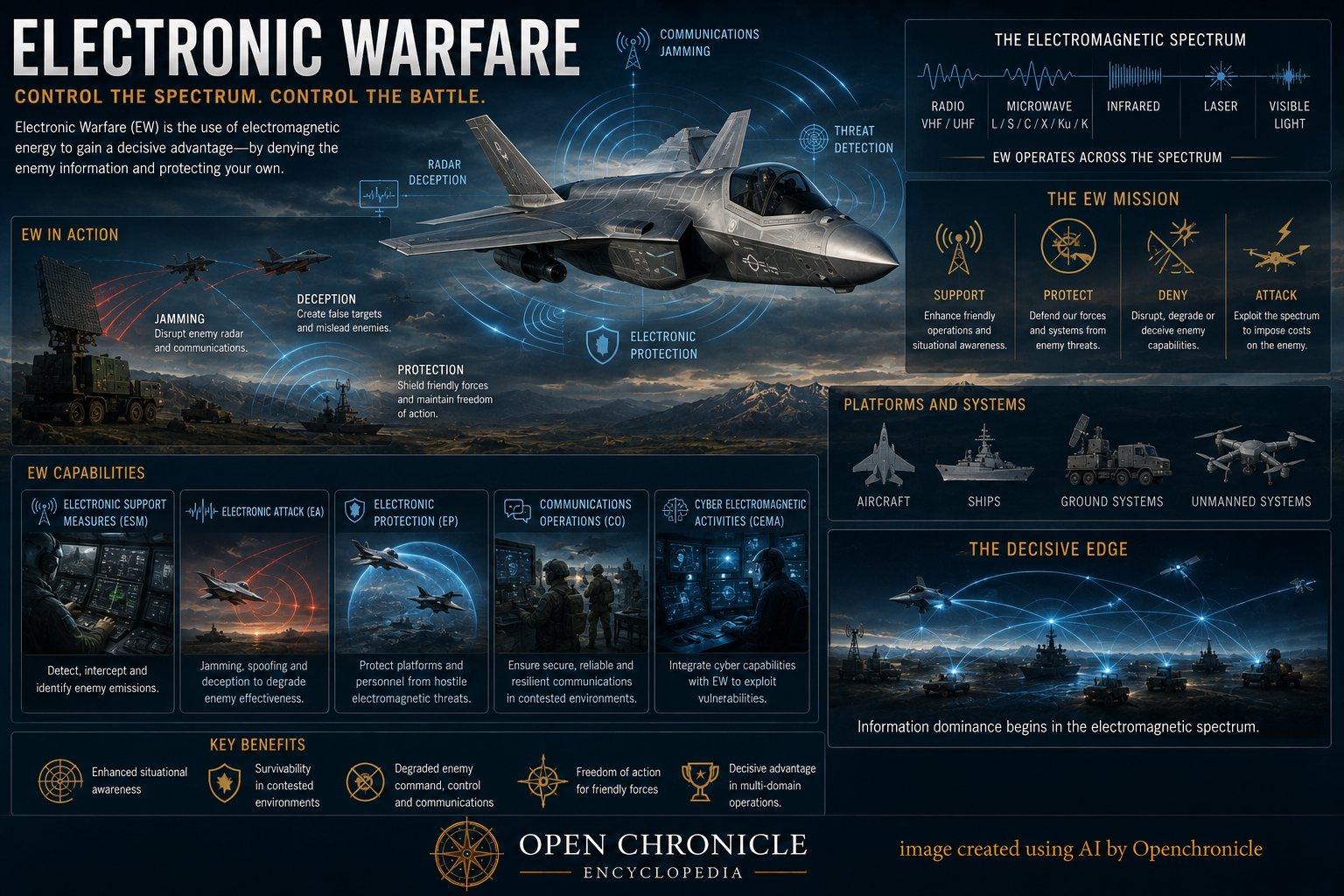
Electronic Warfare
Electronic warfare became increasingly central to fighter survivability.
Radar warning receivers alerted pilots when hostile radars detected or tracked their aircraft.
Chaff and flares attempted to confuse radar-guided and infrared-guided weapons.
Electronic countermeasure pods could interfere with hostile radar.
Later aircraft incorporated increasingly sophisticated internal electronic warfare suites.
Modern systems can detect, classify, locate, and potentially disrupt hostile electromagnetic emitters.
The electromagnetic environment consequently became another battlefield in which fighters must operate.
Precision Strike
The fourth generation coincided with the transformation of air-to-ground warfare through precision-guided weapons.
Laser-guided bombs enabled aircraft to attack point targets with far greater accuracy than conventional unguided bombing.
Later satellite-guided weapons expanded precision attack capability under conditions where laser designation was impractical.
Targeting pods allowed fighters to detect, identify, and designate targets independently.
Aircraft originally designed primarily for air combat could therefore become highly capable strike platforms.
The F-16 provides one of the clearest examples of this transformation.
Thrust Vectoring
Some later fourth-generation derivatives explored or adopted thrust vectoring.
Conventional aircraft manoeuvre primarily through aerodynamic control surfaces.
Thrust vectoring redirects engine exhaust to produce additional control forces.
This can provide substantial control authority at low speeds and very high angles of attack, where conventional aerodynamic surfaces may become less effective.
Russian developments made particularly visible use of this technology.
Aircraft such as the Su-30MKI and later Su-35 demonstrated extreme post-stall manoeuvres using combinations of aerodynamic controls and vectored thrust.
The United States experimented extensively with thrust vectoring on research versions of the F-15 and F-16, although it did not become standard on those operational fourth-generation fleets.
Supermaneuverability
The term supermaneuverability describes an aircraft’s ability to maintain control during manoeuvres beyond the conventional aerodynamic envelope.
Such manoeuvres may involve very high angles of attack, extremely low forward speed or rapid changes in aircraft orientation.
Their tactical usefulness is debated and depends heavily upon circumstances.
A spectacular manoeuvre that dramatically reduces speed may leave an aircraft vulnerable if it does not produce an immediate tactical advantage.
Nevertheless, supermaneuverability became an important area of fighter research and helped influence later aircraft.
Supercruise
Supercruise refers to sustained supersonic flight without continuous use of afterburner.
Afterburners dramatically increase thrust but consume large quantities of fuel.
Supersonic flight without afterburner therefore offers advantages in range and endurance.
Some advanced fourth-generation and 4.5 generation aircraft can achieve limited supercruise under particular configurations.
The capability became more strongly associated with later fighter designs, especially the F-22.
Radar Evolution
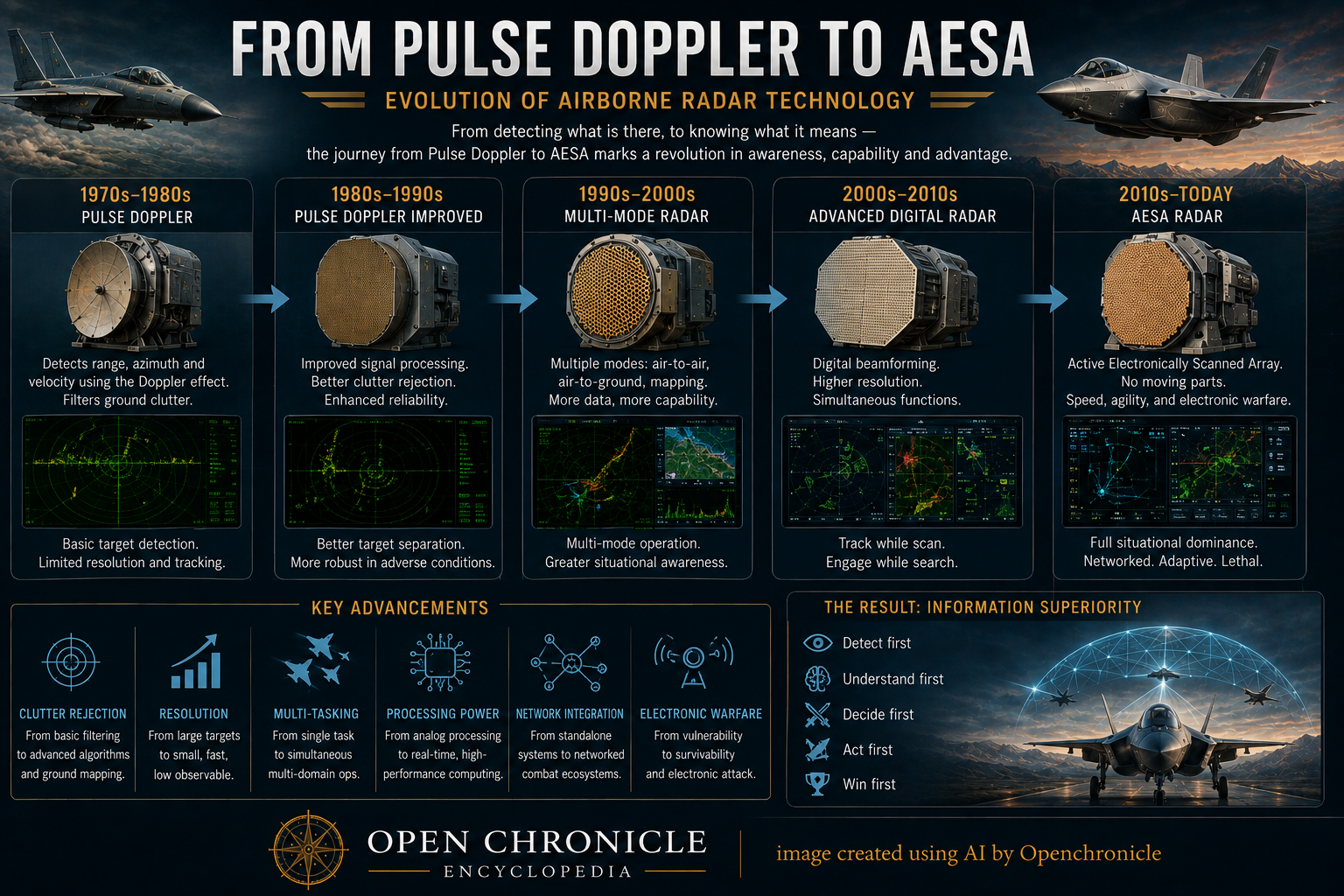
Radar technology provides one of the clearest examples of fourth-generation evolution.
Early aircraft used mechanically scanned pulse Doppler systems.
These could be highly capable but required physical movement of the radar antenna to redirect the beam.
Later active electronically scanned array, or AESA, radars transformed this architecture.
An AESA uses numerous transmitter-receiver modules to steer radar energy electronically.
The beam can therefore move extremely rapidly without mechanically repositioning the entire antenna.
This improves reliability and allows sophisticated combinations of search, tracking, mapping, and electronic functions.
AESA Radar
AESA radar became one of the principal characteristics associated with advanced fourth-generation and 4.5 generation fighters.
Modern F-15, F-16, F/A 18, Rafale and Gripen variants use or can use AESA systems.
The F-16 Block 70 and 72, for example, use the Northrop Grumman APG 83 AESA radar.
Modern AESA systems provide greater situational awareness and flexibility than earlier mechanically scanned systems.
They also illustrate a central characteristic of fourth generation aircraft: the ability of a decades old airframe to receive sensors unimaginable when it was originally designed.
Stealth and the Fourth Generation
The fourth generation was not fundamentally designed around stealth.
That distinction became central to the fifth generation.
Nevertheless, low-observable techniques began influencing later fourth-generation aircraft.
Radar absorbent materials could reduce reflections.
Engine compressor faces could be partially concealed.
Airframe edges could be aligned or swept to redirect radar energy.
Composite materials could reduce weight and sometimes contribute to signature management.
These measures can reduce radar cross section.
They do not transform a conventional fourth-generation aircraft into a genuinely stealth-optimised fifth-generation fighter.
The F-117 and the Stealth Revolution
Stealth technology matured during the same broad historical period.
The Lockheed F-117 Nighthawk demonstrated that aircraft could be designed specifically to reduce radar detection.
Its faceted shape represented the computing limitations and radar modelling techniques available during its development.
The F-117 was primarily a strike aircraft rather than an air superiority fighter.
Nevertheless, its operational success demonstrated the strategic importance of low observability.
Future fighter programmes would incorporate stealth from the beginning rather than treating it as an enhancement.
That transition helped define the boundary between advanced fourth-generation and fifth-generation design.
The Rise of the 4.5 Generation
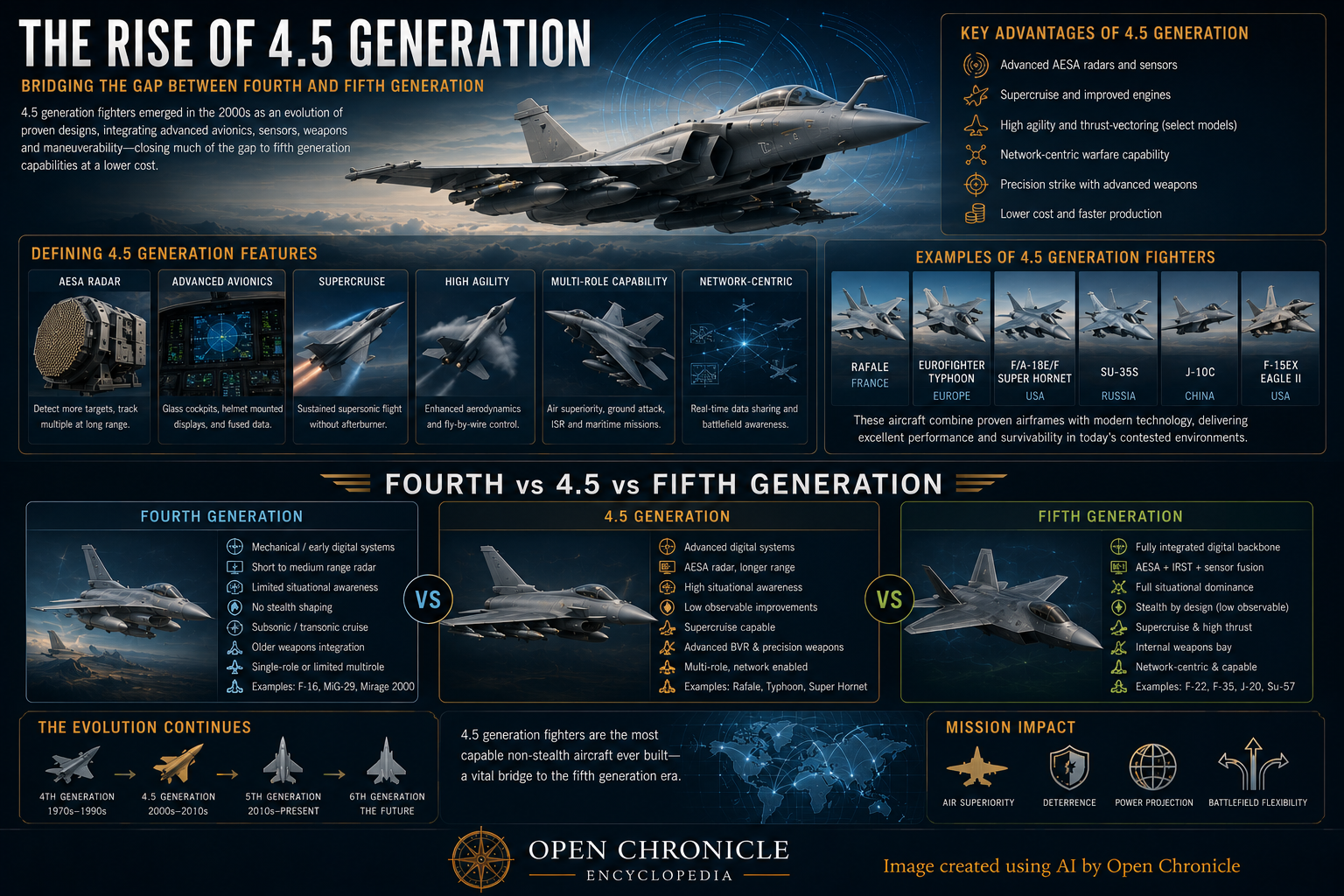
By the 1990s, the term 4.5 generation began to be applied to fighters possessing capabilities substantially beyond those of original fourth-generation aircraft while lacking the complete low-observable architecture and deep sensor integration associated with fifth-generation designs.
There is no universally accepted definition.
The term is nevertheless useful.
Typical characteristics can include AESA radar, advanced electronic warfare, modern data links, integrated infrared sensors, precision weapons, digital cockpits, sophisticated mission computers, reduced radar signatures, and extensive sensor integration.
Some aircraft were entirely new designs.
Others evolved from much older airframes.
Representative 4.5 Generation Aircraft
Aircraft commonly described as belonging to this evolutionary category include various configurations of the Dassault Rafale, Eurofighter Typhoon, Saab JAS 39 Gripen, F/A 18E/F Super Hornet, advanced F-15, F-16V and Block 70/72, Su-30, Su-35, MiG-35, Chengdu J-10C, J-16, HAL Tejas and JF-17 Block III.
Classification varies between sources.
This variation itself demonstrates the limitations of fighter generation terminology.
What matters operationally is not the label but the combination of sensors, weapons, networking, electronic warfare, signature, range, performance, training and support available to the force.
Dassault Rafale
The French Dassault Rafale represents an advanced European interpretation of the multirole fighter.
Dassault uses the term omnirole to emphasise its ability to conduct different mission types during the same sortie.
Modern Rafale configurations incorporate AESA radar, passive electro-optical sensors, sophisticated electronic warfare, advanced weapons and extensive data processing.
An especially important feature is multisensor data fusion.
Information from onboard and external sensors is combined to create a more coherent tactical picture for the pilot.
This represents a major step towards the deeply integrated sensor environment associated with fifth-generation aircraft.
Eurofighter Typhoon
The Eurofighter Typhoon was developed through a multinational European programme.
Its design emphasised air combat performance but evolved into an increasingly broad multirole platform.
The aircraft combines a highly agile canard delta configuration with powerful engines, sophisticated radar and electronic warfare.
Successive upgrades have expanded precision strike, long-range air-to-air and sensor capabilities.
Modern radar programmes further increase electronic scanning and electronic warfare potential.
The Typhoon illustrates how software, sensors and weapons can progressively transform an aircraft long after its basic aerodynamic design has been established.
Saab Gripen
The Swedish Saab JAS 39 Gripen placed particular emphasis on affordability, dispersed operations, rapid turnaround and advanced networking.
The Gripen E represents a substantial evolution.
It incorporates AESA radar, IRST, advanced electronic warfare, modern communications and extensive sensor fusion.
Saab emphasises an avionics architecture designed to allow tactical software and capabilities to evolve rapidly.
This illustrates an increasingly important reality.
Modern fighter effectiveness depends not merely upon aerodynamic design but upon the speed at which software, sensors and electronic warfare systems can adapt to changing threats.
F/A 18E/F Super Hornet
The F/A 18E/F Super Hornet represents a major evolution of the Hornet concept.
It is substantially larger than the original F/A 18 and incorporates greater fuel capacity, payload and development potential.
Modern Super Hornets use AESA radar and sophisticated networked systems.
The aircraft performs air superiority, strike, fleet defence, reconnaissance and other missions from aircraft carriers.
Its continued development demonstrates the value of mature aircraft ecosystems where training, maintenance, weapons and logistics already exist.
F-15EX Eagle II
The F-15EX Eagle II represents perhaps the most dramatic example of fourth-generation longevity.
Its ancestry extends directly to the F-15 first flown in 1972.
Yet the modern aircraft includes technologies that could scarcely have been imagined when the original Eagle was designed.
Digital fly-by-wire controls, AESA radar, modern mission computers, advanced electronic warfare, glass cockpit displays, networking and open mission systems architecture have transformed the platform.
The fundamental aerodynamic design survives because it continues to provide exceptional range, speed and payload.
F 16V and Block 70/72
The F-16 provides another extraordinary example.
Modern F-16V and Block 70/72 configurations incorporate the APG 83 AESA radar, modern mission computers, advanced cockpit displays and contemporary weapons.
New production aircraft also incorporate structural improvements intended to support substantially extended service lives.
The recognisable shape remains closely connected to the YF 16 of the early 1970s.
Internally, however, the aircraft has undergone generations of technological change.
This separation between airframe age and systems age is fundamental to understanding modern fourth-generation fighters.
Sensor Fusion
Sensor fusion increasingly distinguishes advanced fighters from earlier configurations.
A traditional pilot might separately examine radar information, radar warning equipment, infrared sensors, and data link messages.
Modern mission computers can combine these sources.
The objective is to present the pilot with a coherent tactical picture rather than a collection of disconnected sensor outputs.
Rafale and Gripen E provide important examples of this approach.
Fifth-generation aircraft take the concept considerably further, but advanced fourth-generation platforms increasingly incorporate similar principles.
Helmet Mounted Cueing
Helmet-mounted displays and sights changed close-range combat.
Traditional fighter weapons were generally aimed by pointing the aircraft towards the target.
High off-boresight missiles and helmet-mounted cueing changed this relationship.
The pilot could look towards an aircraft far from the fighter’s nose and designate it as a target.
Modern short-range missiles could then manoeuvre aggressively after launch.
This reduced the importance of achieving the traditional firing position directly behind an opponent.
Modern Air-to-Air Missiles
Fourth generation fighters have continuously benefited from improvements in missile technology.
Modern radar-guided missiles possess significantly greater range, resistance to countermeasures, and autonomous terminal guidance than their predecessors.
Infrared missiles gained imaging seekers and high off-boresight engagement capability.
Weapons such as AMRAAM, Meteor, R-77, and modern Sidewinder, IRIS T, and related systems profoundly changed air combat.
Aircraft performance therefore cannot be assessed independently from the weapons it carries.
The Networked Battlespace
Modern fighter warfare increasingly depends upon networks.
Airborne early warning aircraft can provide surveillance.
Ground radar can contribute tracking information.
Ships can provide additional sensor coverage.
Other fighters can share target data.
Satellites and command networks can contribute intelligence and navigation.
The fourth generation fighter has therefore evolved from an independent combat aircraft into part of a distributed information architecture.
In many circumstances, the quality of that network may matter as much as the individual aircraft’s radar.
Fourth Generation versus Fifth Generation
The transition to fifth generation fighters involves more than installing better electronics.
Aircraft such as the F-22 and F-35 were designed around low observability from the beginning.
Airframe shaping, internal weapons carriage, sensor placement, thermal management, electronic warfare and communications are integrated into the overall design.
Sensor fusion is also deeply embedded.
A modernised fourth generation fighter can possess AESA radar, advanced electronic warfare and sophisticated weapons.
It cannot fully reproduce an airframe designed fundamentally around broadband low observability.
The distinction therefore remains meaningful even as avionics capabilities converge.
The Continuing Value of Fourth Generation Fighters
Fifth generation aircraft are highly capable but expensive to acquire, sustain and integrate.
Many missions do not require maximum stealth.
Air policing, homeland defence, routine interception, maritime patrol support and operations in less heavily defended environments can often be performed effectively by fourth generation aircraft.
They can also carry substantial external payloads.
This has encouraged many air forces to maintain mixed fleets.
Stealth aircraft may penetrate highly defended environments.
Fourth generation aircraft can provide additional weapons, defensive patrols, and mass.
The two categories can therefore complement one another.
Cost and Force Structure
Cost has influenced fighter design since the beginning of the generation.
The American F-15 and F-16 relationship became a famous example of the high-low mix.
A smaller number of highly capable and expensive aircraft could be supplemented by larger numbers of lighter and cheaper fighters.
Similar considerations remain relevant today.
A fighter force composed entirely of the most expensive available aircraft may be technologically impressive but financially difficult to sustain in sufficient numbers.
Quantity, availability and sortie generation remain military capabilities in their own right.
Maintenance and Availability
Combat effectiveness depends upon more than performance in flight.
Aircraft must be maintained, fuelled, armed and returned to service.
Fourth generation designs increasingly incorporated modular components and improved diagnostics.
Modernisation has nevertheless created challenges.
Aircraft built decades ago can suffer structural fatigue, wiring deterioration and component obsolescence.
Maintaining older fleets therefore requires continuing investment.
Service life extension programmes can reinforce structures.
New avionics can replace obsolete electronics.
Engine upgrades and maintenance programmes can extend operational viability.
The result is that chronological age alone does not determine combat relevance.
The Software Defined Fighter
Perhaps the greatest transformation during the fourth generation has occurred in software.
Early aircraft depended heavily upon hardware configuration.
Modern fighters increasingly acquire new capabilities through software.
Radar modes can be updated.
New weapons can be integrated.
Electronic warfare threat libraries can be revised.
Data links can receive new protocols.
Mission computers can be replaced.
The fighter has therefore become an evolving digital platform.
This explains why some airframes designed during the 1970s remain operationally relevant in the twenty-first century.
Combat Experience
Fourth generation fighters have participated in virtually every major air campaign involving advanced air forces since the late Cold War.
They fought in the Middle East, the Balkans, Afghanistan, Iraq and numerous regional conflicts.
They have conducted air superiority, interception, precision strike, suppression of enemy air defences, close air support, maritime strike, reconnaissance and nuclear deterrence missions.
Their combat records vary enormously because aircraft do not fight independently.
Pilot training, intelligence, maintenance, command systems, weapons, electronic warfare and numerical balance all influence outcomes.
The generation’s longevity nevertheless means that its operational history spans several distinct eras of warfare.
Fourth Generation Fighters Today
Fourth generation aircraft remain widespread.
Some original fleets are approaching retirement.
Others are receiving major upgrades.
Still others are being manufactured in advanced forms.
The F-16 remains in production in Block 70 and Block 72 configuration.
The F-15 continues through the F-15EX.
Gripen E production continues.
Rafale and Typhoon programmes continue to evolve.
Advanced derivatives of the Su-27 family remain operational.
The generation has therefore not disappeared.
It has fragmented into numerous technological levels ranging from relatively old Cold War configurations to highly networked aircraft with AESA radar and sophisticated electronic warfare.
A Classification That Keeps Moving
The distinction between fourth generation, 4.5 generation, and fifth generation is becoming increasingly complicated.
An upgraded fourth-generation fighter may possess radar and computing technology comparable in some respects with newer aircraft.
A newly built advanced fighter may incorporate reduced signature features without possessing comprehensive stealth.
Manufacturers, governments, and analysts may also use generation terminology differently.
The classification should therefore be treated as descriptive rather than absolute.
Aircraft should ultimately be evaluated according to actual capabilities.
Representative Early and Core Fourth Generation Fighters
| Aircraft | Country or origin | General design emphasis |
|---|---|---|
| F-14 Tomcat | United States | Fleet defence, interception, air superiority |
| F-15 Eagle | United States | Air superiority |
| F-16 Fighting Falcon | United States | Lightweight multirole fighter |
| F/A 18 Hornet | United States | Carrier-based multirole fighter |
| Mirage 2000 | France | Interception and multirole combat |
| MiG 29 | Soviet Union | Tactical air superiority |
| Su 27 | Soviet Union | Long-range air superiority |
| MiG 31 | Soviet Union | Long-range interception |
| Panavia Tornado ADV | United Kingdom, Germany, Italy programme lineage | Long-range air defence |
Representative Advanced Fourth Generation and 4.5 Generation Fighters
| Aircraft | Principal advanced characteristics |
|---|---|
| F-15EX Eagle II | AESA radar, digital fly-by-wire, advanced EW, networking, large payload |
| F 16V / Block 70/72 | AESA radar, modern cockpit, mission computer, advanced weapons |
| F/A 18E/F Super Hornet | AESA radar, networking, multirole carrier capability |
| Dassault Rafale | AESA, sensor fusion, advanced EW, multirole capability |
| Eurofighter Typhoon | High performance, advanced radar, IRST, electronic warfare |
| Saab Gripen E | AESA, IRST, advanced EW, networking, sensor fusion |
| Su 30 family | Long-range, multirole capability, some versions with thrust vectoring |
| Su 35 | Advanced radar, thrust vectoring, high manoeuvrability |
| MiG 35 | Advanced MiG-29 derivative with modern sensors and avionics |
| J 10C | AESA radar, modern weapons and avionics |
| J 16 | Advanced multirole development of the Flanker family |
| HAL Tejas Mk1A | Modern radar, electronic warfare and digital avionics |
| JF 17 Block III | AESA radar, modern cockpit and updated weapons |
Technology Comparison
| Capability | Early fourth generation | Advanced fourth / 4.5 generation | Fifth generation |
|---|---|---|---|
| Manoeuvrability | High | High to very high | High |
| Fly-by-wire | Some aircraft | Common | Standard |
| Pulse Doppler radar | Common | Retained or replaced | Superseded by AESA |
| AESA radar | Generally absent originally | Increasingly standard | Standard characteristic |
| IRST | Present on some aircraft | Increasingly common | Integrated where fitted |
| Data links | Limited or later added | Advanced | Deeply integrated |
| Sensor fusion | Limited | Increasing | Fundamental |
| Electronic warfare | Separate or relatively basic systems | Highly sophisticated | Deeply integrated |
| Precision strike | Developing | Extensive | Extensive |
| Stealth | Minimal | Signature reduction on some designs | Fundamental airframe requirement |
| Internal weapons | Generally no | Generally no | Characteristic of stealth operations |
| Software architecture | Initially limited | Increasingly modular | Central to aircraft design |
Timeline
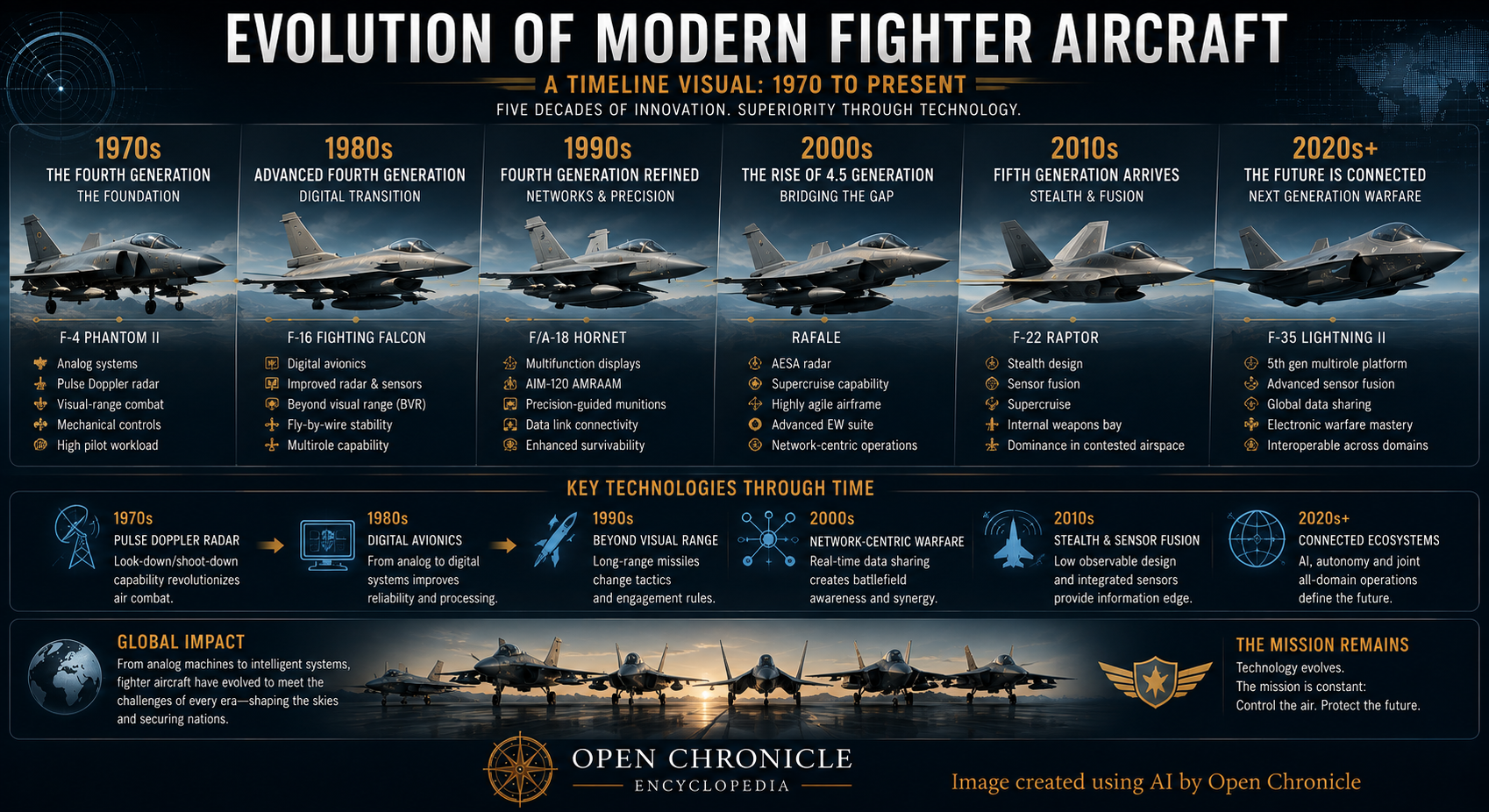
Late 1960s: Combat experience and technological development begin reshaping assumptions about future fighter warfare.
1970: F-14 Tomcat makes its first flight.
1972: F-15 Eagle makes its first flight.
1974: YF-16 and YF-17 prototypes begin flight testing.
1970s: Energy manoeuvrability concepts influence American fighter development.
Late 1970s: F-15 and F-16 begin entering operational service.
1980s: F/A 18, Mirage 2000, MiG-29, and Su-27 establish the fourth generation across several major air powers.
1980s: Digital avionics and fly-by-wire become increasingly important.
1990s: Precision weapons, improved radar and data links transform fourth-generation operations.
1990s: The expression 4.5 generation increasingly describes advanced new designs and extensively modernised fighters.
2000s: AESA radar begins spreading across advanced fourth-generation fleets.
2010s: Sensor fusion, helmet-mounted displays, modern IRST, advanced electronic warfare and networked operations become increasingly important.
2020s: F-15EX, F-16 Block 70/72, Rafale, Typhoon, Gripen E and other advanced fighters demonstrate the continuing evolution of non-fifth-generation combat aircraft.
Present: Fourth generation and advanced fourth generation fighters continue operating alongside fifth generation aircraft.
Did You Know?
The fourth generation spans such a long period that some aircraft first designed in the early 1970s now carry radar, computers, and weapons developed decades after their original designers completed the airframe.
The F-15 and F-16 were originally conceived as complementary elements of an American high-low fighter force.
The YF-17, which lost the Lightweight Fighter competition to the YF-16, ultimately contributed to the development of the highly successful F/A 18 Hornet.
The Su-27 produced one of the largest families of derivative combat aircraft developed from a single fourth-generation fighter design.
Modern F-16 Block 70 and Block 72 aircraft are still being manufactured more than half a century after the YF-16 first flew.
AESA radar can transform the sensor capabilities of an older fighter without requiring replacement of its fundamental aerodynamic design.
An aircraft’s generation does not automatically determine the outcome of combat. Weapons, sensors, pilot training, intelligence, electronic warfare, maintenance and command systems can be equally decisive.
Open Chronicle Perspective
The fourth generation represents one of the most important transitions in the history of combat aviation because it changed not merely what fighters could do, but what a fighter fundamentally was.
Earlier jet fighters were largely defined by their aerodynamic performance, engines, radar, and weapons.
Fourth-generation aircraft increasingly became integrated systems.
The pilot no longer simply moved control surfaces.
Computers interpreted commands.
Radar no longer merely indicated that something was ahead.
Digital processing identified, tracked, and prioritised targets.
Weapons no longer required the aircraft always to point directly towards an opponent.
Helmet-mounted sights and increasingly agile missiles expanded the engagement envelope.
Aircraft no longer fought entirely alone.
Data links connected them with other fighters, command aircraft, ships and ground systems.
And eventually the distinction between aircraft hardware and aircraft software became increasingly blurred.
This explains the extraordinary longevity of the generation.
An aerodynamic configuration cannot easily be changed after an aircraft enters production.
Computers can.
Radar can.
Displays can.
Electronic warfare can.
Weapons can.
Software can.
The fourth generation therefore discovered something that would become fundamental to modern military aviation: a sufficiently capable airframe can become the foundation for several technological generations of combat systems.
The F-15 flying today is not technologically the F-15 of the 1970s.
The F-16 Block 70 is not the F-16A of the early production programme.
The latest Gripen, Rafale, Typhoon and Super Hornet configurations operate in an information environment fundamentally different from that of the aircraft that opened the generation.
Yet there is also a limit.
Stealth cannot simply be added to an aircraft in the same way as a new radar.
True low observability affects the shape of the airframe, engine installation, weapons carriage, cooling, sensors, antennas and almost every other element of aircraft design.
That boundary explains why fifth generation fighters represent more than another avionics upgrade.
The fourth generation nevertheless remains indispensable.
Its aircraft provide numbers, payload, flexibility and increasingly sophisticated networked combat capability.
Some will operate beside fifth-generation fighters for decades.
The fourth generation therefore should not be understood merely as a historical period between the Phantom and the Raptor.
It became one of the most adaptable technological foundations ever created for military aviation.
Its legacy is still flying.
References and Further Reading
Wikipedia contributors, Fourth generation fighter, used as a starting reference for the classification, principal characteristics, technology categories, and aircraft examples.
United States Air Force historical material concerning the development and continuing role of fourth generation tactical combat aircraft.
NASA Technical Reports Server, material concerning the YF-16 active fly-by-wire flight control system, relaxed static stability and side stick control.
United States Government publications concerning characteristics of modern fourth generation combat aircraft, including multimode radar, IRST, glass cockpits, data links, electronic warfare and advanced weapons.
Lockheed Martin technical and programme information concerning the F-16 Fighting Falcon, F-16V and Block 70/72.
Boeing programme information concerning the F-15EX Eagle II and modern digital flight controls, AESA radar, electronic warfare and networked operations.
Dassault Aviation technical material concerning Rafale multisensor data fusion and modular data processing.
Saab technical material concerning Gripen E AESA radar, IRST, electronic warfare, data links, sensor fusion and avionics architecture.
Historical and technical literature concerning the F-14 Tomcat, F-15 Eagle, F/A 18 Hornet, Mirage 2000, MiG-29 and Su-27.
Robert L. Shaw, Fighter Combat: Tactics and Maneuvering, Naval Institute Press.
Studies concerning energy manoeuvrability theory, fighter aircraft design and the development of modern air combat doctrine.
Explore this subject
Continue exploring related Open Chronicle Encyclopedia entries through the categories associated with this article.

Staff Writers at Open Chronicle produce trusted journalism, strategic analysis and authoritative reference content across global affairs, geopolitics, defense, science, history, technology, business, culture and sport. Their work combines accurate reporting with historical perspective and analytical depth, helping readers understand not only what is happening, but why it matters. Beyond daily news coverage, Staff Writers contribute to the Open Chronicle Encyclopedia, investigative features, original research projects and long-form reports, building a comprehensive knowledge platform designed to inform, educate and preserve reliable information for a global audience.