
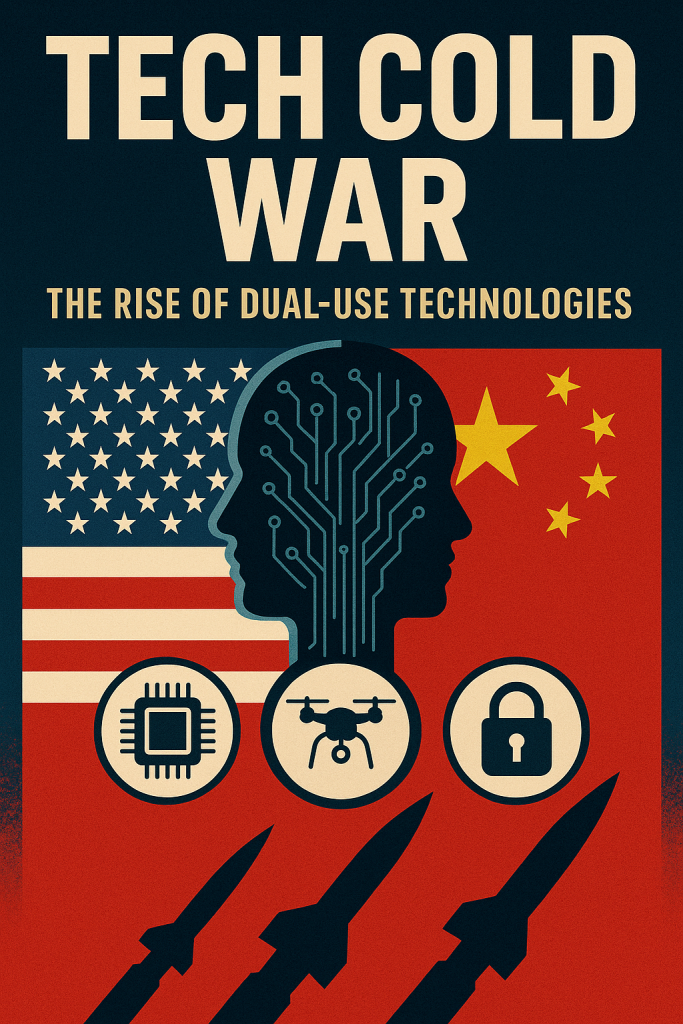
Image Credentials: Image Title: Tech Cold War: The Rise of Dual-Use Technologies Source: (sora.chatgpt) Date: May 2025 Attribution: Created by AI-generated imagery (sora.chatgpt), it does not depict a real-world scene.
By Open Chronicle
As the world increasingly pivots toward a digital-first future, the intersection of technology and national security has become a battleground for global power. The growing divide between the U.S. and China has given rise to a new kind of Cold War, a Tech Cold War, where both superpowers vie for dominance in cutting-edge technologies that have the potential to reshape global economies, military capabilities, and political power. At the heart of this evolving conflict lies the concept of dual-use technologies, innovations that can serve both civilian and military purposes, and are increasingly at the center of geopolitical competition.
What Are Dual-Use Technologies?
Dual-use technologies are innovations designed for civilian use but can be adapted for military or defense applications. These technologies often blur the lines between commerce and warfare, making them highly sensitive from a national security standpoint. As they evolve, dual-use technologies become critical assets for both economic and strategic purposes. Examples of these include:
-
Artificial Intelligence (AI): AI can power civilian applications like healthcare diagnostics, autonomous vehicles, and energy efficiency. However, it also has military uses in cyber warfare, autonomous weapons, and surveillance systems.
-
5G Networks: While 5G networks promise faster internet speeds and better connectivity for everyday users, they are also key for military communications, battlefield communications, and controlling military-grade drones or vehicles.
-
Quantum Computing: Quantum computing has enormous potential for accelerating scientific research, cybersecurity, and encryption, but could also break current encryption systems used by the military and intelligence agencies.
-
Semiconductors: Chips are used in everything from smartphones to military-grade weaponry. Both China and the U.S. see control over semiconductor production as vital to their long-term technological and military supremacy.
The Geopolitical Stakes
The battle for dominance in these dual-use technologies has escalated tensions between countries, especially the U.S. and China. On one hand, China has invested heavily in technologies like AI, 5G, and quantum computing as part of its Made in China 2025 initiative, aiming to become a global tech leader. On the other hand, the U.S. has tightened export controls on critical technologies, fearing China’s potential use of these technologies for military purposes, as well as the implications for its own cybersecurity and economic interests.
China’s ambitious global technological expansion, especially through initiatives like the Belt and Road Initiative (BRI), has enabled it to spread dual-use technologies to other countries, many of which have been entangled in debt traps. Through these initiatives, China is not only gaining access to infrastructure but also influencing the technological landscape of its allies and partners. For the U.S., the prospect of China controlling critical global infrastructure has serious national security ramifications.
The Arms Race of the Digital Age
Just as the traditional arms race during the Cold War was marked by the proliferation of nuclear weapons, today’s Tech Cold War is characterized by the rapid development of digital weapons, from cyberattacks to AI-powered military systems. With advanced technologies often created by private corporations, these weapons have blurred the lines between government and industry. Some argue that this digital arms race poses an even greater threat to national security than conventional weapons, as it involves a greater level of covert operations, technological espionage, and economic leverage.
-
Cyber Warfare: The potential for state-sponsored cyberattacks against critical infrastructure, financial systems, or even civilian data has never been more prevalent. Both China and the U.S. have engaged in cyber-espionage, stealing intellectual property and compromising sensitive data. As the cyber threat landscape evolves, dual-use technologies enable faster, more sophisticated attacks.
-
AI in Military Systems: AI-powered autonomous drones and robots are already in use in military applications, but the next frontier is the use of AI in warfare decision-making, where algorithms could dictate military tactics, resource allocation, and even target selection without human intervention.
The Economic Implications
The race for dual-use technologies is not limited to military competition—it’s also about securing economic supremacy. Control over technologies like 5G, semiconductors, and AI not only confers military advantages but also enables economic leverage. For instance, as nations adopt different technological standards, they create dependency on their infrastructure, thus reshaping global trade patterns.
China’s Made in China 2025 plan includes dominating industries like aerospace, telecommunications, and robotics, which would ensure that Chinese companies control key technologies that have both civilian and military applications. The U.S., meanwhile, has tightened its restrictions on the export of critical technologies to China and other adversaries, fearing that these innovations will bolster military capabilities and pose national security risks.
The ongoing trade war between China and the U.S. over technology has further underlined the importance of securing technological dominance. From the Huawei 5G ban to the Semiconductor Export Ban, both countries are positioning themselves to prevent their adversaries from gaining access to critical technologies.
Ethical and Security Risks
As these technologies develop, they bring new ethical and security challenges. For example:
-
AI and Ethics: As AI becomes more involved in military and surveillance applications, questions surrounding autonomy, accountability, and the potential for misuse grow. Can AI be trusted with life-and-death decisions, or will it become a tool for authoritarian regimes to suppress civil rights?
-
Data Privacy and Surveillance: 5G networks and AI-powered surveillance systems enable unprecedented data collection, giving states the power to monitor their populations like never before. This creates a chilling effect on free speech and human rights, particularly in authoritarian regimes like China.
-
Cybersecurity Threats: The use of dual-use technologies makes infrastructure highly vulnerable to cyberattacks. Disabling key systems, be it power grids, transportation networks, or communication channels, could wreak havoc on a country’s economy and security.
Conclusion: The Future of Tech in Global Security
The Tech Cold War, defined by the battle for dual-use technologies, is reshaping how global powers approach both security and economics. As nations race to develop and control these technologies, the global landscape is being redefined. The outcomes of this competition will not only influence military strategy but also global governance, international relations, and the future of innovation. The stakes are high, and the world is watching as two technological titans vie for supremacy in this new arms race of the digital age.
References:
-
The Tech Cold War: Understanding Dual-Use Technologies – Global Security Review, 2023.
www.globalsecurityreview.com -
Made in China 2025: China’s Strategy to Dominate Global Tech – The Diplomat, 2022.
www.thediplomat.com -
China’s Cyber Espionage Campaign: Implications for the Global Order – Foreign Affairs, 2021.
www.foreignaffairs.com -
The U.S.-China Trade War and Technology Restrictions – The Wall Street Journal, 2023.
www.wsj.com -
5G Technology and National Security: A Modern Arms Race – Harvard Kennedy School Review, 2022.
www.hks.harvard.edu -
AI, Military Strategy, and the Ethics of Autonomous Weapons – MIT Technology Review, 2023.
www.technologyreview.com -
Huawei and the Global Technology Struggle – BBC News, 2020.
www.bbc.com -
The Future of Quantum Computing: Global Implications for Security – Science and Technology Policy Institute, 2023.
www.stpi.edu -
China’s Push to Dominate Semiconductor Production: Impacts on Global Trade – The Economist, 2023.
www.economist.com -
Cybersecurity in the Age of Dual-Use Technologies: Risks and Threats – Cybersecurity Policy Journal, 2022.
www.cybersecuritypolicy.com -
The Internet of Things: How Dual-Use Technology Impacts National Security – International Journal of Security Studies, 2021.
www.ijss.edu -
The Growing Influence of China in Global Technology Markets – The New York Times, 2022.
www.nytimes.com -
AI-Powered Surveillance: Balancing Innovation and Human Rights – Amnesty International, 2023.
www.amnesty.org -
Global Digital Arms Race: The Role of Technology in Modern Warfare – International Security Review, 2023.
www.internationalsecurityreview.com -
Tech and National Security: The Importance of Securing Innovation – U.S. National Security Council Report, 2021.
www.whitehouse.gov
Explore this subject
Continue exploring related Open Chronicle Encyclopedia entries through the categories associated with this article.

Staff Writers at Open Chronicle produce trusted journalism, strategic analysis and authoritative reference content across global affairs, geopolitics, defense, science, history, technology, business, culture and sport. Their work combines accurate reporting with historical perspective and analytical depth, helping readers understand not only what is happening, but why it matters. Beyond daily news coverage, Staff Writers contribute to the Open Chronicle Encyclopedia, investigative features, original research projects and long-form reports, building a comprehensive knowledge platform designed to inform, educate and preserve reliable information for a global audience.