
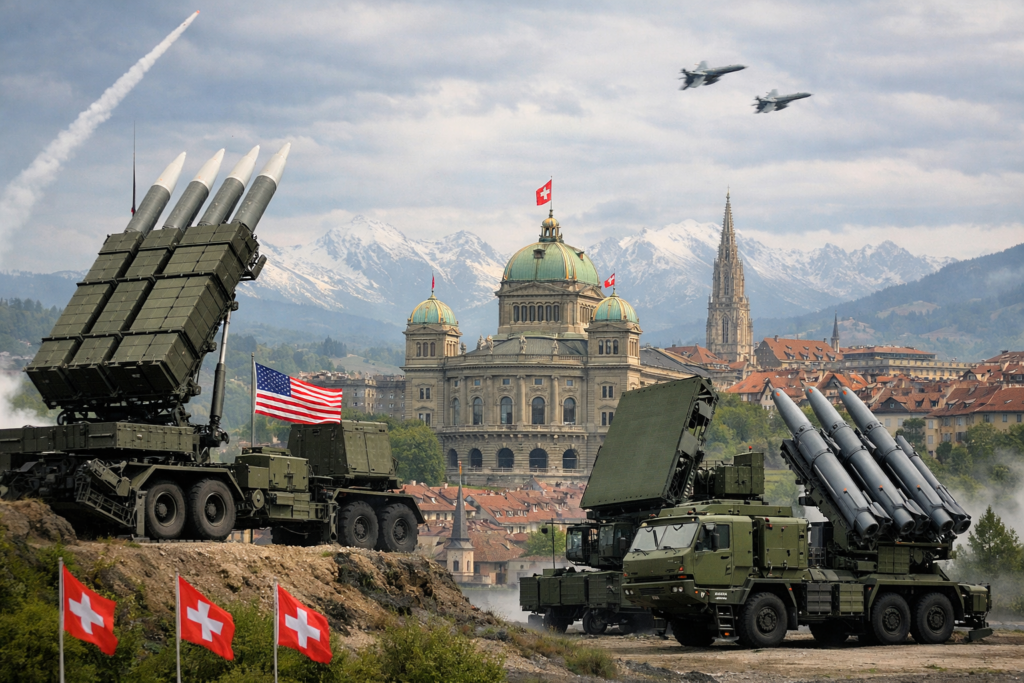
Image Credentials: Image Title: Bulgaria’s “Small Basket” Now Costs More Than in Germany and France Source: (sora.openai) Date: Feb 2026. Attribution: This image was created using AI-generated imagery (sora.openai) and does not depict a real-world scene.
By Open Chronicle Staff with Agencies
BERN – The Swiss Federal Department of Defense is reportedly evaluating a strategic pivot toward European-made air defense systems following Washington’s decision to postpone the delivery of five Patriot missile batteries. The delay, attributed to the United States prioritizing defense supplies for Ukraine, has sparked a political firestorm in Bern and raised questions about the future of Switzerland’s “Air2030” modernization program.
The SAMP/T Contingency
With the Patriot delivery timeline now pushed beyond 2030, Swiss officials are actively analyzing the SAMP/T (Surface-to-Air Missile Platform/Terrain), a medium-to-long-range system developed by the Franco-Italian consortium Eurosam.
According to reports in NZZ am Sonntag, manufacturers have signaled that if Switzerland places an order now, the SAMP/T could be operational by 2029, potentially beating the delayed American schedule.
Strategic and Financial Risks
Abandoning the deal with the U.S. is not a simple maneuver. Switzerland has already invested heavily in the Patriot partnership:
-
Down Payment: Approximately CHF 700 million ($770 million) has already been paid to the U.S. government.
-
Contractual Penalties: Lawmakers from the Swiss People’s Party (SVP) warned that a withdrawal could trigger massive fines and “diplomatic fallout” with the Trump administration.
-
The F-35 Link: There are growing concerns that canceling the Patriot order could jeopardize Switzerland’s planned acquisition of 36 F-35A fighter jets, as both systems are part of a coordinated defense package under the Foreign Military Sales (FMS) program.
Political Divide
The shift has drawn support from the Green Party, with parliamentarian Clarence Chollet noting that a European alternative would better align with Switzerland’s desire to cooperate with regional partners. However, military traditionalists argue that doubling down on the U.S. relationship is the only way to “restore trust” and secure a place in the production queue.
“We have asked ourselves this question and will discuss it in the Federal Council,” said Robert Scheidegger, deputy secretary general of the Swiss Defense Ministry. “We will communicate the direction we take once a decision is finalized.”
The Swiss government expects a formal “roadmap” from Washington by the end of March 2026. If the U.S. cannot provide a firm delivery commitment, the SAMP/T, and potentially Israel’s Arrow system, may move from “back-up plan” to the frontline of Swiss national security.