
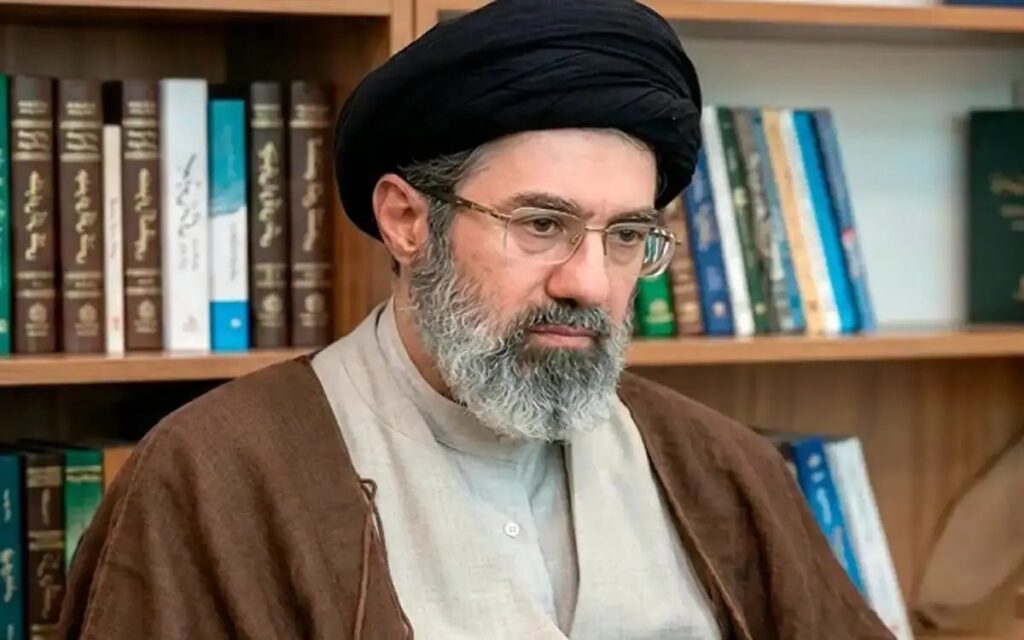
Image: from Ryan Rozbiani X @RyanRozbiani
By Open Chronicle Staff
In a chilling debut that has rattled world capitals and sent oil prices soaring, Iran’s newly appointed Supreme Leader, Ayatollah Mojtaba Khamenei, issued his first public statement on Thursday, March 12, 2026. The 56-year-old successor to his late father, Ali Khamenei, signaled a total commitment to the ongoing war, vowing to use the blockade of the Strait of Hormuz as a permanent “chokehold” on the global economy.
The statement, read by a state television anchor, confirms that the younger Khamenei, who had been rumored to be incapacitated by Israeli strikes, is actively leading a regime that has “abandoned all restraint.”
BREAKING:
Iran’s new Supreme Leader, Mojtaba Khamenei, has not appeared publicly or spoken live on television. Instead, his message was read on Iranian state TV.
There have previously been unconfirmed speculations that he was wounded or possibly killed in an Israeli/US… pic.twitter.com/duFLAhYVf6
— Visegrád 24 (@visegrad24) March 12, 2026
avenging the Father: A Hardline Shift
Mojtaba Khamenei’s ascension follows the February 28, 2026, Israeli strike that killed his father and his wife. Widely regarded as more radical than his predecessor, the new Supreme Leader used his first address to warn of “opening other fronts” where Western forces are “highly vulnerable.”
While Khamenei’s physical location remains a closely guarded secret to evade U.S. and Israeli “decapitation strikes,” his rhetoric was unmistakably defiant. He called on Gulf Arab nations to immediately eject U.S. military forces, labeling American protection a “lie.”
Regional Chaos: Drones Over Dubai and Riyadh
As if to underscore Khamenei’s words, a wave of Iranian-led attacks targeted the “futuristic” hubs of the Middle East early Thursday:
-
Bahrain: A major fire erupted on Muharraq Island, home to the international airport, following an Iranian strike.
-
Dubai: A projectile hit a container ship off the coast, and a drone strike ignited a blaze at a high-rise tower in the city center.
-
Kuwait: Authorities reported a drone strike on a residential building and damage to the Kuwait International Airport.
-
Saudi Arabia: Air defenses intercepted drones over Riyadh’s diplomatic quarter and the strategic Shaybah oil field.
Oil Hits $100 as the IEA Sounds the Alarm
The “Strait of Hormuz blockade” has officially pushed Brent crude past $100 a barrel, a 38% increase since the conflict ignited. In Washington, President Donald Trump maintained a hardline stance, posting on Truth Social that stopping Iran’s nuclear program is a “higher priority than soaring oil prices.”
The International Energy Agency (IEA) warned today that this represents the “biggest oil supply disruption in history,” as the regional war effectively removes 10% of the world’s daily oil demand from the market.
A Humanitarian Crisis in the Making
The toll of the two-week-old war is mounting with staggering speed:
-
Displacement: The UN reports that 3.2 million people have fled Tehran and other major Iranian cities, while 800,000 are displaced in Lebanon.
-
Lebanon Front: Hezbollah launched approximately 200 rockets into northern Israel overnight. Israel retaliated with a devastating strike in central Beirut near the Lebanese Parliament, reportedly targeting a Hezbollah facility.
-
Casualties: A strike on a school in Iran earlier this week reportedly killed over 165 people, an event Mojtaba Khamenei cited as a primary driver for his “unending vengeance.”
As the U.S. and Israel continue to target Iran’s military and nuclear infrastructure—including a strike on a previously destroyed facility in the last 48 hours—the world enters the third week of a conflict that shows no signs of de-escalation.